
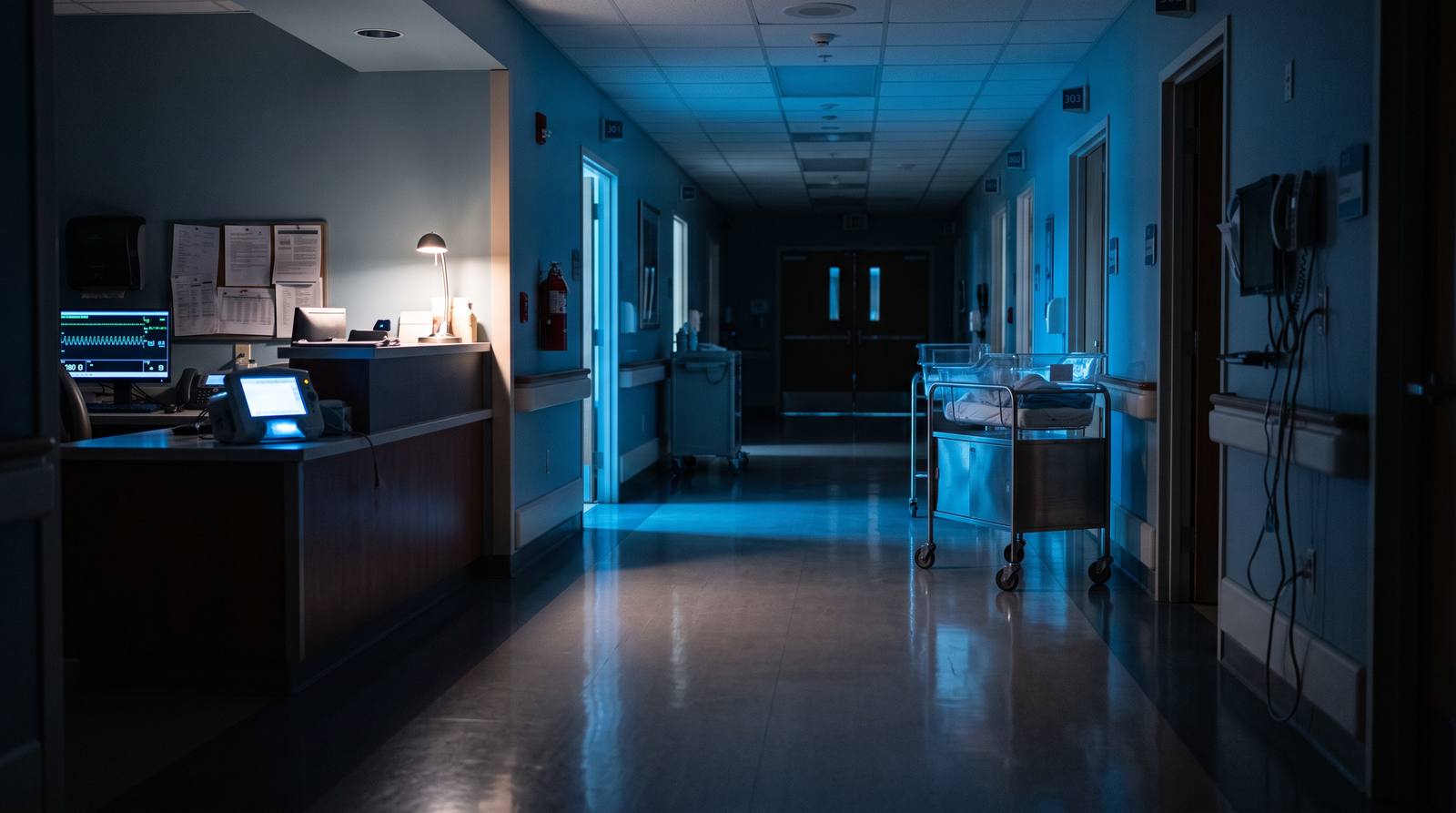

If your baby was born at Kaiser Permanente Ontario Medical Center, at 2295 S. Vineyard Avenue in Ontario, San Bernardino County, and the delivery was difficult or your child is now showing signs of a problem, you probably have many questions. This page is written for parents and family members who want to understand what a birth injury is, what the warning signs look like, and what options exist for finding out more. It is general information, not legal advice and not a statement about any particular delivery.
The hospital's own maternity page describes private birthing suites, 24-hour OB/GYN physicians, comprehensive maternal-fetal (perinatal) services and on-site lactation consultants. According to the hospital's 2024 report to the state (HCAI), the hospital cared for 2,850 newborns in its newborn nursery that year, and it has 14 licensed intensive-care newborn (NICU) beds, with 278 NICU discharges in 2024. Most families who deliver here go home with healthy babies. This page is for the smaller number who are left wondering what happened.
We explain medical terms in plain words, point to trusted medical sources, and describe how an independent review of a delivery works. Nothing here suggests that anyone at the hospital did anything wrong. A review simply helps a family replace uncertainty with answers, and there are strict deadlines in California, so it helps to learn your options early.
Was your baby hurt during delivery?
Tell us your name and phone. We call you back today, in English or Spanish, and the consultation is free.
Free consultation · English y Español · No fees or costs unless we win
At a glance: Kaiser Permanente Ontario Medical Center
| Address | 2295 S. Vineyard Avenue, Ontario, CA 91761 |
| County | San Bernardino County |
| Health system / operator | Kaiser Foundation Hospitals (Kaiser Permanente) |
| Type of hospital | Kaiser Permanente hospital (private nonprofit) |
| Newborns in 2024 | 2,850 (report to the state, HCAI) |
| Licensed NICU beds | 14 |
| Main phone | 909-724-5000 |
| Hospital website | healthy.kaiserpermanente.org/southern-california/health-wellness/maternity/find-hospital/ontario |
Sources: HCAI — 2024 Hospital Annual Utilization Report and the hospital’s own website.
Labor and delivery at Kaiser Permanente Ontario Medical Center
Kaiser Permanente Ontario Medical Center is a Kaiser Permanente hospital in Ontario, California. The state classifies it as a non-profit corporation, and its parent organization in the state report is Kaiser Foundation Hospitals, Inc. The hospital's maternity page lists labor and delivery services, and the services it names include private birthing suites, private family bonding and postpartum rooms, 24-hour OB/GYN physicians, comprehensive maternal-fetal (perinatal) services, on-site lactation consultants and a VBAC option for mothers who want to try a vaginal birth after a cesarean.
The hospital reports its volume to the state each year. According to the hospital's 2024 report to the state (HCAI), 2,850 newborns were cared for in the newborn nursery in 2024. The same report shows 14 licensed intensive-care newborn beds and 278 NICU discharges for the year. We have not found a NICU level stated on the hospital's own pages or on a state page, so we do not give one here. If your baby spent time in the NICU, the NICU records will show who cared for your child and what treatments were given.
The hospital serves families across the Ontario area and the Inland Empire, many of them members of the Kaiser Permanente health plan. Kaiser Permanente works differently from most hospitals because the same organization often provides a member's prenatal care, delivery and follow-up. That matters later if questions come up, because a member's records may span many visits and many clinicians.
Birth injuries families ask about after a difficult delivery
Hypoxic-ischemic encephalopathy (HIE) is brain injury from too little oxygen and blood flow around the time of birth. Doctors may treat eligible full-term babies with moderate or severe HIE with controlled cooling (therapeutic hypothermia), which research reviews indicate lowers the chance of death or major disability when started within about six hours of birth. Cerebral palsy is a group of movement and posture disorders that appear in early childhood. The CDC and NICHD explain that most cerebral palsy begins before or during birth, that the cause is often not found, and that oxygen deprivation during birth accounts for only a small share of cases. Risk factors also include preterm birth, low birth weight and infections.
Erb's palsy, also called brachial plexus palsy, is an injury to the nerves that run from the neck to the arm. The Cleveland Clinic and NINDS explain that it can happen when a baby's shoulder is stuck during delivery (shoulder dystocia) and the nerves are stretched. Many babies recover, but some have lasting weakness. Other conditions families ask about include bleeding inside the newborn's brain, a broken collarbone or skull fracture, and infections such as group B strep (GBS) that can pass from mother to baby around birth. Newborn infections can become serious quickly, so prompt treatment matters.
Mothers can be injured too. Postpartum hemorrhage, or heavy bleeding after delivery, is a leading cause of serious complications after childbirth. ACOG notes that it usually begins within 24 hours of delivery but can occur weeks later. Other maternal injuries include severe tears and infection. Many of these conditions occur even when everyone does everything right, and not every poor outcome is the result of a mistake. Telling the difference is the job of an expert review of the records, not of a general web page.

Warning signs of a birth injury in the first days, weeks and months
In the first days, parents and nurses watch for a baby who is very floppy or very stiff, who has a weak or unusual cry, who has trouble feeding, sucking or swallowing, who has seizures (rhythmic jerking, staring spells or lip smacking), or who has trouble breathing. A baby who does not move one arm, whose collarbone feels unusual, or who has a large swelling or bruise on the head should be examined. A low Apgar score, a need for resuscitation, or a transfer to the NICU does not by itself mean a baby has a lasting injury, but it is a reason to ask questions.
In the weeks and months that follow, some signs show up as milestones are missed. These can include a baby who cannot hold up the head, who uses one hand much more than the other, who is not following faces or sounds, who has persistent feeding difficulty, or whose muscles feel unusually tight or loose. The CDC's Learn the Signs. Act Early. materials and your child's pediatrician can help you track milestones. Cerebral palsy is often diagnosed between 12 and 24 months, and sometimes later, so a family may not have a firm answer for a long time.
If something worries you, do not wait for a certain diagnosis. Tell your child's doctor, ask for a developmental evaluation, and write down what you see with dates. Early therapy helps children whatever the cause. Writing things down also helps later, if you decide to have the delivery reviewed, because memories fade and details matter.
Free birth-injury case review
We review the delivery records with medical experts and tell you honestly whether there is a case. You pay no fees or costs unless we win.
Who may be responsible in a birth-injury claim
A birth-injury claim is not about blaming a whole hospital or a single person. It asks whether the care given met accepted medical standards and, if not, whether that caused the injury. Depending on the facts, the people and organizations involved may include the nurses and other hospital staff who watched the baby's heart rate and the mother's labor, the obstetrician who delivered the baby, midwives, anesthesia providers, neonatal specialists, and the medical group or hospital that employed or contracted with them.
Who is responsible can depend on who employed the clinician. Some doctors are hospital employees, some belong to a medical group, and some are independent physicians who simply have privileges at a hospital. At Kaiser Permanente, care is generally provided by physicians of the Permanente Medical Group together with the hospital and health plan. A family usually cannot tell from the bedside who works for whom, and it does not have to. Sorting that out is part of the review.
Because these questions are technical, families are best served by an independent review that looks at the records first. If a doctor did not work for the hospital, the claim may still be possible, but it may be directed to a different party. The word may matters: nothing is certain until the records have been studied by qualified experts.
How an independent expert review of a delivery works
An independent review starts with the complete records of the mother and baby. Experts, usually physicians in obstetrics, neonatology, pediatric neurology and nursing, read the prenatal notes, the labor chart, the delivery summary and the NICU notes. They look at several key items. The fetal heart monitoring strips show the baby's heart rate and the mother's contractions over time. The Apgar scores rate the baby's condition at one and five minutes. Cord blood gases measure acid and oxygen levels in the umbilical cord blood and can suggest whether the baby was short of oxygen.
Imaging and neonatal records add detail. An MRI of the baby's brain, taken in the first days or weeks, can show the pattern and timing of an injury. EEG results, cooling records, lab results and the NICU notes show how the baby was treated and how the baby responded. Experts compare all of this with the standard of care, meaning what a reasonably careful professional would have done in the same situation.
The review can end in several ways. It may show that the care was appropriate and the outcome was unforeseeable, and that is useful information for a family too. It may find that more questions need to be answered. Or it may support a claim. The review is a way to get answers, and starting it does not commit a family to anything. It is also worth starting early, because records are easier to collect and experts easier to hire well before a deadline.
What you can do now: step by step
First, take care of your child. Keep every appointment with the pediatrician, specialists and therapists, and ask about early intervention services. Second, request the complete medical records for both mother and baby from the hospital, including the labor records, the fetal monitoring strips, the delivery summary and the NICU chart. The records section below explains how. Keep your own notes of dates, names of staff you met if you remember them, and what you were told.
Third, keep paperwork together: bills, insurance letters, therapy plans and anything you were asked to sign. Do not post details on social media. Fourth, learn the time limits. California has strict deadlines for birth-injury claims, and families who delivered at a Kaiser Permanente hospital as members should also know that their claims are usually handled through binding arbitration rather than in court. The verified legal sections of this page explain those rules.
Fifth, talk to a lawyer who handles birth-injury cases. A first conversation is a chance to ask questions and understand your options, and Beverly Law can arrange an independent review of your records. Calling does not mean you must file anything. Many families simply want to know whether their child's condition could have been related to the delivery.
Support for your child and family while a case is reviewed
Your child's care should not wait for any legal question. Physical, occupational and speech therapy, specialist visits and equipment can begin as soon as a doctor recommends them. For babies and toddlers under three with a delay or a condition likely to cause one, California's Early Start program offers evaluation and services through the regional center that serves your area. Your pediatrician can also refer your child to California Children's Services (CCS) for certain medical conditions, and Medi-Cal may cover therapies and equipment for eligible families.
Families who are Kaiser Permanente members can also ask their child's Kaiser care team about referrals to specialists and therapy. It is reasonable to ask for a written plan with the type and frequency of therapy. Children's hospitals and university programs also offer support groups and social workers who help families sort through benefits and school services as the child grows.
No outcome of a legal review can be promised, and no support program replaces your child's medical care. But knowing what help exists, and asking for it early, makes a real difference in how children develop and how families cope.
Kaiser members: arbitration instead of a jury
Kaiser Permanente works differently from most hospitals. Kaiser’s own member materials explain that members agree to binding arbitration instead of a jury or court trial for certain matters, that a member who believes their care was negligent can ask for binding arbitration, and that the arbitrator’s decision is binding on both the member and Kaiser Permanente. These arbitrations are run by a neutral Office of the Independent Administrator (oia-kaiserarb.com), not by Kaiser. For a family who delivered at a Kaiser hospital as Kaiser members, that usually means a birth-injury claim is decided by an arbitrator rather than a jury — and the claim still has to be started on time, so it is important not to wait.
Deadlines for a birth-injury claim in California
California gives a child’s birth-injury case its own deadline. Under Code of Civil Procedure § 340.5, a minor must sue within three years of the wrongful act, but a child who was under six when it happened has until his or her eighth birthday if that is longer. For a baby hurt during labor or delivery, that usually means the eighth birthday. The clock runs from the act itself, not from the day the family learned what went wrong, and it is paused only in narrow cases of fraud or collusion. Parents’ own claims, and claims against a public hospital, can have much shorter deadlines, so it is safer to get advice early.
California’s MICRA law limits one part of a medical malpractice recovery. Under Civil Code § 3333.2, as amended by AB 35, non-economic damages (pain, suffering, loss of enjoyment of life) are capped. In 2026 the cap is $470,000 for injury and $650,000 for wrongful death, and it rises every January 1 ($40,000 and $50,000 a year until 2033, then 2% a year). Separate caps can apply to doctors, hospitals and unaffiliated providers. Economic damages are not capped: lifetime medical care, therapy, equipment, home modifications and lost earning capacity can be recovered in full, and in a birth-injury case they are usually the largest part of the claim.
How to get the delivery records from Kaiser Permanente Ontario Medical Center
California law gives families a right to these records. Under Health and Safety Code § 123110, a patient or the patient’s personal representative — for a baby, a parent or guardian (§ 123105) — may inspect the records within five working days of a written request and is entitled to a paper or electronic copy, which the provider must send within 15 days after receiving a request that says which records are wanted. For a birth-injury review, ask for both charts: the mother’s labor and delivery record, including the fetal heart rate monitoring strips, and the baby’s newborn and NICU record.
To get the delivery and NICU records from Kaiser Permanente Ontario Medical Center, use the Release of Information process that Kaiser Permanente describes on its Southern California records page. A member can request a detailed copy of the medical record through the member account or app, and a parent or guardian can ask for a baby's records. To send records to a lawyer or another third party, Kaiser Permanente asks for a signed authorization to disclose health information. Ask for the complete chart, including the labor and delivery record, the fetal heart monitoring strips, the delivery summary, the cord blood gas results and the NICU notes. Strips are sometimes kept apart from the main chart, so name them in your request. California law gives families a right to these records, and the verified legal text on this page explains the timelines.
The hospital’s medical records page →
Where a case from Ontario would be filed
A birth-injury case from Ontario that goes to court would usually be filed with the Superior Court of California, County of San Bernardino. The court's own listing places Ontario in the civil service area of the Civil Division of the San Bernardino District, at the San Bernardino courthouse, 247 West Third Street, San Bernardino, CA 92415-0210. Because the court may change where filings are accepted, a lawyer confirms the location before filing. For Kaiser Permanente members, however, claims against Kaiser are usually decided in binding arbitration instead of court, so a court filing may not be the first step.
Superior Court of California, County of San Bernardino – Civil Division, San Bernardino District → — 247 West Third Street, San Bernardino, CA 92415-0210
Help for your child now: Early Start in San Bernardino County
Babies and toddlers under three with a developmental delay, or a condition likely to cause one, may qualify for Early Start, California's early intervention program. Families in Ontario and San Bernardino County are served by Inland Regional Center, one of the regional centers of the California Department of Developmental Services. Anyone, including a parent, doctor or nurse, can refer a child. Call the center's Early Start intake line for San Bernardino County, listed by the Department of Developmental Services as (909) 890-4711, and ask for an evaluation. No legal case is needed, and a referral does not depend on whether anyone was at fault.
Key facts
- Kaiser Permanente Ontario Medical Center is at 2295 S. Vineyard Avenue in Ontario, San Bernardino County, and its own maternity page lists labor and delivery services.
- According to the hospital's 2024 report to the state (HCAI), it cared for 2,850 newborns in its nursery in 2024 and has 14 licensed NICU beds with 278 NICU discharges that year.
- Most cerebral palsy begins before or during birth, and the CDC says oxygen shortage at delivery explains only a small share of cases.
- Kaiser Permanente members usually resolve injury claims through binding arbitration run by a neutral administrator, not through a jury trial.
- Families have a right to the mother's and the baby's records, including the fetal monitoring strips and NICU notes, and getting them early helps.
Questions parents ask
Can I file a birth-injury claim against Kaiser Permanente Ontario Medical Center?
A family may be able to bring a claim if an independent review of the records finds that the care fell below accepted standards and caused the injury. Many bad outcomes happen without any error, so the first step is a review, not a filing. For Kaiser Permanente members, the claim usually goes to binding arbitration rather than court.
How long do I have to bring a birth-injury claim?
California gives a child's birth-injury case its own deadline, which for a baby hurt during labor or delivery usually means the child's eighth birthday. Parents' own claims can have much shorter deadlines. Since the clock runs from the event itself, it is safer to get advice early.
Is Kaiser Permanente Ontario Medical Center a public hospital?
No. The state classifies it as a non-profit corporation operated by Kaiser Foundation Hospitals, Inc, not a county or University of California hospital. The six-month claim rule for public hospitals therefore does not usually apply, but a lawyer should confirm who the right parties are.
What if my doctor did not work for the hospital?
A claim may still be possible. Some doctors are employees, some belong to a medical group and some are independent physicians, and each can be handled differently. An expert review of the records helps show who was involved and who may be responsible.
How do I get my fetal monitoring strips from Kaiser Permanente Ontario Medical Center?
Request the full labor and delivery chart through Kaiser Permanente's Release of Information process, and name the fetal heart monitoring strips specifically. A parent or guardian can ask for a baby's records. If you want them sent to a lawyer, you will need to sign an authorization.
Does it cost anything to talk to a lawyer about a birth injury?
Many birth-injury lawyers, including Beverly Law, offer a free first conversation to talk through what happened and what your options are. Calling does not obligate you to file anything. Ask any firm how fees and costs work before you agree to anything.
Ask a question
Not ready to call? Write your question and a member of our team answers you — no cost, no commitment.
Other San Bernardino County hospitals we cover
Kaiser Permanente Fontana · Loma Linda Children’s Hospital · San Bernardino birth injury lawyers →
Kaiser Permanente Ontario Medical Center Birth Injury Lawyers — Beverly Law
Free case review for families in Ontario. We obtain the delivery records, have them reviewed by medical experts and deal with the hospital and its insurer — you focus on your child. You pay no fees or costs unless we win.
Related pages
Cerebral Palsy · Erb’s Palsy / Brachial Plexus Injury · HIE / Oxygen Deprivation at Birth · Statute of Limitations · MICRA Damages Cap · All California hospitals · California birth injury lawyers · Birth injury guides
Sources
- HCAI — 2024 Hospital Annual Utilization Report (final, October 2025)
- Kaiser Permanente – Ontario Medical Center maternity page — Hospital name, address, phone and the labor and delivery services it lists (private birthing suites, 24-hour OB/GYN, perinatal services).
- Kaiser Permanente – Request records, forms and certifications (Southern California) — How members and caregivers request a detailed copy of a medical record.
- Superior Court of California, County of San Bernardino – Where Can I File? — Civil unlimited filing locations and the San Bernardino civil service area that includes Ontario.
- California Department of Developmental Services – Regional Center Listings — Inland Regional Center serves San Bernardino County; Early Start intake contact.
- CDC – Risk Factors for Cerebral Palsy — Causes and risk factors of cerebral palsy, including prematurity and infection.
- NICHD – Cerebral Palsy — Overview of cerebral palsy, its causes and early signs.
- Cleveland Clinic – Erb's Palsy — Brachial plexus birth injury, shoulder dystocia and recovery.
- NINDS – Brachial Plexus Injury — Nerve injury of the arm, symptoms and outlook.
- Cochrane review via NIH PMC – Cooling for newborns with hypoxic ischaemic encephalopathy — Evidence for therapeutic cooling of newborns with HIE.
- ACOG – 3 Conditions to Watch for After Childbirth — Postpartum hemorrhage timing and warning signs.
- Code of Civil Procedure § 340.5
- Civil Code § 3333.2 (as amended by AB 35, 2022)
- Health and Safety Code § 123110 (patient access to records)
- Kaiser Permanente — Member resource guide, California (binding arbitration, Office of the Independent Administrator)
Beverly Law is an independent law firm. We are not affiliated with, endorsed by or speaking for Kaiser Permanente Ontario Medical Center or Kaiser Foundation Hospitals (Kaiser Permanente). Hospital facts on this page come from the public sources listed above.
Important: This page is general information about birth injuries and California law, not legal advice, and reading it does not create an attorney-client relationship with Beverly Law. Every case is different — talk to a lawyer about your own situation. Attorney advertising. Prior results do not guarantee a similar outcome. No fees or costs unless we win. Last reviewed: 2026-09-18.