


If a baby is born not breathing well or shows signs of distress in the first hours of life, the medical team may start talking about "cooling" and a diagnosis called hypoxic-ischemic encephalopathy, or HIE. For a parent hearing these words for the first time, often while their baby is moved to a neonatal intensive care unit (NICU), it can be hard to absorb why the clock suddenly seems to matter so much.
HIE happens when a baby's brain doesn't get enough oxygen and blood flow around the time of birth, according to Cleveland Clinic. This guide covers what HIE is, how doctors grade its severity with Sarnat staging, why the first 6 hours after birth matter for therapeutic hypothermia (cooling therapy), what typically happens in the NICU, how California, Texas, and Washington handle which hospitals can cool a baby, and what records parents can ask to see afterward.
Was your baby hurt during delivery?
Tell us your name and phone. We call you back today, in English or Spanish, and the consultation is free.
Free consultation · English y Español · No fee unless we win
What Is Hypoxic-Ischemic Encephalopathy?
Hypoxic-ischemic encephalopathy is a brain injury that can happen when a baby's brain is deprived of oxygen and blood flow around labor and delivery, according to Cleveland Clinic. During pregnancy, contributing factors can include problems with the baby's heart or lungs, infection, or the mother's blood pressure or oxygen levels; during delivery, causes can include a prolapsed umbilical cord, placental abruption, or uterine rupture, per Cleveland Clinic.
Mild to moderate HIE can show up as weak muscle tone, trouble feeding, or an unusually weak cry, while severe HIE can involve little to no response to touch or sound, abnormal breathing, seizures, or loss of consciousness, according to Cleveland Clinic. Doctors typically look at Apgar scores, umbilical cord blood gas results, and a clinical exam in the first hours of life, along with imaging and EEG monitoring, to help confirm the diagnosis.
Outcomes vary widely. Some babies with mild HIE go on to have a normal neurological outcome, while more severe cases carry a higher risk of death or long-term disability, including cerebral palsy, seizure disorders, and cognitive or sensory impairment, according to research on neonatal HIE published through the National Institutes of Health (NIH).
Sarnat Staging: Mild, Moderate, and Severe
To grade how severe a baby's HIE is, doctors commonly use Sarnat staging, a clinical scale that looks at six categories: level of consciousness, spontaneous activity, muscle tone, posture, primitive reflexes, and autonomic signs such as heart rate and pupil response, according to research published through the NIH. A baby is generally placed in a stage when several categories point the same way.
In Stage 1 (mild), a baby is typically hyper-alert with normal or slightly increased tone, and symptoms usually resolve within 24 hours. In Stage 2 (moderate), a baby is often lethargic with reduced tone and, frequently, seizures, lasting a couple of days to about two weeks. In Stage 3 (severe), a baby may be in a stupor or coma with little spontaneous movement and absent reflexes, per the NIH-published research.
Sarnat staging isn't just descriptive — together with an EEG, it's one of the factors doctors use to decide whether a baby is a candidate for cooling and to talk with families about what to expect.

Why the First 6 Hours Matter
After a brain is deprived of oxygen, there's usually a short window — thought to last around 6 hours — before a second, more damaging wave of injury sets in, sometimes called secondary energy failure, according to research published through the NIH. Animal studies found that cooling worked best when started before that window closed, and was far less protective when started later.
That's the reasoning behind the urgency around HIE: the sooner a baby at risk is identified and, if eligible, started on cooling, the more it may help limit the injury. A separate NIH-funded trial looked at starting cooling later, between 6 and 24 hours after birth, and found it could still lower the combined risk of death or disability, though the benefit was smaller and less certain than starting within 6 hours.
In practice, a resuscitation team may need to assess a baby, run initial tests, and either begin cooling or arrange transport to a hospital equipped to do so, all within hours. If a baby is moved to a different NICU to be cooled, that reflects how regionalized this care is — not necessarily that something went wrong at the birth hospital.
Inside the NICU: What Cooling Therapy Involves
During therapeutic hypothermia, a baby's core temperature is lowered to about 33.5°C (roughly 92.3°F), within an acceptable range of 33.0–34.0°C, using a cooling blanket connected to a temperature-controlled device, according to research published through the NIH. Cooling is generally maintained for 72 hours, then the baby is rewarmed slowly, about 0.5°C per hour.
While a baby is cooled, the NICU team monitors the brain with continuous EEG to watch for seizures, and typically orders an MRI around days 4 to 7 to assess any brain injury, per the same NIH-published research. Other organs are watched closely too — breathing, heart rate and blood pressure, kidney function, blood counts, and blood sugar, since both low and high glucose have been linked to a higher risk of later neurodevelopmental problems.
This level of care requires a hospital with a Level III or IV NICU equipped for critically ill infants, generally with access to pediatric neurology, according to the NIH-published research — part of why not every hospital that delivers babies can provide cooling on-site.
Cooling Therapy in California, Texas, and Washington
Each of these three states has its own process for deciding which hospitals can offer cooling. In California, the Department of Health Care Services (DHCS), through the California Children's Services program, designates NICUs at different levels — including Regional and Community NICUs — and requires hospitals providing therapeutic hypothermia to meet American Academy of Pediatrics Level III criteria and treat a minimum number of cooled infants each year.
Texas designates hospital neonatal units on a Level I through IV scale under rules the Department of State Health Services (DSHS) developed after House Bill 15 (2013) and House Bill 3433 (2015); DSHS works with survey organizations, including the AAP NICU Verification Program, to confirm which hospitals qualify. Washington's Department of Health maintains a similar Level I through IV framework, with Level III and IV NICUs equipped for intensive and regional newborn care.
In practice, a baby who needs cooling may be treated where they were born, or may need a short transfer to a higher-level NICU nearby. That transfer exists because cooling requires specific equipment and continuous specialist monitoring — it matches each baby to the right level of care, not a reflection of the birth hospital's competence.
What Parents Can Ask For in the Medical Records
Because timing is so central to how HIE is treated, many parents later want to understand the exact sequence of events. Hospitals generally must provide copies of a baby's medical records on request, and it can help to specifically ask for: Apgar scores at 1, 5, and 10 minutes; cord blood gas results; nursing and physician notes on resuscitation; the time HIE was first suspected and the time cooling actually began; the Sarnat stage assigned; EEG reports; the MRI report and date; and the NICU discharge summary.
Reading these records with a pediatric neurologist or another specialist can help a family understand how their baby's care unfolded, including how quickly cooling started relative to birth. Some families want this simply to understand their child's condition going forward; others want to know whether the 6-hour window was met and, if not, why.
This article is general information about HIE and cooling therapy, not medical or legal advice, and it isn't a substitute for speaking directly with your child's treating physicians. If your baby was diagnosed with HIE and you have questions about whether the care provided during pregnancy, delivery, or the newborn period met the standard it should have, a free, no-obligation case review can help you understand your options.
Key facts
Read the key facts as text
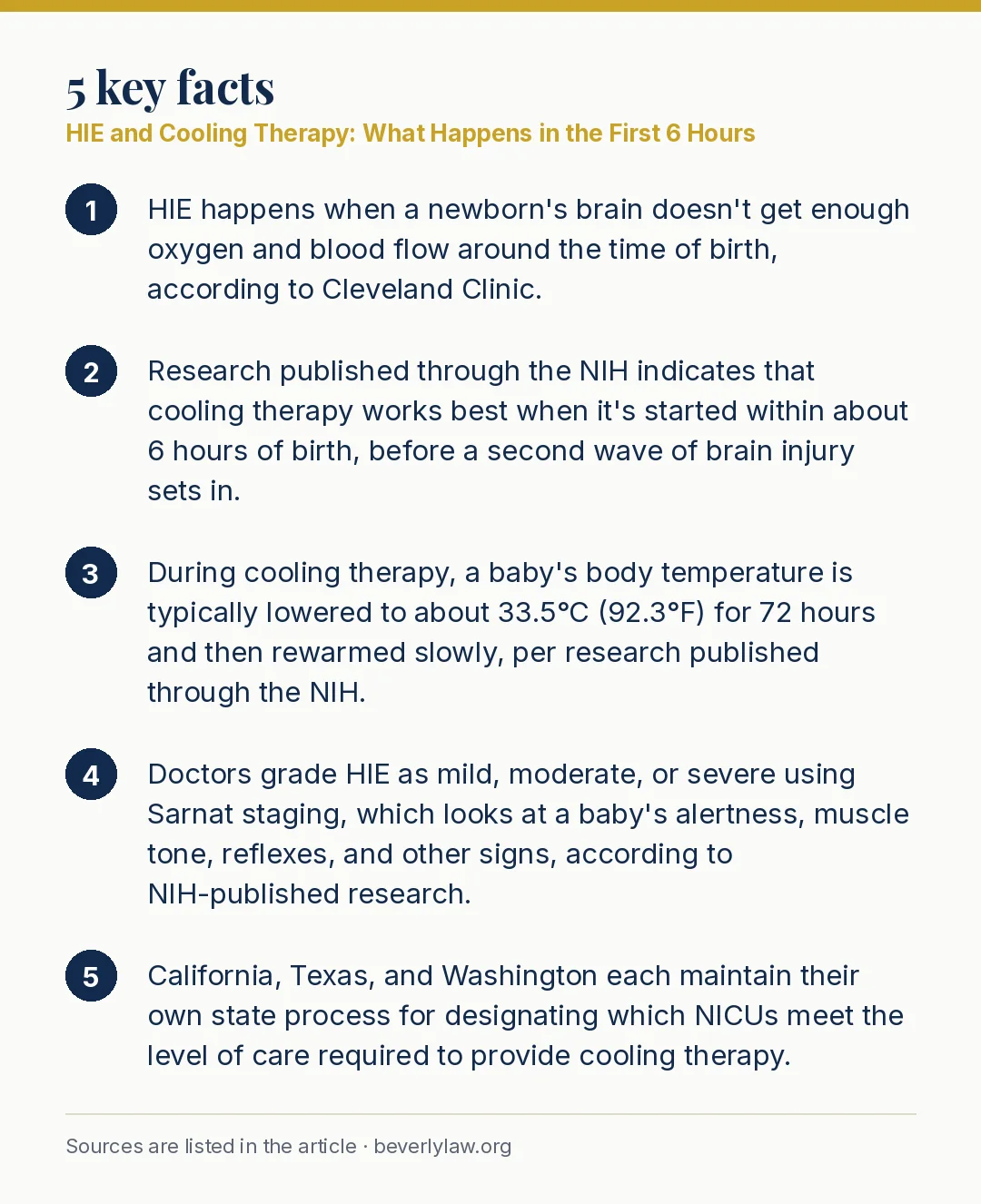
- HIE happens when a newborn's brain doesn't get enough oxygen and blood flow around the time of birth, according to Cleveland Clinic.
- Research published through the NIH indicates that cooling therapy works best when it's started within about 6 hours of birth, before a second wave of brain injury sets in.
- During cooling therapy, a baby's body temperature is typically lowered to about 33.5°C (92.3°F) for 72 hours and then rewarmed slowly, per research published through the NIH.
- Doctors grade HIE as mild, moderate, or severe using Sarnat staging, which looks at a baby's alertness, muscle tone, reflexes, and other signs, according to NIH-published research.
- California, Texas, and Washington each maintain their own state process for designating which NICUs meet the level of care required to provide cooling therapy.
Free birth-injury case review
We review the delivery records with medical experts and tell you honestly whether there is a case. You pay nothing unless we win.
Questions parents ask
How soon after birth is HIE usually diagnosed?
Doctors typically start evaluating a baby in the first minutes to hours of life, using Apgar scores, umbilical cord blood gas results, and a clinical exam, according to Cleveland Clinic. If HIE is suspected, the team also needs to move quickly because eligibility for cooling therapy is generally tied to that same early window.
Does cooling therapy guarantee my baby won’t have long-term problems?
No. Cooling therapy lowers the risk of death or major disability but doesn’t eliminate it — a meta-analysis of early trials found it reduced the rate of death or disability from 61.4% to 46.0%, according to research published through the NIH. How a baby ultimately does depends on the severity of the original injury, the Sarnat stage, and other factors, not just whether cooling was provided.
If my baby wasn’t cooled within 6 hours, does that mean something went wrong?
Not necessarily. Some babies aren’t clearly showing signs of HIE right away, and a separate NIH-funded trial found that starting cooling between 6 and 24 hours after birth could still help, just with a smaller and less certain benefit. If you want to understand the exact timeline for your baby, requesting the medical records — including the times resuscitation and cooling began — is a reasonable place to start.
Sources
Cleveland Clinic
NIH – National Center for Biotechnology Information (PMC)
California Department of Health Care Services (DHCS) – California Children's Services
Texas Department of State Health Services (DSHS)
Washington State Department of Health
Hearing that your baby has HIE and needs cooling therapy is frightening, and the first hours can feel like a blur of monitors, transfers, and decisions made under time pressure. Understanding the basics — what Sarnat staging means, why the 6-hour window matters, and what's in the medical record — can help you make sense of what happened once things settle down. This article is general information, not medical or legal advice, and if you're left wondering whether the care your baby received during that window met the standard it should have, a free, no-obligation case review can help you get clearer answers.
Ask a question
Not ready to call? Write your question and a member of our team answers you — no cost, no commitment.
HIE and Cooling Therapy: What Happens in the First 6 Hours — Beverly Law
Free case review for families in California, Texas and Washington. We obtain the delivery records, have them reviewed by medical experts and deal with the hospital and its insurer — you focus on your child. You pay nothing unless we win.
Related pages
Cerebral Palsy · Erb’s Palsy / Brachial Plexus Injury · HIE / Oxygen Deprivation at Birth · Statute of Limitations · All birth-injury guides · Birth injury news
Important: This page is general information about birth injuries and California law, not legal advice, and reading it does not create an attorney-client relationship with Beverly Law. Every case is different — talk to a lawyer about your own situation. Attorney advertising. Prior results do not guarantee a similar outcome. No fee unless we win. Last reviewed: 2026-09-18.