

By Michael Shemtoub, Esq., Managing Attorney, Beverly Law
Dealing with an insurance adjuster?
Leave your name and phone. We call back today, in English or Spanish. The consultation is free and confidential.
Free consultation · English y Español · No fees or costs unless we win
Where this copy came from
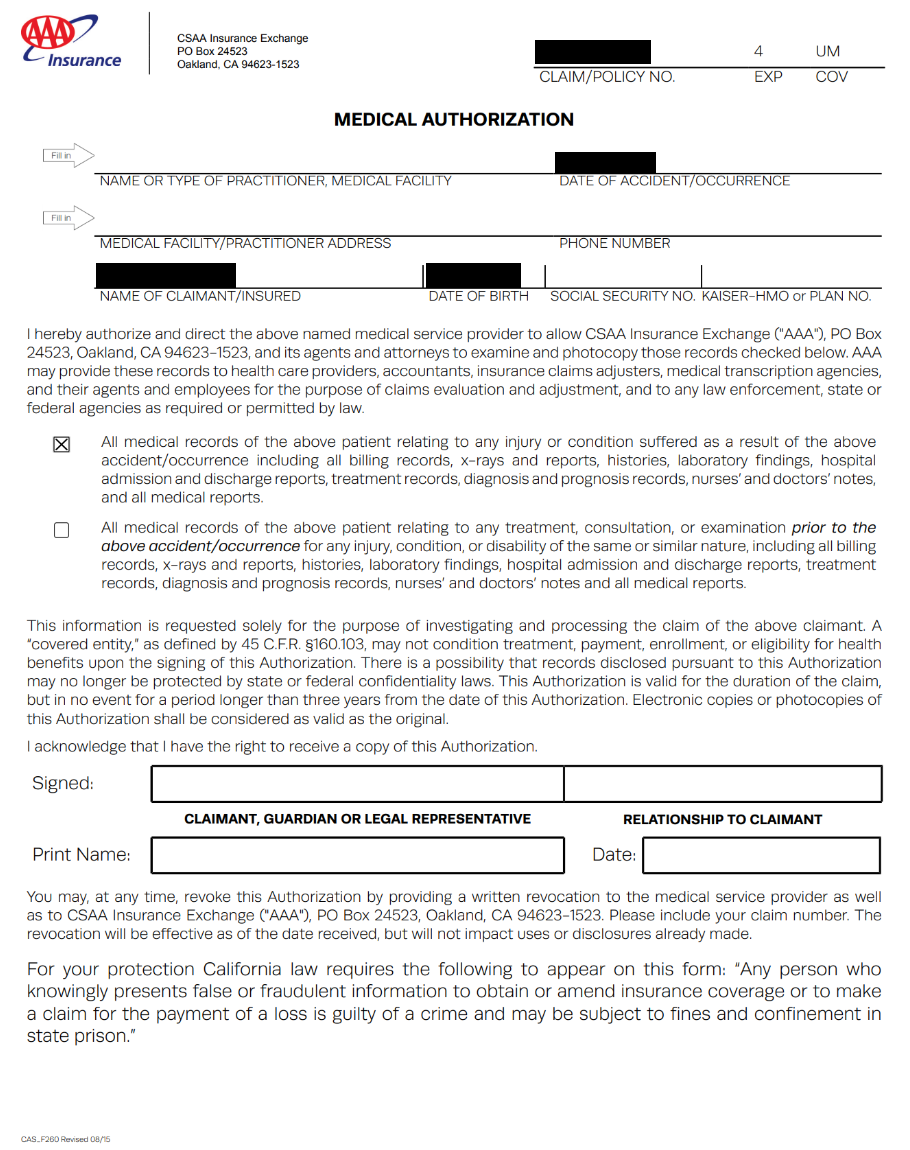
This is the CSAA Insurance Exchange Medical Authorization, form CAS_F260, revised 08/15, with a CSAA Insurance Exchange P.O. box address in Oakland, California. It came to our office in 2026 in a packet on a first-party claim, which means the injured person was making a claim on their own AAA policy, here under uninsured motorist coverage. We blacked out the claim and policy number, the accident date, and the claimant’s name and date of birth. We only describe what the page shows.
The clauses that matter, by number
- One provider per form. The top has a fill-in line for the name or type of practitioner or medical facility, its address and phone, and then your name, date of birth, Social Security number and Kaiser or health plan number. When a single provider is named there, the form reaches only that office, which is better than a blanket form. A type of practitioner written in instead could reach more. AAA may send you several.
- Accident records, box one. On our copy this box was already checked. It covers records of any injury or condition from the accident: bills, X-rays and reports, histories, lab findings, hospital admission and discharge reports, treatment records, diagnosis and prognosis, and nurses’ and doctors’ notes.
- Prior records, box two. This box was unchecked on our copy. If checked, it reaches every treatment, consultation or exam before the accident for any injury, condition or disability of the same or similar nature, with the same list of record types. There is no start date. A back strain from fifteen years ago could count as similar to a back injury today. Do not check it yourself, and look for it before you sign a copy someone else filled in.
- Who else gets the records. AAA may share them with other health care providers, accountants, insurance claims adjusters, medical transcription agencies and their agents and employees, for evaluating and adjusting the claim. It may also give them to law enforcement and state or federal agencies as required or permitted by law.
- Privacy may not follow. The form says records released under it may no longer be protected by state or federal confidentiality laws. Federal rules require that warning on any valid authorization (45 CFR 164.508(c)(2)(iii)), and HHS treats automobile medical payment insurance as outside HIPAA’s health plan definition.
- How long it lasts. For the duration of the claim, and never more than three years from the date of the authorization. Copies and electronic copies count as originals.
- Revoking. You can revoke at any time in writing, sent to both the provider and AAA, with your claim number. It is effective from the date received and does not undo disclosures already made.
The form also says the records are requested solely to investigate and process your claim, and that a covered entity may not condition treatment, payment, enrollment or eligibility for benefits on whether you sign.
Your own insurer is a different situation
On a claim against the other driver’s insurer, you have no contract with that company. On a MedPay or uninsured motorist claim, you are claiming under your own policy, and auto policies often include duties to cooperate with the insurer’s investigation. What your AAA policy requires depends on its exact wording and your state, so read the policy section on duties after an accident or ask your lawyer to. Our page on your own insurer’s medical authorization goes deeper, and so do the pages on MedPay and PIP adjusters and the uninsured motorist adjuster.
AAA packets on first-party claims can also include Medicare questions. Federal law requires liability, no-fault and workers’ compensation insurers to report claims involving Medicare beneficiaries, as CMS explains. Answer that part as a separate matter from the medical authorization.
Free case review
Tell us what happened. We will tell you plainly whether there is a case and what to do next. You owe no fees or costs unless we win.
What to ask for instead
Even with a duty to cooperate, the scope of what you hand over can usually be discussed. A reasonable version:
- Box one only, with box two left blank.
- If prior history really is at issue, a defined window you agree to, such as a few years before the crash, limited to the same body part.
- The provider named at the top, and only the providers who treated you for this crash.
- No mental health, HIV or substance treatment records unless the claim involves them.
- A shorter term than three years.
- A written limit on sharing to what is needed for this claim.
Our sample letters to an adjuster include language for a limited authorization. If the adjuster says your symptoms came from an old injury, read what to do about a pre-existing condition argument.
What to do next
Check both boxes on every copy before it leaves your hands. Keep a copy of each signed form and note which provider it went to, so you can revoke it later if needed. If AAA also asks for a recorded statement, see giving a recorded statement to your own insurer. The forms other carriers use, like the National General form, are in our insurance adjuster questions guide.
Common questions
Why is my own insurance asking for medical records?
To pay MedPay or an uninsured motorist claim, your insurer has to see what was treated and what it cost. The question is how much history beyond that it gets.
What does the prior-records box mean?
It authorizes release of treatment before the accident for any injury or condition of the same or similar kind, with no start date. Leave it unchecked unless you have agreed otherwise.
How long does the AAA authorization last?
For the life of the claim, up to three years from the date of the form.
Why does AAA want my Social Security number?
There is a line for it on the form. See why insurers ask for your Social Security number.
Can I revoke it?
Yes, in writing to both the provider and AAA, with your claim number. Our page on revoking a medical authorization has the steps. Texas cases are handled by the firm’s Texas-licensed attorneys, Joyce Ondich and John Efstathiou. You owe no fees or costs unless we win. Call toll-free 1-877-427-2752 (1-877-4-ASAP-LAW), 24/7, from anywhere in the country.
Ask a question
Not ready to call? Write your question and someone on our team will answer. No cost, no commitment.
Injury lawyer — Beverly Law
Hurt because of someone else in California, Texas and Washington? Talk to an injury attorney. Free, confidential, English or Spanish. You owe no fees or costs unless we win.
Related pages
Insurance adjuster questions · Injury law FAQs
Sources
Important: This page is general information, not legal or medical advice, and reading it does not create an attorney-client relationship. Every case is different; talk to a lawyer about yours. Texas cases are handled by the firm’s Texas-licensed attorneys, Joyce Ondich and John Efstathiou. Last reviewed: November 23, 2026.