

By Michael Shemtoub, Esq., Managing Attorney, Beverly Law
Dealing with an insurance adjuster?
Leave your name and phone. We call back today, in English or Spanish. The consultation is free and confidential.
Free consultation · English y Español · No fees or costs unless we win
What MedPay and PIP are
Medical payments coverage, usually called MedPay, pays reasonable medical costs from a crash up to a set amount, regardless of who caused it. Personal injury protection, or PIP, is broader in many states. The NAIC describes PIP as coverage available in states that have enacted no-fault laws or other auto reparation reform laws, for treatment of injuries to the insured and passengers.
The rules change a lot from state to state. Some states require PIP. Others only require insurers to offer it. Washington, for example, says an insurer must offer PIP with a new or renewed auto liability policy, and the named insured may reject it in writing, under RCW 48.22.085. Your declarations page shows whether you have MedPay, PIP or neither, and the limit.
Why your own adjuster asks for so much
Because you are the policyholder, your policy sets duties for you as well as the insurer. California’s Department of Insurance tells consumers that with a medical payments or uninsured motorist claim, you must provide documentation of your loss, such as injuries, medical expenses and lost wages. That is different from a claim against another driver’s insurer, where you owe that company no contract duties.
So the MedPay or PIP adjuster will usually send a packet: a claim form, a request for bills and records, and a medical authorization. You generally have to give them what the policy requires. You do not have to give them more than that.
What one insurer’s authorization asks for
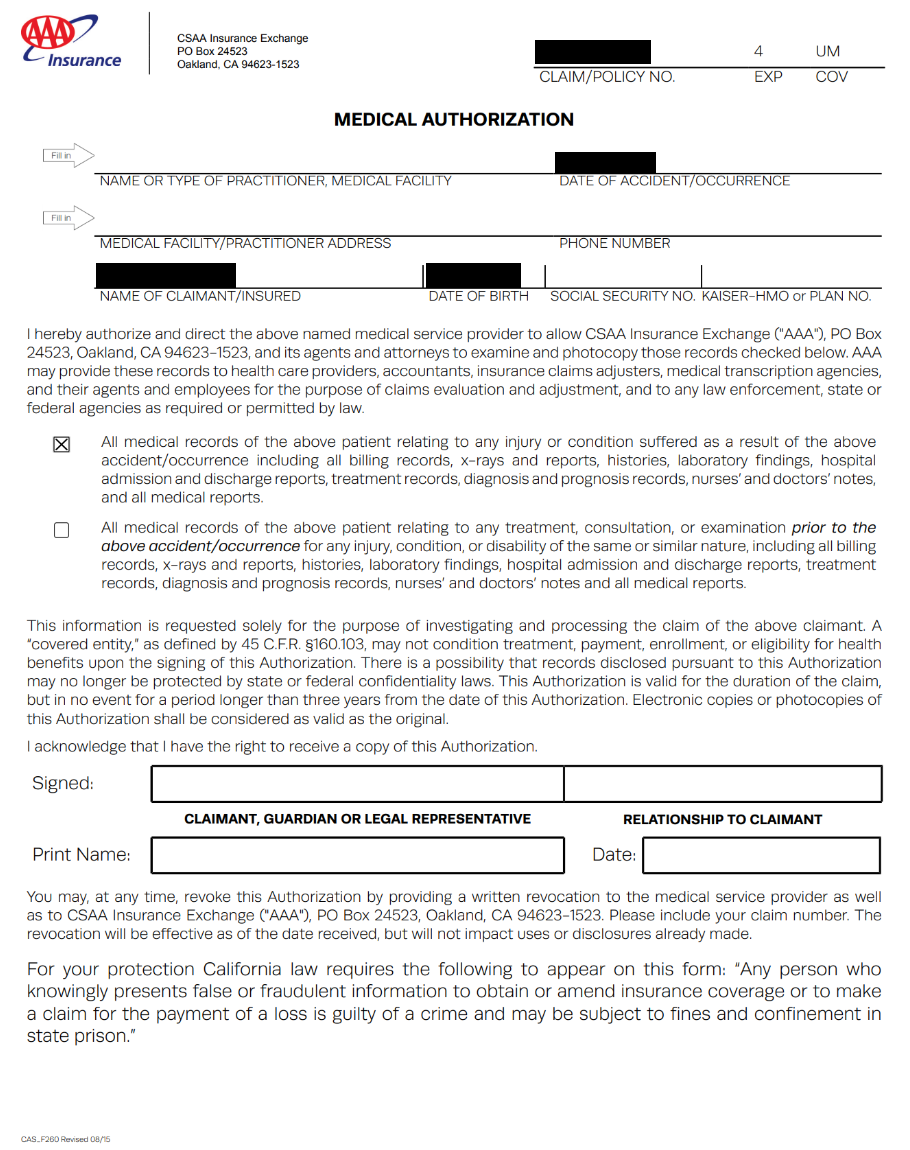
The form above was part of a first-party MedPay and uninsured motorist packet that CSAA Insurance Exchange, the AAA insurer named on the form, sent to our office in 2026. It is worth reading closely.
It has two checkboxes. The first covers records for injuries from the crash, and on our copy it was already checked. The second reaches records from before the crash for any condition “of the same or similar nature.” If that box is checked, your older history goes to the insurer too.
The form lets the insurer pass the records to other providers, accountants, claims adjusters, transcription companies and government agencies where the law requires or permits. It warns that released records may lose privacy protection. It stays in force for the life of the claim, with a three-year outer limit. Revoking it takes a written notice to both the provider and the insurer, and it does not undo past releases.
You can ask to leave the prior-records box blank and to limit the form to named providers and dates. For more, see my own insurance company’s medical authorization and the full walkthrough of the AAA medical authorization form.
Free case review
Tell us what happened. We will tell you plainly whether there is a case and what to do next. You owe no fees or costs unless we win.
Why payments get cut, and what to do about each
Bill review. Insurers often run bills through software or a review company that reduces charges it sees as above usual rates. Ask for the explanation of review for each bill. Your provider may be able to respond with coding or pricing support.
Medical necessity. A nurse or doctor hired by the insurer may decide some care was not needed. Ask for the reviewer’s written report and name. Send it to your treating doctor and ask for a written response.
An exam by the insurer’s doctor. Some policies let the insurer ask you to see a doctor it chooses. That doctor works for the insurer, the same as a defense medical exam in an injury case. Ask for the report afterward.
Limit reached. MedPay and PIP limits are often low. Ask for a payment log showing what was paid, to whom and when. Errors happen, such as duplicate payments to one provider.
Example only: a passenger has $5,000 in MedPay. Payments stop after three months. The payment log shows the ER bill was paid twice. Once the duplicate is corrected, more of the limit is available for therapy bills. The facts of each case and the policy language decide.
What to do next
Ask for the denial or reduction reason in writing, with the report and the policy language it relies on.
Read the policy for any appeal, arbitration or dispute process, and the deadlines in it. Keep copies of everything you send.
If the insurer misses its own time limits, see how long the insurance company has to accept or deny a claim. If you are stuck, a complaint to your state insurance department is free. See how to file a complaint against an insurance adjuster.
Remember that MedPay and PIP are only part of the picture. A claim against the at-fault driver covers more than bills. See the adjuster will only pay my medical bills, and our insurance adjuster questions page for the rest of the series.
Common questions
Will using MedPay raise my premium?
Insurers price policies differently, and some states limit surcharges for crashes you did not cause. Ask your insurer in writing.
Does MedPay have to be paid back from my injury settlement?
It depends on your state and your policy. Some policies give the insurer a right to be repaid from a recovery against the at-fault driver. Read the reimbursement or subrogation section.
Can the MedPay adjuster take a recorded statement?
Your policy may require cooperation. Ask what the statement is for and keep it to the facts. See recorded statement to my own insurance company.
Do I have to sign the authorization exactly as sent?
You can ask to narrow it. If the insurer insists, ask which policy term requires the broader version.
What if I have no MedPay or PIP?
Your health insurance may pay, and the at-fault driver’s insurer may cover costs in the injury claim. Your own uninsured motorist coverage can matter too. See the uninsured motorist adjuster. Texas cases are handled by the firm’s Texas-licensed attorneys, Joyce Ondich and John Efstathiou. You owe no fees or costs unless we win. Call toll-free 1-877-427-2752 (1-877-4-ASAP-LAW), 24/7, from anywhere in the country.
Ask a question
Not ready to call? Write your question and someone on our team will answer. No cost, no commitment.
Injury lawyer — Beverly Law
Hurt because of someone else in California, Texas and Washington? Talk to an injury attorney. Free, confidential, English or Spanish. You owe no fees or costs unless we win.
Related pages
Insurance adjuster questions · Injury law FAQs
Sources
- NAIC Glossary of Insurance Terms (personal injury protection)
- Washington RCW 48.22.085 (PIP must be offered; written rejection)
- California Department of Insurance, Automobile Insurance guide (Form 101, revised Feb. 5, 2025; MedPay pays "no matter who is at fault")
- California Department of Insurance, So You've Had an Accident, What's Next? (consumer guide, text version revised December 2024; replaces the October 2015 PDF edition)
Important: This page is general information, not legal or medical advice, and reading it does not create an attorney-client relationship. Every case is different; talk to a lawyer about yours. Texas cases are handled by the firm’s Texas-licensed attorneys, Joyce Ondich and John Efstathiou. Last reviewed: November 23, 2026.