

By Michael Shemtoub, Esq., Managing Attorney, Beverly Law
Dealing with an insurance adjuster?
Leave your name and phone. We call back today, in English or Spanish. The consultation is free and confidential.
Free consultation · English y Español · No fees or costs unless we win
About this copy
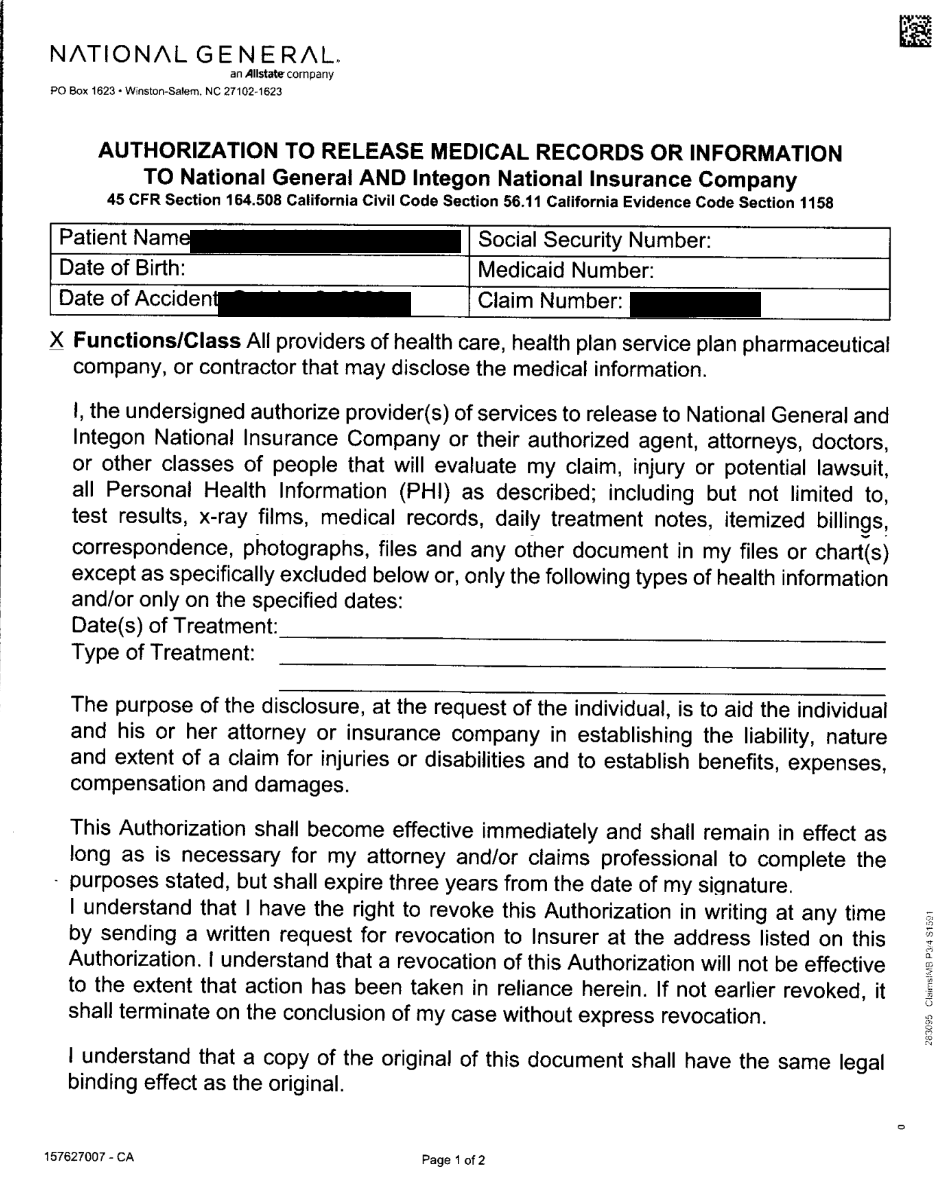
National General describes itself on the form as an Allstate company. The form is titled Authorization to Release Medical Records or Information to National General and Integon National Insurance Company, form 157627007-CA, two pages. It came to our office in 2026 with a letter acknowledging that we represent the injured person. We blacked out the patient’s name, accident date and claim number. Page 2 arrived blank. Encompass, another Allstate company, has sent us the same template.
Page 1, clause by clause
- Every kind of source. A box marked with an X covers all providers of health care, health plans, pharmaceutical companies and contractors that may disclose medical information. Nothing is named, so any of them can respond.
- A wide circle of readers. The records go to National General and Integon, and to their agents, attorneys, doctors or other classes of people who will evaluate your claim, injury or a potential lawsuit.
- Everything in the chart. The form lists test results, X-ray films, medical records, daily treatment notes, itemized bills, correspondence, photographs and any other document in your files or charts.
- The two blank lines. Right below that list are lines for Date(s) of Treatment and Type of Treatment. These are the only built-in limits on the form. Left empty, nothing narrows the request. Filled in, they confine it.
- The purpose line. It says the disclosure is made “at the request of the individual” to help the individual and his or her attorney or insurance company. Under federal rules, that phrase is an acceptable purpose statement when the individual starts the authorization (45 CFR 164.508(c)(1)(iv)). Here the insurer started it by mailing the form.
- How long it lasts. It takes effect immediately, stays in force as long as needed for the claim, and expires three years after you sign. A later sentence says it ends when your case concludes if not revoked first.
- Revoking. You can revoke in writing by sending a request to the insurer at the address on the form. Anything already done in reliance on it stays done.
- Identity fields. The header has lines for your Social Security number and Medicaid number. See why insurers ask for your Social Security number.
- Copies count. A copy of the signed form has the same effect as the original, so one signature can be sent to many offices.
Page 2: the separate consents
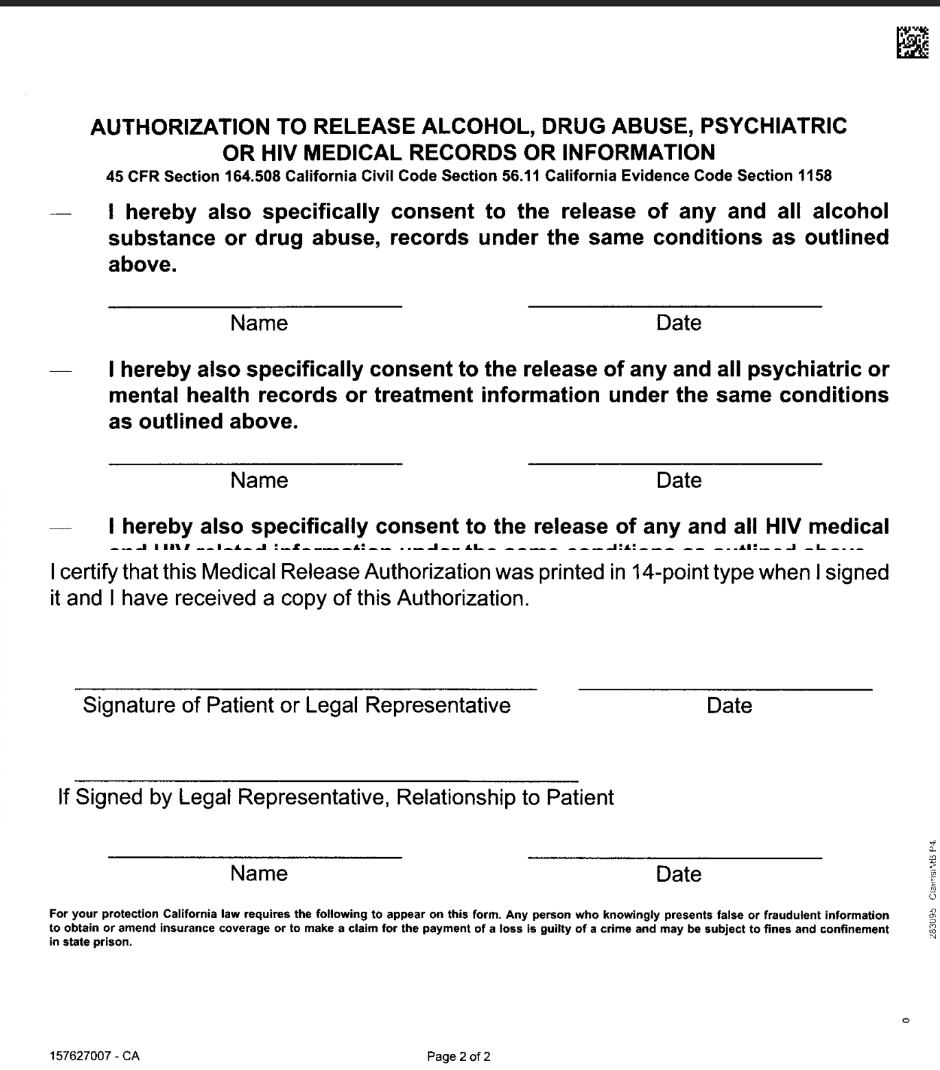
Page 2 has three separate consents, each with its own name and date line:
- Alcohol, substance or drug abuse records.
- Psychiatric or mental health records and treatment information.
- HIV medical and HIV-related information.
Each one is optional. If your injury claim does not involve that kind of care, leave the line unsigned. Signing all three just because they are on the page is an easy mistake to make.
At the bottom you certify that the form was printed in 14-point type when you signed and that you received a copy. There are lines for a legal representative’s relationship to the patient and a fraud warning.
Free case review
Tell us what happened. We will tell you plainly whether there is a case and what to do next. You owe no fees or costs unless we win.
What the legal citations on the header mean
The header cites 45 CFR 164.508, California Civil Code 56.11 and California Evidence Code 1158. The federal rule lists what a valid authorization must contain: a specific description of the information, who may disclose it and who may receive it, the purpose, an expiration date or event, a signature and date, a statement of the right to revoke in writing, a statement on whether treatment or payment can be conditioned on signing, and a warning that released records may be redisclosed and lose protection (45 CFR 164.508(c)). That redisclosure warning matters here because HHS treats auto liability and auto medical payment insurance as outside HIPAA’s definition of a health plan. We could not open the official California code text for this page, so we do not describe the two state sections.
What to ask for instead
The form already gives you room to narrow it. Use that room, or attach a limited authorization of your own:
- On the Date(s) of Treatment line, write the accident date to the present.
- On the Type of Treatment line, write the injuries you claim, such as neck, back or right knee.
- Cross out the all-providers box and list the providers who treated you for this crash.
- Leave all three page-2 consents unsigned unless the claim involves that care.
- Shorten the term. A 90-day term is a fair request, and it can be renewed if needed.
- Add a sentence limiting use to this claim, with no sharing with other companies.
Our sample letters to an adjuster include a limited authorization you can adapt.
What to do next
If you have a lawyer, the lawyer should be the one returning this form, or sending records directly instead. If not, fill in the limit lines before you sign anything. To see how other carriers write theirs, compare the Allstate form, the GEICO form and the Progressive form. Our insurance adjuster questions guide covers what happens after the records go out, including what adjusters look for in medical records.
Common questions
Is National General part of Allstate?
The form itself says National General is an Allstate company. The records go to National General and Integon National Insurance Company.
Do I have to sign the page-2 consents?
Each one is a separate, optional signature. Sign only the ones that match care your claim actually involves.
How long does the National General authorization last?
Up to three years from signing, or until the case ends, whichever the form’s two sentences produce first. You can write in a shorter date.
Can the insurer ask for all my medical records?
It can ask. Whether you have to give them is another matter; see can insurance ask for my medical records and do I have to sign a medical release.
How do I cancel it after signing?
Send a written revocation to the insurer at the address on the form. Our page on revoking a medical authorization explains what that does and does not undo. Texas cases are handled by the firm’s Texas-licensed attorneys, Joyce Ondich and John Efstathiou. You owe no fees or costs unless we win. Call toll-free 1-877-427-2752 (1-877-4-ASAP-LAW), 24/7, from anywhere in the country.
Ask a question
Not ready to call? Write your question and someone on our team will answer. No cost, no commitment.
Injury lawyer — Beverly Law
Hurt because of someone else in California, Texas and Washington? Talk to an injury attorney. Free, confidential, English or Spanish. You owe no fees or costs unless we win.
Related pages
Insurance adjuster questions · Injury law FAQs
Sources
Important: This page is general information, not legal or medical advice, and reading it does not create an attorney-client relationship. Every case is different; talk to a lawyer about yours. Texas cases are handled by the firm’s Texas-licensed attorneys, Joyce Ondich and John Efstathiou. Last reviewed: November 23, 2026.