


When a baby is hurt around birth, parents usually have two kinds of questions at the same time: how is my child doing, and what, if anything, can we do about what happened? This guide is about the second question. It explains, in plain words, the main steps and limits that Texas law sets for a medical claim involving a birth injury.
In Texas, these claims fall under Chapter 74 of the Civil Practice and Remedies Code, often called the Texas Medical Liability Act. It has its own deadlines, its own pre-suit notice and its own early expert requirement. Knowing the outline can help you ask better questions, whoever you talk to. The text below follows the Texas Legislature's published version of the code.
Was your baby hurt during delivery?
Tell us your name and phone. We call you back today, in English or Spanish, and the consultation is free.
Free consultation · English y Español · No fees or costs unless we win
The filing deadline: two years, and a special rule for young children
Section 74.251 of the Texas Civil Practice and Remedies Code says that a health care liability claim generally must be filed within two years from the date of the breach or tort, or from the date the treatment or hospitalization at issue was completed. The section begins with the words «notwithstanding any other law», so it is meant to override other deadlines.
The same section adds a rule for young children: minors under the age of 12 have until their 14th birthday to file, or have a claim filed on their behalf. The statute also sets a separate outer limit, called a statute of repose, of 10 years after the act or omission that gave rise to the claim.
This is an area where the details matter. In Weiner v. Wasson (Tex. 1995), the Texas Supreme Court held that applying the older version of the minors' rule to a child's own medical claim violated the Texas Constitution, according to a later opinion of the Fourteenth Court of Appeals. How that history applies today to a child's claim, and to the parents' own separate claims, is a question for a licensed Texas attorney. The safest approach for any family is not to wait, and to treat the two-year mark as the date to plan around.
Step one: the 60-day written notice
Before a lawsuit can be filed, Section 74.051 requires the person making the claim to give written notice to each physician or health care provider, by certified mail, return receipt requested, at least 60 days before the suit is filed. The notice must come with a medical authorization form that lets the provider obtain the patient's earlier medical records. The required form is described in Section 74.052.
The notice also affects the clock. Section 74.051(c) says that notice given as the chapter provides tolls the applicable statute of limitations through 75 days after the notice is given. Tolling means the deadline is paused for that period. In Hampton v. Thome (2024), the Texas Supreme Court explained that an authorization form with small mistakes can still be a medical authorization form that triggers the 75-day tolling, but it also stressed that the notice must really include a form.
Because the notice and the form have exact requirements, this is a step many families leave to a lawyer. Your own records, such as the dates of the delivery and the names of the hospital and doctors, are what make it possible to prepare it.
Step two: the 120-day expert report
Once a suit is filed, Section 74.351 requires the claimant to serve an expert report, with the expert's curriculum vitae, no later than the 120th day after each defendant's original answer is filed. The deadline can be extended by written agreement of the parties.
The statute defines an expert report as a fair summary of the expert's opinions about the applicable standards of care, how the care allegedly failed to meet those standards, and the connection between that failure and the injury claimed. In plain words, a qualified medical professional has to put in writing, early in the case, why the claim has a medical basis.
If no report is served in time, the court, on the defendant's motion, must dismiss the claim against that provider with prejudice and award reasonable attorney's fees and costs. If a report is served but found deficient, the court may allow one 30-day extension to fix it. Because the consequences are serious, this is the part of a Texas case that tends to shape how it is prepared from the start.
The cap on non-economic damages
Section 74.301 limits noneconomic damages in a health care liability claim. Noneconomic damages generally refer to losses that are not bills or wages, such as pain, suffering and mental anguish. Against physicians and other providers who are not institutions, the limit is $250,000 for each claimant. Against a single health care institution, it is also $250,000 for each claimant.
When a judgment is entered against more than one health care institution, each institution is limited to $250,000 per claimant, and all institutions together are limited to $500,000 per claimant. The statute applies these limits to everyone for whom a defendant may be vicariously responsible.
The text of this section limits noneconomic damages. It does not set the same kind of limit on the cost of future medical care or similar financial losses, which can be a large part of a child's needs. How much each category is worth in a particular case depends on the facts and on the evidence.
Public hospitals and charitable organizations
Some defendants have extra limits. Under the Texas Tort Claims Act, liability of a unit of local government is limited to $100,000 for each person and $300,000 for each occurrence for bodily injury or death. For the state government the limits are $250,000 per person and $500,000 per occurrence, and for a municipality $250,000 per person and $500,000 per occurrence (Section 101.023). A governmental unit is also entitled to notice of a claim within six months after the incident (Section 101.101). Chapter 74 says that if it conflicts with Section 101.023, that section controls.
Chapter 84, the charitable immunity and liability act, applies in other situations. For a nonhospital charitable organization, liability is limited to $500,000 per person and $1,000,000 per occurrence for bodily injury or death (Section 84.006). For a hospital, Section 84.0065 sets a $500,000 limit only when the patient, or the person responsible for a minor patient, signed a written acknowledgment that the care was not given in expectation of payment and that damages are limited. Section 84.007 says the chapter does not apply to acts that are intentional, willfully negligent, or done with conscious indifference.
Whether a particular hospital falls into one of these groups depends on who owns and runs it and on the facts of the care. Ask for that to be checked early, because it changes both the notice deadlines and the limits.
This article is general information, not legal or medical advice. Laws change, and every family's facts are different, so please talk with a licensed Texas attorney about your own situation.
Key facts
Read the key facts as text
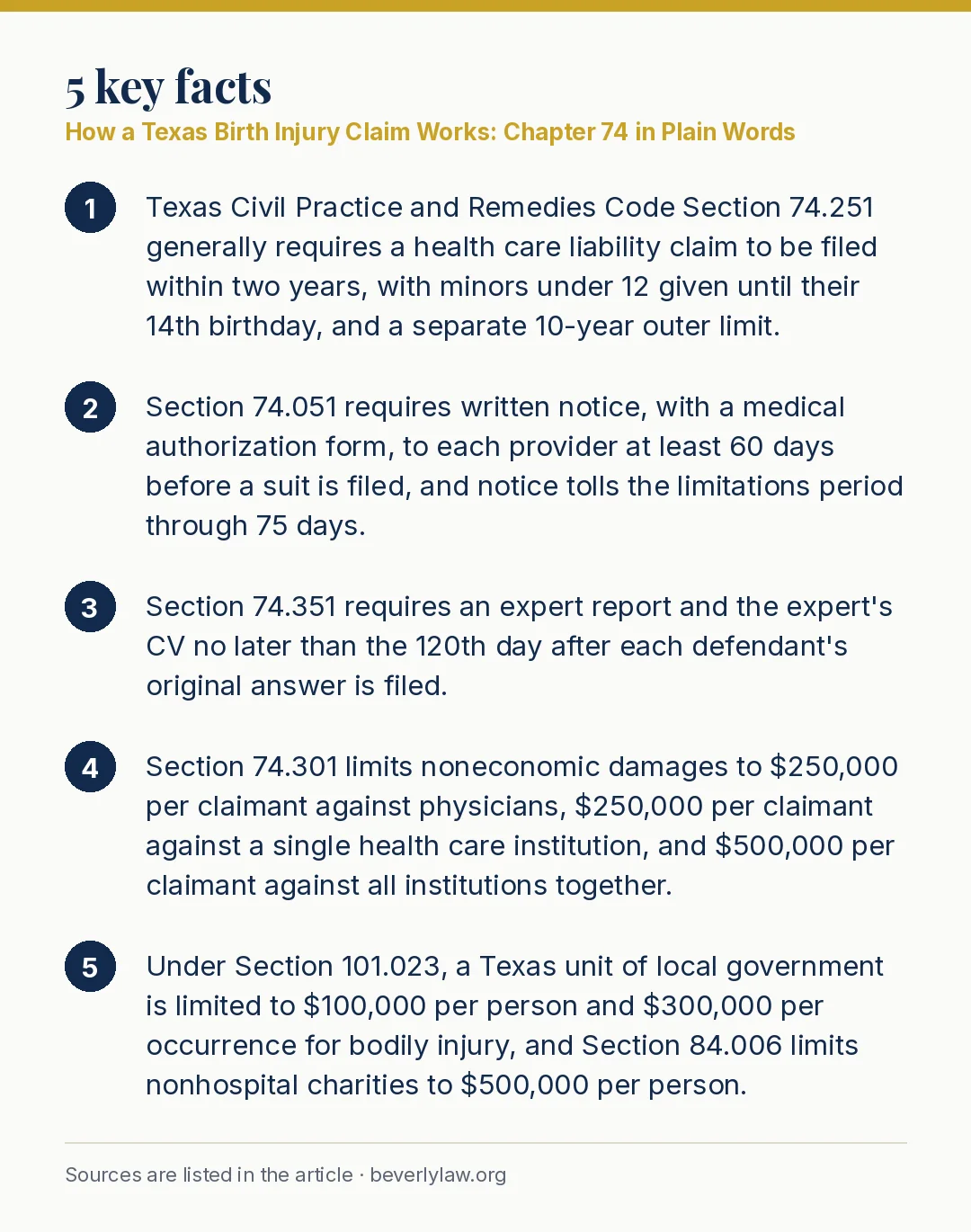
- Texas Civil Practice and Remedies Code Section 74.251 generally requires a health care liability claim to be filed within two years, with minors under 12 given until their 14th birthday, and a separate 10-year outer limit.
- Section 74.051 requires written notice, with a medical authorization form, to each provider at least 60 days before a suit is filed, and notice tolls the limitations period through 75 days.
- Section 74.351 requires an expert report and the expert's CV no later than the 120th day after each defendant's original answer is filed.
- Section 74.301 limits noneconomic damages to $250,000 per claimant against physicians, $250,000 per claimant against a single health care institution, and $500,000 per claimant against all institutions together.
- Under Section 101.023, a Texas unit of local government is limited to $100,000 per person and $300,000 per occurrence for bodily injury, and Section 84.006 limits nonhospital charities to $500,000 per person.
Free birth-injury case review
We review the delivery records with medical experts and tell you honestly whether there is a case. You pay no fees or costs unless we win.
Questions parents ask
Do I have to wait until my child is older to file?
No, and waiting can carry risk. Section 74.251 sets a two-year general rule and gives children under 12 until their 14th birthday, but courts have discussed how the minors’ rule works. Because deadlines can be hard to read, it is wise to have a Texas attorney look at your dates as soon as you can.
What is the expert report, and who writes it?
It is a written report from a qualified expert, often a physician, that summarizes the standard of care, how it was allegedly not met, and how that is linked to the injury. Section 74.351 requires it within 120 days after each defendant’s original answer. The claimant’s side arranges it, and the defendant may object to it.
Does the cap mean my child cannot receive money for future care?
Section 74.301 limits noneconomic damages, such as pain and mental anguish. It does not use the same wording for financial losses like future medical care. What is available in a given case depends on the facts, the defendants and the evidence, so ask a Texas attorney about your situation.
Sources
Texas Legislature – Civil Practice and Remedies Code, Chapter 74 (Medical Liability)
Texas Legislature – Civil Practice and Remedies Code, Chapter 101 (Tort Claims Act)
Texas Legislature – Civil Practice and Remedies Code, Chapter 84 (Charitable Immunity and Liability)
Supreme Court of Texas – Hampton v. Thome, No. 22-0435 (2024)
Texas Fourteenth Court of Appeals opinion discussing Weiner v. Wasson
A Texas birth injury claim runs on a few firm checkpoints: a two-year general deadline with special language for young children, a written notice at least 60 days before suit, an expert report within 120 days after a defendant answers, and limits on noneconomic damages and on some public and charitable defendants. None of this tells you what is right for your family, and every case turns on its own facts. If you would like to talk it through, Beverly Law offers a free case review, with no obligation and no promises about the outcome.
Ask a question
Not ready to call? Write your question and a member of our team answers you — no cost, no commitment.
How a Texas Birth Injury Claim Works: Chapter 74 in Plain Words — Beverly Law
Free case review for families in Texas. We obtain the delivery records, have them reviewed by medical experts and deal with the hospital and its insurer — you focus on your child. You pay no fees or costs unless we win.
Related pages
Cerebral Palsy · Erb’s Palsy / Brachial Plexus Injury · HIE / Oxygen Deprivation at Birth · Statute of Limitations · All birth-injury guides · Birth injury news · Birth injury lawyers by California hospital
Important: This page is general information about birth injuries and California law, not legal advice, and reading it does not create an attorney-client relationship with Beverly Law. Every case is different — talk to a lawyer about your own situation. Attorney advertising. Prior results do not guarantee a similar outcome. No fees or costs unless we win. Last reviewed: 2026-09-18.