


When a baby is hurt around the time of birth, the first months are about care, therapy and answers. Legal deadlines are usually the last thing on a parent's mind. Yet the law sets time limits for filing a claim, and in some states those limits can be shorter than many families expect.
This article compares the rules in California, Texas and Washington for a child's claim and for the parents' own claims. It also explains terms like discovery rule and tolling, and what changes when the hospital or clinic is run by a government entity. Deadlines depend on the facts of each case, so treat this as a map, not a calendar.
Was your baby hurt during delivery?
Tell us your name and phone. We call you back today, in English or Spanish, and the consultation is free.
Free consultation · English y Español · No fees or costs unless we win
Why deadlines exist and two words to know
A statute of limitations is the period of time the law gives someone to file a lawsuit. If the case is filed after that period ends, a court may dismiss it, even if the underlying concerns were serious. Lawmakers say these limits exist so that evidence and memories do not go stale.
Two ideas appear again and again. The discovery rule can start or extend the clock based on when someone knew, or reasonably should have known, that an injury was connected to care. Tolling means the clock is paused or extended for a reason set out in the law, such as the age of the injured person, a required notice, or concealment. Each state uses these ideas differently.
California: three years, one year and a rule for young children
For claims against a health care provider based on professional negligence, California Code of Civil Procedure section 340.5 sets the time to file at three years after the date of injury or one year after the person discovers, or through reasonable diligence should have discovered, the injury, whichever occurs first. The three-year limit can be tolled for fraud, intentional concealment, or a foreign object left in the body with no medical purpose.
The same section has a rule for children. Actions by a minor must be filed within three years of the alleged wrongful act, except that a child under six has three years or until their eighth birthday, whichever is longer. The time can also be tolled if a parent or guardian and the provider or its insurer committed fraud or collusion in not bringing the claim. Parents' own claims, such as for their own costs, generally follow the three-year and one-year rule for adults.
Texas: two years, with extra time only for some children
Texas handles medical claims under Chapter 74 of the Civil Practice and Remedies Code. Section 74.251 says a health care liability claim must generally be filed within two years of the breach or tort, or of the date treatment or hospitalization ended. A child under 12 has until their 14th birthday. Outside that exception, the section says it applies to everyone regardless of minority, which means a parent's own claim does not get the extra time.
The same section sets a 10-year outer limit, described by the statute as a statute of repose, so claims must be brought within 10 years of the act or omission. It also says that notice given as required by the chapter tolls the limitations period for 75 days after the notice is given. Texas law has its own notice and authorization steps before filing, which is one more reason to ask early.
Washington: three years, one year and a special rule about parents' knowledge
Under RCW 4.16.350, a claim for injury from health care must be filed within three years of the act or omission, or within one year of when the patient or a representative discovered or reasonably should have discovered that the act caused the injury, whichever period expires later. There is also an eight-year outer limit, and the clock can be tolled for fraud, intentional concealment, or a foreign body left in the patient.
Washington's general rule, RCW 4.16.190, pauses the clock while a person is under 18. But RCW 4.16.350 says that, notwithstanding that rule, the knowledge of a custodial parent or guardian is imputed to the child. In plain words, what a parent knew or should have known can count against the child's claim. Courts interpret how this works in practice, so families should not assume a child automatically has until adulthood.
Hospitals run by a government entity
If the hospital, clinic or doctor is part of a city, county, district or state, extra steps and shorter periods may apply. In California, the Government Claims Act generally requires a written claim to the public entity within six months for injury claims (Government Code section 911.2) before a lawsuit can be filed. There are late-claim procedures, including some for minors, but they have their own strict time limits.
Texas and Washington also have special rules for claims against governmental bodies. We have not confirmed the details of those rules here, so we do not state them. If the care was at a public or university hospital, it is especially important to ask about the deadline as soon as possible, because a shorter notice period could pass before the usual limit does.
What families can do, and an important note
Many families find it helpful to keep copies of medical records, bills, therapy notes and the dates of care in one folder. Writing down the date of the birth, the dates of any later diagnosis, and when a doctor first connected the condition to the delivery may help a lawyer work out which deadline applies. Asking a question does not commit you to filing anything.
This article is general information, not legal or medical advice. Deadlines can change, exceptions are fact-specific, and nothing here says whether any particular claim is timely or has merit. Only a licensed attorney who reviews your records can tell you the deadline that applies to your situation.
Key facts
Read the key facts as text
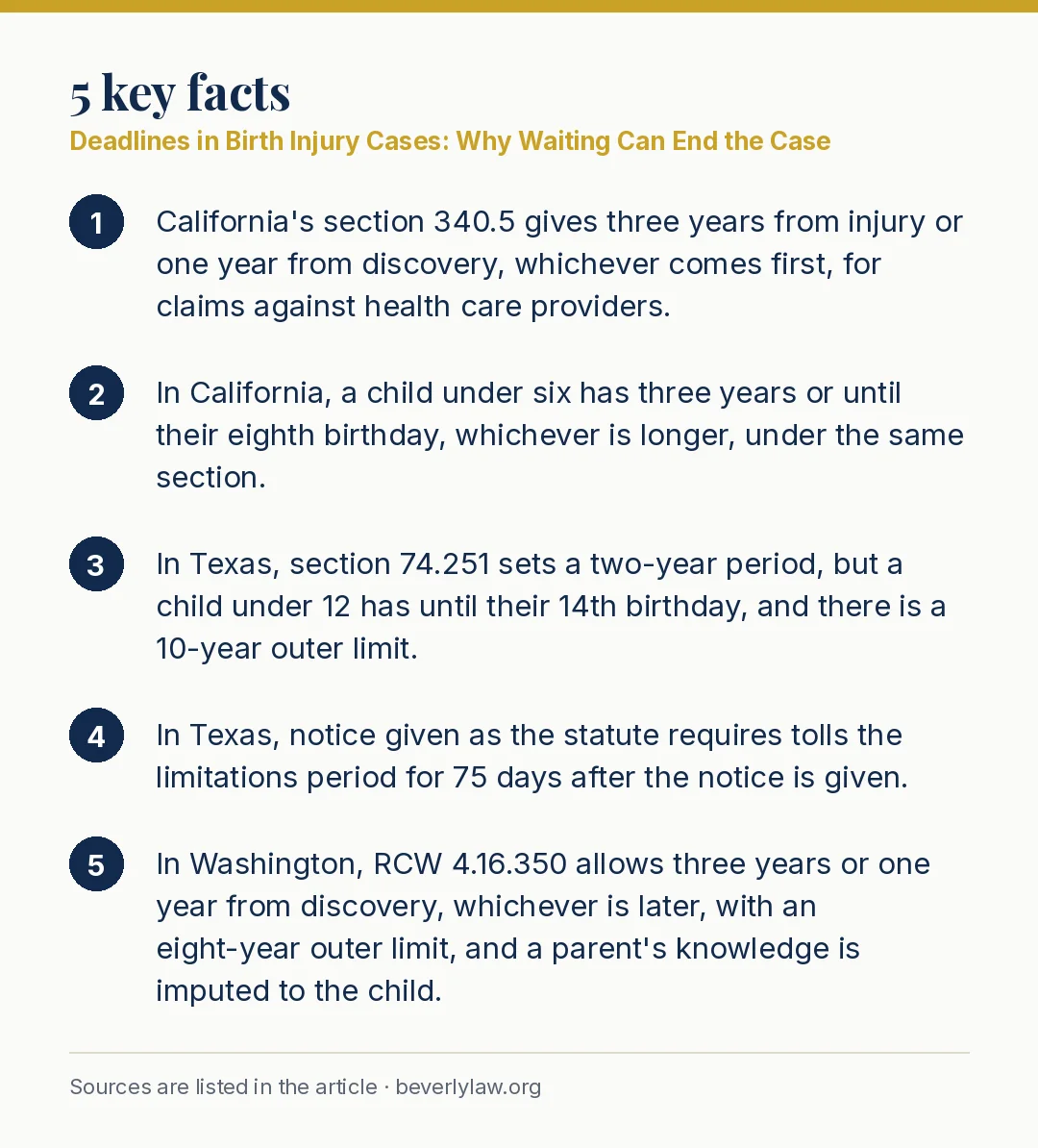
- California's section 340.5 gives three years from injury or one year from discovery, whichever comes first, for claims against health care providers.
- In California, a child under six has three years or until their eighth birthday, whichever is longer, under the same section.
- In Texas, section 74.251 sets a two-year period, but a child under 12 has until their 14th birthday, and there is a 10-year outer limit.
- In Texas, notice given as the statute requires tolls the limitations period for 75 days after the notice is given.
- In Washington, RCW 4.16.350 allows three years or one year from discovery, whichever is later, with an eight-year outer limit, and a parent's knowledge is imputed to the child.
Free birth-injury case review
We review the delivery records with medical experts and tell you honestly whether there is a case. You pay no fees or costs unless we win.
Questions parents ask
Does my child automatically have until age 18 to file?
Not necessarily. In California the statute gives a child under six until the eighth birthday or three years, whichever is longer. In Texas a child under 12 has until the 14th birthday. In Washington the statute says a custodial parent’s knowledge is imputed to the child. Many states pause the clock for minors in other kinds of cases, but birth injury claims often have their own rules.
Do parents have the same deadline as the child?
Often not. Parents’ own claims generally follow the adult rules. In California that is three years from injury or one year from discovery, whichever is first. In Texas, section 74.251 applies to everyone outside the stated child exception, and in Washington the three-year and one-year periods apply. Because the child’s and parents’ dates can differ, the shorter one is the one to watch.
What if we only learned later that the injury might be linked to the birth?
California, Texas and Washington each treat discovery differently, and Washington and California measure from when a person knew or should have known. All three also have outer limits that can end a claim regardless of discovery, with narrow exceptions such as fraud or concealment. If you are unsure when the clock started, a prompt review of the records is the safest way to find out.
Sources
California Legislative Information: Code of Civil Procedure 340.5
California Legislative Information: Government Code, Tort Claims Act
Texas Statutes: Civil Practice and Remedies Code, Chapter 74
Washington Legislature: RCW 4.16.350
Washington Legislature: RCW 4.16.190
Birth injury deadlines vary by state, by who is filing, and by whether a public entity is involved, and some of them are measured in months or a few years rather than decades. You do not need to decide anything today, but learning your dates early keeps your options open. If you have questions about your child's care, Beverly Law offers a free case review, with no obligation and no promises about any outcome.
Ask a question
Not ready to call? Write your question and a member of our team answers you — no cost, no commitment.
Deadlines in Birth Injury Cases: Why Waiting Can End the Case — Beverly Law
Free case review for families in California, Texas and Washington. We obtain the delivery records, have them reviewed by medical experts and deal with the hospital and its insurer — you focus on your child. You pay no fees or costs unless we win.
Related pages
Cerebral Palsy · Erb’s Palsy / Brachial Plexus Injury · HIE / Oxygen Deprivation at Birth · Statute of Limitations · All birth-injury guides · Birth injury news · Birth injury lawyers by California hospital
Important: This page is general information about birth injuries and California law, not legal advice, and reading it does not create an attorney-client relationship with Beverly Law. Every case is different — talk to a lawyer about your own situation. Attorney advertising. Prior results do not guarantee a similar outcome. No fees or costs unless we win. Last reviewed: 2026-09-18.