

Bringing a baby home healthy is the goal of every family. Most newborns never have a serious infection. Still, infection in the first days and weeks of life can move quickly, which is why prenatal testing and careful newborn observation matter so much. This guide explains, in plain words, how Group B Strep (GBS) is screened for, how antibiotics in labor are used, and how doctors look for sepsis in a newborn.
The information comes from the CDC, the American Academy of Pediatrics (AAP) and the American College of Obstetricians and Gynecologists (ACOG). It applies to families in California, Texas and Washington, and across the United States, because these clinical recommendations are national. It is meant to help you ask good questions, not to replace your care team.
Was your baby hurt during delivery?
Tell us your name and phone. We call you back today, in English or Spanish, and the consultation is free.
Free consultation · English y Español · No fee unless we win
What Group B Strep is and why it matters
Group B Streptococcus is a common bacterium. According to the AAP's HealthyChildren.org, about 25% of pregnant women carry it, usually with no symptoms at all. Carrying GBS is not an infection in the mother and does not mean she did anything wrong.
The concern is for the baby. A baby can pick up the bacteria around the time of birth. The AAP says GBS can cause serious newborn illness, including blood infection (sepsis), pneumonia and meningitis. Premature babies face a higher risk. Most babies born to mothers who carry GBS stay healthy, especially when preventive steps are followed.
Screening in late pregnancy
The CDC's 2010 prevention guideline described routine screening with a vaginal and rectal swab between 35 and 37 weeks. ACOG's more recent Committee Opinion 797 (2020) recommends testing between 36 weeks 0 days and 37 weeks 6 days. According to ACOG, a culture collected within 5 weeks of birth predicts GBS status well. This is why the test is done late in pregnancy and not earlier.
The swab is quick and does not hurt. Ask your provider for your result and make sure it is written in your prenatal record. Also tell your provider if you had GBS in a urine test during this pregnancy, or if a previous baby had GBS disease. The CDC lists both as reasons that antibiotics in labor may be recommended.
Preterm labor is a special case. The CDC guideline says antibiotics in labor are generally offered when labor or membrane rupture starts before 37 weeks, unless a recent negative culture is already available.

Antibiotics during labor
When a mother tests positive, doctors usually recommend intravenous antibiotics once labor begins or the water breaks. The antibiotics cross to the baby and lower the chance of early infection. According to the CDC, protection is considered adequate when penicillin, ampicillin or cefazolin is given by IV for at least 4 hours before delivery.
Penicillin or ampicillin is the preferred choice. If a mother reports a penicillin allergy, ACOG advises that allergy testing is safe in pregnancy and that other antibiotics are chosen by allergy risk and by lab results. Tell your team about any allergy early. A planned cesarean birth before labor with intact membranes is a situation where ACOG says antibiotics may not be needed.
Because timing matters, it helps to tell the nurse on arrival that you are GBS positive. If a baby is born quickly, before 4 hours of antibiotics, the newborn team may watch the baby more closely.
Early-onset and late-onset sepsis
The CDC defines early-onset GBS disease as infection from birth through 6 days of life, and late-onset disease as infection from 7 days through about 3 months. Early-onset illness usually shows up fast. The CDC guideline notes that babies typically show signs within the first 24 to 48 hours, and that about 90% of cases appear within 24 hours.
Antibiotics in labor lower early-onset disease. The CDC reported a 31% drop in early-onset GBS disease after universal screening began. The same CDC report found that late-onset disease did not change, and the AAP states that antibiotics in labor do not prevent it. Late-onset infection may come from a mother, other family members or caregivers.
Signs of sepsis can be subtle. The CDC lists fast or labored breathing, pauses in breathing (apnea), unstable temperature, unusual sleepiness (lethargy), poor feeding and a slow heart rate. The AAP adds fever and irritability. In older babies, a fever of 100.4°F (38°C) or higher is a reason to call a doctor right away.
How newborns are watched, and what a missed diagnosis can look like in the chart
According to the CDC, a well-appearing baby whose mother received adequate antibiotics is generally observed for at least 48 hours, and may go home after 24 hours if other criteria are met and follow-up is reliable. A baby who looks ill, or whose mother had a fever or infection of the membranes (chorioamnionitis), usually needs a fuller evaluation: blood culture, blood counts, sometimes a chest X-ray and a lumbar puncture, along with prompt IV antibiotics. The AAP lists ampicillin and gentamicin among usual treatments.
In a medical record, families and reviewers often look at a few things. Was the mother's GBS result documented, and was the culture done in the recommended window? Were antibiotics started, and for how many hours before delivery? Were the newborn's temperature, breathing, heart rate and feeding checked and written down at regular times? If a baby showed warning signs, when were cultures drawn and when did antibiotics start?
A delay can mean a missing GBS result, antibiotics given too late, vital signs not repeated, or warning signs that were not followed up. A gap in the chart does not by itself show that something went wrong. Medical teams make judgment calls, and many babies recover fully with fast treatment. Only a review of the full record by qualified medical experts can say whether care met accepted standards.
Questions to ask, and when to get help
During pregnancy, ask: When is my GBS test? What was the result? If positive, how will I get antibiotics, and what should I tell the nurse when I arrive? After birth, ask: How long will my baby be watched, and what signs should I report?
At home, call your pediatrician right away or seek urgent care if your baby has a fever, is hard to wake, feeds poorly, breathes fast or with effort, or just seems 'not right'. You know your baby best.
If your baby had a serious infection and you have questions about what happened, you can ask the hospital for a copy of the medical records. Laws on time limits for medical claims differ in California, Texas and Washington, so it is wise not to wait. This article is general information only, and is not legal or medical advice. For advice about your own situation, speak with your doctor and a licensed attorney.
Key facts
Read the key facts as text
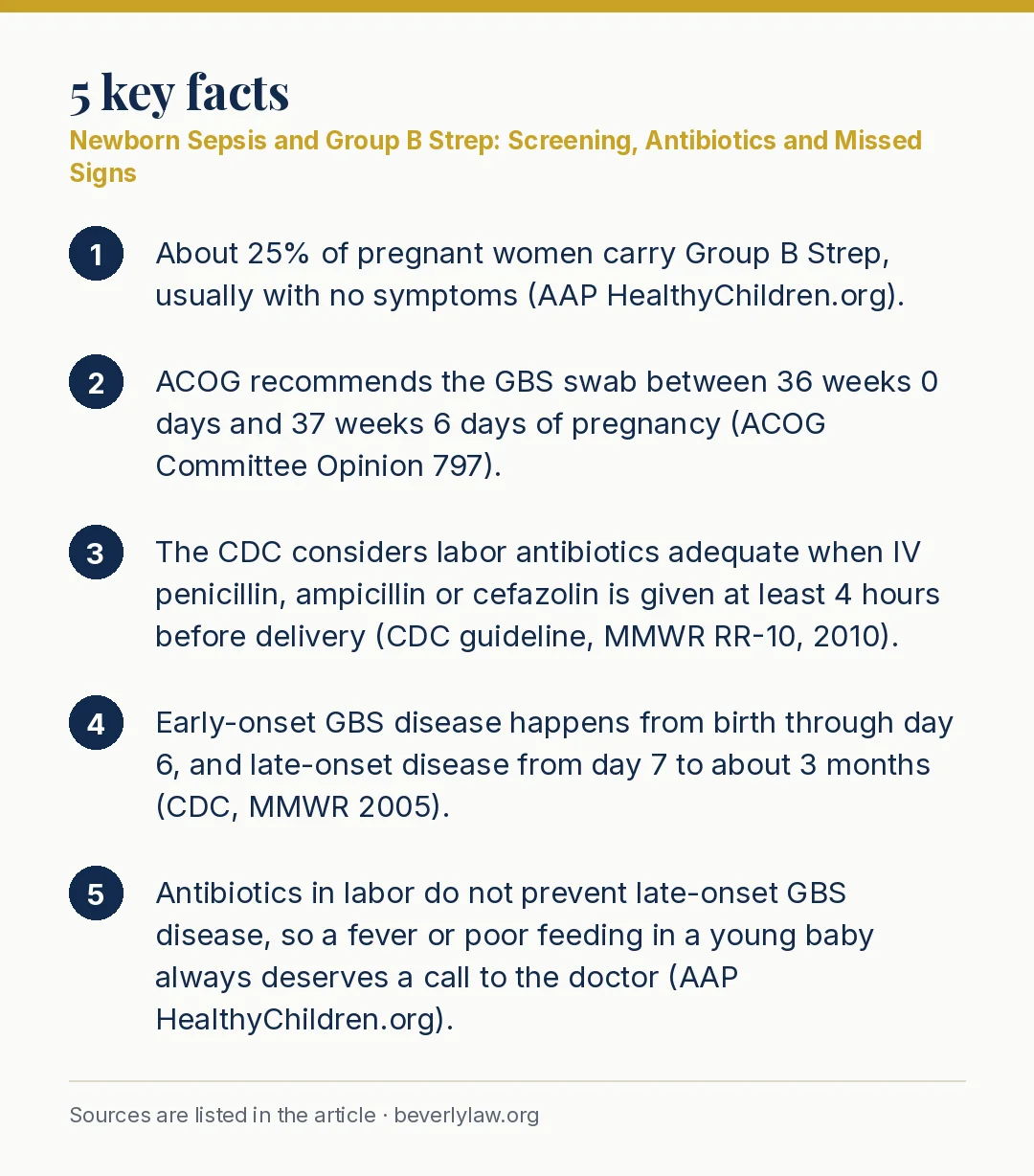
- About 25% of pregnant women carry Group B Strep, usually with no symptoms (AAP HealthyChildren.org).
- ACOG recommends the GBS swab between 36 weeks 0 days and 37 weeks 6 days of pregnancy (ACOG Committee Opinion 797).
- The CDC considers labor antibiotics adequate when IV penicillin, ampicillin or cefazolin is given at least 4 hours before delivery (CDC guideline, MMWR RR-10, 2010).
- Early-onset GBS disease happens from birth through day 6, and late-onset disease from day 7 to about 3 months (CDC, MMWR 2005).
- Antibiotics in labor do not prevent late-onset GBS disease, so a fever or poor feeding in a young baby always deserves a call to the doctor (AAP HealthyChildren.org).
Free birth-injury case review
We review the delivery records with medical experts and tell you honestly whether there is a case. You pay nothing unless we win.
Questions parents ask
If I tested positive for GBS, will my baby get sick?
Most babies of GBS-positive mothers stay healthy, especially when the mother gets IV antibiotics in labor. The AAP notes these antibiotics can often prevent early-onset infection. Your baby will still be watched after birth for signs of illness.
What if my baby is born before the 4 hours of antibiotics are finished?
According to the CDC, less than 4 hours of antibiotics is not counted as adequate for newborn planning. The newborn team may then observe the baby longer or run tests, depending on the baby’s condition and other risk factors. Ask your care team what plan they are following.
Can a baby get GBS infection even if I was tested and treated?
Yes, it is uncommon but possible. Late-onset disease from 7 days to 3 months is not prevented by antibiotics in labor, according to the CDC and AAP. Call your pediatrician right away for fever, poor feeding, trouble breathing or unusual sleepiness.
Sources
CDC
CDC (MMWR)
AAP HealthyChildren.org
ACOG Committee Opinion 797
Group B Strep screening, antibiotics in labor and careful newborn observation work together to protect babies, and most families never face a serious infection. Knowing your test result, when antibiotics started and which warning signs to report can help you speak up for your baby. If your child had a newborn infection and you wonder whether the care and records were appropriate, Beverly Law offers a free case review. It is a conversation to understand your options, and it carries no promises about any outcome.
Ask a question
Not ready to call? Write your question and a member of our team answers you — no cost, no commitment.
Newborn Sepsis and Group B Strep: Screening, Antibiotics and Missed Signs — Beverly Law
Free case review for families in California, Texas and Washington. We obtain the delivery records, have them reviewed by medical experts and deal with the hospital and its insurer — you focus on your child. You pay nothing unless we win.
Related pages
Cerebral Palsy · Erb’s Palsy / Brachial Plexus Injury · HIE / Oxygen Deprivation at Birth · Statute of Limitations · All birth-injury guides · Birth injury news
Important: This page is general information about birth injuries and California law, not legal advice, and reading it does not create an attorney-client relationship with Beverly Law. Every case is different — talk to a lawyer about your own situation. Attorney advertising. Prior results do not guarantee a similar outcome. No fee unless we win. Last reviewed: 2026-09-18.