


Most babies are born without any tools. Sometimes, though, a doctor or midwife uses forceps or a vacuum device to help a baby through the last part of the birth canal. When this is done for the right reason and with the right steps, it can help a baby who needs to be born soon.
These tools also carry known risks for the baby. This article explains, in plain words, when assisted delivery is usually considered, when it is not recommended, which injuries can happen, and what the medical record should show. It is written for parents who have questions about a delivery in California, Texas or Washington.
Was your baby hurt during delivery?
Tell us your name and phone. We call you back today, in English or Spanish, and the consultation is free.
Free consultation · English y Español · No fee unless we win
What forceps and vacuum delivery are
Forceps look like two smooth spoons that are placed around the baby's head. A vacuum device uses a soft or rigid cup that attaches to the top of the baby's head by suction. In both cases the clinician gently pulls during a contraction while the mother pushes.
Both are called operative or assisted vaginal delivery. Research summarized in the medical literature suggests the two tools tend to carry different risks: forceps are more often linked to tears for the mother, while vacuum is more often linked to bruising and bleeding under the baby's scalp.
Clinicians choose between the tools, or choose a cesarean birth instead, based on the baby's position, how far down the head is, the mother's health and the clinician's training. Parents are usually asked to agree to the plan, and the record should show that the risks and benefits were discussed.
When assisted delivery is usually considered
According to a clinical review in American Family Physician, assisted delivery is considered when the pushing stage is prolonged, when the baby's heart rate pattern suggests the baby may be in trouble, or to shorten labor for a mother's health reasons. That review describes a prolonged pushing stage as, for example, more than 3 hours with an epidural for a first-time mother, or more than 2 hours with an epidural for a mother who has given birth before.
The same review lists conditions that should be in place first: the cervix is fully open, the water has broken, the baby is head-first, the head is engaged in the pelvis, and the clinician can tell exactly how the head is positioned.

When it is not recommended, and when to stop
The review lists situations where vacuum is generally not appropriate. These include a baby whose head has not engaged, a baby who may not fit through the pelvis, a face or non-head-first presentation, a baby born before 34 weeks, and a baby with a known bleeding or bone-strength condition.
Vacuum use also has stopping points. According to the same source, use should be halted after three pop-offs, which means the cup slips off the baby's head three times, after more than 20 minutes, or when three pulls in a row make no progress. A single pop-off does not by itself mean a baby was hurt, but repeated pop-offs and repeated pulls are among the details a careful medical record should describe.
These limits are guidance for clinicians, not a promise about any one birth. Whether a particular delivery followed accepted practice is a question for medical experts who review the full chart.
Injuries that can happen
Many effects of assisted delivery are mild and pass on their own, such as marks or bruising on the head. More serious problems are uncommon. The American Family Physician review names subgaleal hematoma and bleeding inside the skull as the most serious vacuum complications, and notes that skull fractures are rare.
A subgaleal hemorrhage is bleeding in the space between a baby's skull and scalp. Cleveland Clinic explains that this space is large, so a baby can lose a lot of blood. It reports that the condition happens about 4 times in 10,000 vaginal births without tools and about 60 times in 10,000 births that use a vacuum. Signs can include a soft swelling on the head that shifts when touched, a fast heart rate, pale skin and trouble breathing.
Symptoms may not show up until hours after birth, which is why newborns are watched closely. Cleveland Clinic says treatment may include blood and fluid support in the NICU, and that more than 75 percent of diagnosed babies do well with early treatment, while 10 to 25 percent of babies with this condition die in early infancy from severe bleeding. Early recognition matters.
What the medical record should show, and time limits
The American Family Physician review says the record should include the reason for the assisted delivery, the baby's head position and station, the number of attempts, how long traction lasted, the discussion of risks and benefits with the mother, the heart rate and contraction tracings, and a description of any injuries to mother or baby. Parents can ask for a copy of their records and the baby's NICU records.
Time limits for a legal claim differ by state and can be short. In California, Code of Civil Procedure section 340.5 sets a general limit of three years from the date of injury or one year from discovery, with a different rule for children under six. In Washington, RCW 4.16.350 uses three years from the act or one year from discovery, with an eight-year outer limit. In Texas, see Civil Practice and Remedies Code chapter 74. Rules for children and for discovery have exceptions, so confirm your own deadline with a lawyer.
This article is general information, not legal or medical advice. Every birth is different, and only a doctor can explain what happened in your baby's care.
Key facts
Read the key facts as text
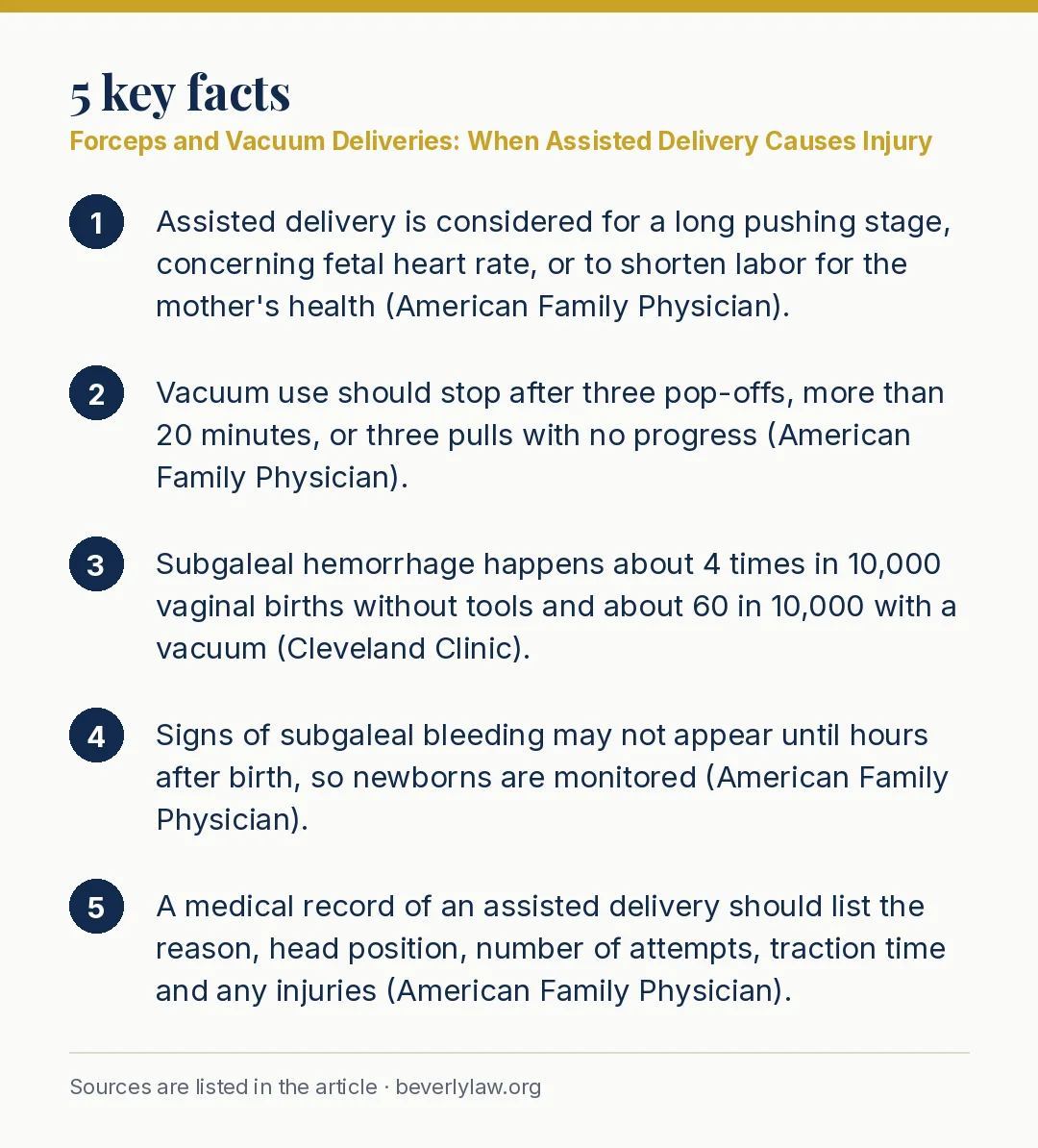
- Assisted delivery is considered for a long pushing stage, concerning fetal heart rate, or to shorten labor for the mother's health (American Family Physician).
- Vacuum use should stop after three pop-offs, more than 20 minutes, or three pulls with no progress (American Family Physician).
- Subgaleal hemorrhage happens about 4 times in 10,000 vaginal births without tools and about 60 in 10,000 with a vacuum (Cleveland Clinic).
- Signs of subgaleal bleeding may not appear until hours after birth, so newborns are monitored (American Family Physician).
- A medical record of an assisted delivery should list the reason, head position, number of attempts, traction time and any injuries (American Family Physician).
Free birth-injury case review
We review the delivery records with medical experts and tell you honestly whether there is a case. You pay nothing unless we win.
Questions parents ask
Does a vacuum mark on my baby’s head mean something is wrong?
Not always. Swelling or bruising on the head is common after assisted delivery and often fades. Tell the care team if the head swelling grows, feels soft and shifts, or if your baby is pale, breathing fast or hard to wake, and ask what is being monitored.
What is a pop-off?
A pop-off is when the vacuum cup comes off the baby’s head during a pull. According to American Family Physician, vacuum use should stop after three of them. One pop-off alone does not prove an injury, but the number should be written in the record.
How can I get the records of my baby’s birth?
You can ask the hospital’s medical records office in writing for the labor and delivery chart and the newborn or NICU chart. A doctor can help you read them, and a lawyer can review them in a free case review.
Sources
American Family Physician (AAFP): Vacuum-Assisted Vaginal Delivery
Cleveland Clinic: Subgaleal Hemorrhage
California Code of Civil Procedure section 340.5
Washington RCW 4.16.350
Texas Civil Practice and Remedies Code, Chapter 74
Forceps and vacuum can help a baby who needs to be born soon, and most assisted births go without serious harm. When a baby is hurt, the details matter: why the tool was used, how many attempts, and how the newborn was watched afterward. If you have questions about your baby's delivery, gather the records and talk with your pediatrician. Beverly Law also offers a free case review, with no promises about any outcome.
Ask a question
Not ready to call? Write your question and a member of our team answers you — no cost, no commitment.
Forceps and Vacuum Deliveries: When Assisted Delivery Causes Injury — Beverly Law
Free case review for families in California, Texas and Washington. We obtain the delivery records, have them reviewed by medical experts and deal with the hospital and its insurer — you focus on your child. You pay nothing unless we win.
Related pages
Cerebral Palsy · Erb’s Palsy / Brachial Plexus Injury · HIE / Oxygen Deprivation at Birth · Statute of Limitations · All birth-injury guides · Birth injury news
Important: This page is general information about birth injuries and California law, not legal advice, and reading it does not create an attorney-client relationship with Beverly Law. Every case is different — talk to a lawyer about your own situation. Attorney advertising. Prior results do not guarantee a similar outcome. No fee unless we win. Last reviewed: 2026-09-18.