
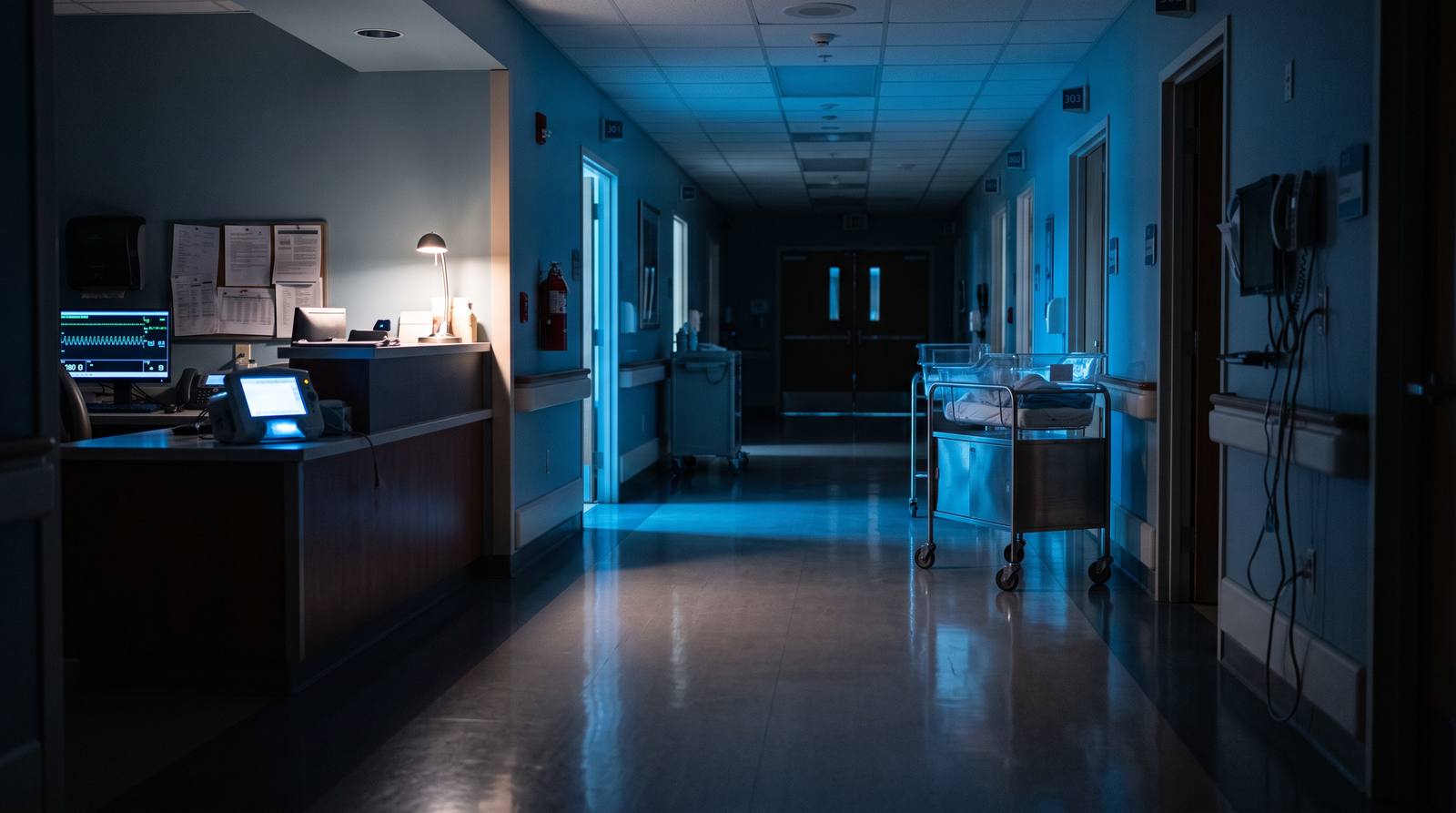

When a baby is hurt around the time of birth, parents often have two questions at once: how do we care for our child, and is there anything we can do about what happened? This guide explains, in plain words, how a birth injury claim usually works in California. It is meant to help you understand the steps, not to tell you what to do.
Most newborns do well. According to Cleveland Clinic, birth injuries are uncommon and usually minor, and many heal with little or no care. When an injury is serious, though, California law has special rules about deadlines, notice, and limits on certain damages. Knowing them early can keep your options open.
Was your baby hurt during delivery?
Tell us your name and phone. We call you back today, in English or Spanish, and the consultation is free.
Free consultation · English y Español · No fee unless we win
Step 1: Get your child the care they need
The first priority is your child's health. Cleveland Clinic describes birth injuries as ranging from scalp bruising and broken collarbones to nerve damage and brain injuries. Most of the common ones heal well, but some need ongoing care from specialists. Follow your child's medical team's advice and keep every appointment.
At the same time, it can help to ask the hospital for a copy of the mother's and the baby's medical records. These records show what happened during labor, delivery, and the first days of life, and they are the starting point for any later review. Writing down your own notes while memories are fresh can also be useful.
Step 2: Know the deadlines
California gives a child's birth injury case its own deadline. Under Code of Civil Procedure § 340.5, a minor must sue within three years of the wrongful act, but a child who was under six when it happened has until their eighth birthday if that is longer. For a baby hurt during labor or delivery, that usually means the eighth birthday. The clock runs from the act itself, not from the day the family learned what went wrong, and it is paused only in narrow cases of fraud or collusion.
Parents' own claims, such as medical bills they paid, can have much shorter deadlines. The California Courts self-help site notes that, for adults, the general rule is the earlier of one year after discovering the injury or three years after the injury itself. Because a parent's claim and a child's claim are different, it is safer to get advice early rather than wait for the eighth birthday.
Claims against a public hospital have a much shorter first step. Many California babies are born at county or University of California hospitals, which are public entities covered by the Government Claims Act. Under Government Code § 911.2, a written claim for injury must be presented to the public entity within six months of the injury, before any lawsuit. If the claim is rejected in writing, Government Code § 945.6 gives a limited time to file in court, and that time is also short. A lawyer can check which rules apply to the hospital involved.
Step 3: The 90-day notice before filing
Before a lawsuit against a private health care provider can be filed, California Code of Civil Procedure § 364 requires that the provider receive at least 90 days' notice of the intention to sue. The California Courts self-help site explains that the notice must state the legal basis for the claim, the injuries, and the losses. No court form is required, but the notice must be delivered correctly.
The notice also interacts with deadlines. Under § 364, if the notice is served close to the time limit, the deadline is extended so that the provider has the full 90 days. The notice is often a time when the two sides can begin to talk, and in some cases, a claim is resolved without a lawsuit.
Step 4: Expert review
Birth injury claims are medical malpractice claims, so they usually depend on expert opinions. The California Courts self-help site explains that a claimant generally needs an expert witness to explain the standard of care, show how the provider fell short of it, and connect that failure to the injury. Expert fees can be significant and are recoverable only in limited situations.
In practice, this stage often involves a careful review of the full chart, fetal monitoring records, and the child's later medical records by qualified doctors. Not every bad outcome means a mistake was made. Many injuries happen even when care was appropriate, and an honest expert review can tell a family that, too.
Step 5: MICRA caps and the usual timeline
California's Medical Injury Compensation Reform Act, in Civil Code § 3333.2, limits noneconomic damages, such as pain and suffering, in health care malpractice cases. It does not limit economic damages, such as medical care costs. A 2022 law (AB 35) raised the old $250,000 limit. According to the Governor's office, in cases not involving wrongful death, the cap starts at $350,000 and rises by $40,000 each year until it reaches $750,000. In wrongful death cases, it starts at $500,000 and rises by $50,000 each year until it reaches $1 million.
Following that schedule from January 1, 2023, the amounts for 2026 work out to about $470,000 for cases without a death and about $650,000 for wrongful death cases. Please confirm the current figure with the statute or a lawyer, since it is a calculation from the published schedule.
Timelines vary. A typical path is: medical records and expert review, then notice, then filing, an exchange of information, depositions, mediation, and sometimes trial. Cases may take a few years or more, and a child's case that involves a settlement usually needs court approval to protect the child. No one can promise an outcome or a date.
Key facts
Read the key facts as text
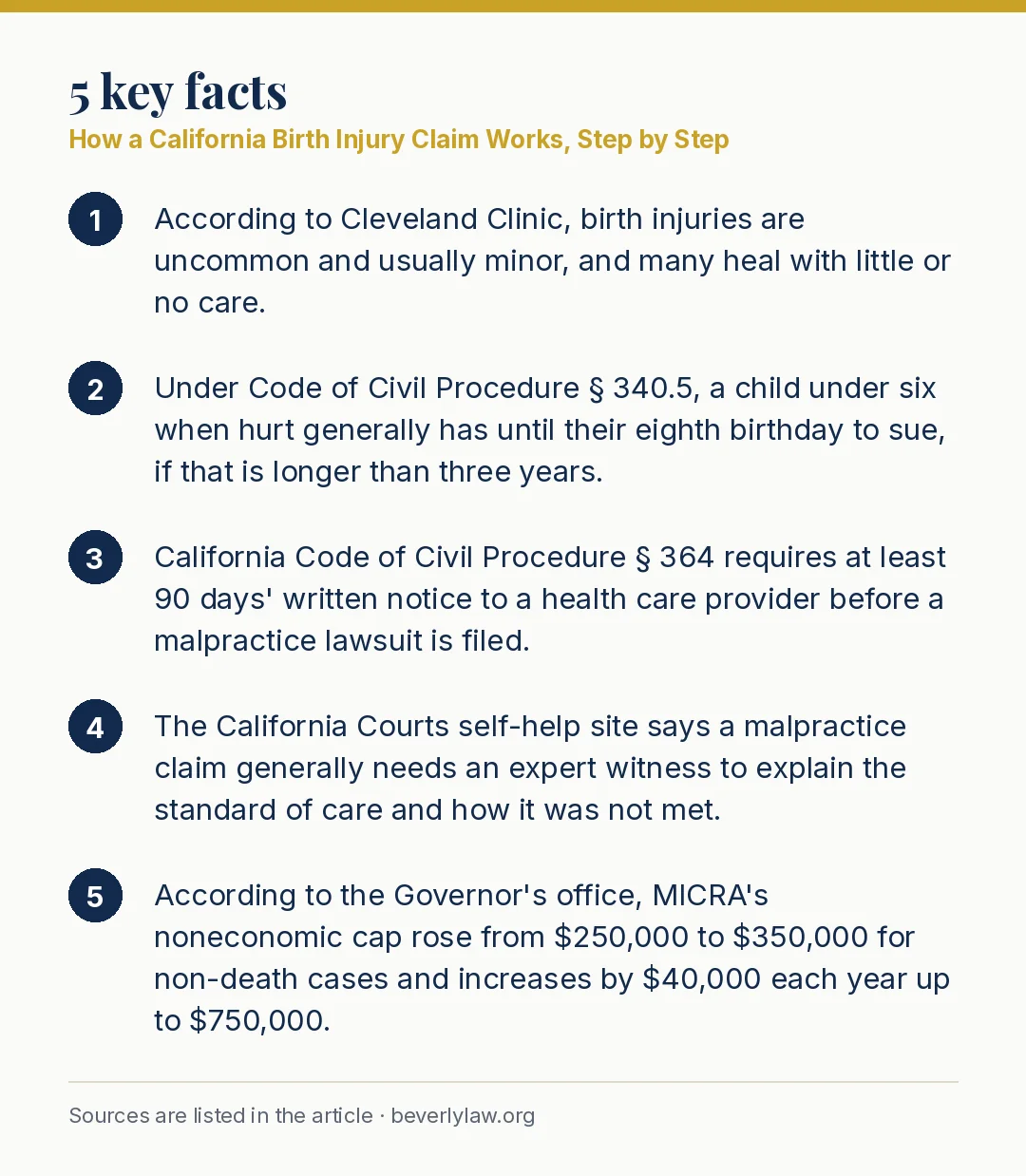
- According to Cleveland Clinic, birth injuries are uncommon and usually minor, and many heal with little or no care.
- Under Code of Civil Procedure § 340.5, a child under six when hurt generally has until their eighth birthday to sue, if that is longer than three years.
- California Code of Civil Procedure § 364 requires at least 90 days' written notice to a health care provider before a malpractice lawsuit is filed.
- The California Courts self-help site says a malpractice claim generally needs an expert witness to explain the standard of care and how it was not met.
- According to the Governor's office, MICRA's noneconomic cap rose from $250,000 to $350,000 for non-death cases and increases by $40,000 each year up to $750,000.
What California law says
California gives a child’s birth-injury case its own deadline. Under Code of Civil Procedure § 340.5, a minor must sue within three years of the wrongful act, but a child who was under six when it happened has until his or her eighth birthday if that is longer. For a baby hurt during labor or delivery, that usually means the eighth birthday. The clock runs from the act itself, not from the day the family learned what went wrong, and it is paused only in narrow cases of fraud or collusion. Parents’ own claims, and claims against a public hospital, can have much shorter deadlines, so it is safer to get advice early.
California’s MICRA law limits one part of a medical malpractice recovery. Under Civil Code § 3333.2, as amended by AB 35, non-economic damages (pain, suffering, loss of enjoyment of life) are capped. In 2026 the cap is $470,000 for injury and $650,000 for wrongful death, and it rises every January 1 ($40,000 and $50,000 a year until 2033, then 2% a year). Separate caps can apply to doctors, hospitals and unaffiliated providers. Economic damages are not capped: lifetime medical care, therapy, equipment, home modifications and lost earning capacity can be recovered in full, and in a birth-injury case they are usually the largest part of the claim.
Free birth-injury case review
We review the delivery records with medical experts and tell you honestly whether there is a case. You pay nothing unless we win.
Questions parents ask
Do I have to wait until my child is older to act?
No, and waiting can carry risks. The child’s deadline under § 340.5 is usually the eighth birthday, but parents’ own claims and claims against public hospitals can have much shorter deadlines, and records and memories fade over time. Getting advice early keeps your options open.
Does the MICRA cap limit all of the money in a case?
No. Under Civil Code § 3333.2, the cap applies to noneconomic damages, such as pain and suffering. It does not limit economic damages such as medical care costs. A lawyer can explain how it may apply to a specific situation.
Does every birth injury lead to a lawsuit?
No. Many birth injuries heal on their own and happen without any mistake. A claim is usually considered only when an injury is serious and an expert review suggests the care fell below the accepted standard. Many families simply want to understand what happened.
Sources
California Courts Self-Help: Suing a healthcare provider
California Legislative Information: Code of Civil Procedure § 364
Office of the Governor of California: 2022 MICRA legislation
Cleveland Clinic: Birth Injuries
A California birth injury claim usually moves in a clear order: care for your child, collect records, watch the deadlines, send the 90-day notice, get an expert review, and then move through a process that can take years. The child's deadline is often longer than the parents' own, and public hospitals have a six-month first step, so early advice matters. This article is general information, not legal or medical advice. If you would like to talk through your situation, you are welcome to request a free case review with Beverly Law, with no promise of any result.
Ask a question
Not ready to call? Write your question and a member of our team answers you — no cost, no commitment.
How a California Birth Injury Claim Works, Step by Step — Beverly Law
Free case review for families in California. We obtain the delivery records, have them reviewed by medical experts and deal with the hospital and its insurer — you focus on your child. You pay nothing unless we win.
Related pages
Cerebral Palsy · Erb’s Palsy / Brachial Plexus Injury · HIE / Oxygen Deprivation at Birth · Statute of Limitations · All birth-injury guides · Birth injury news
Important: This page is general information about birth injuries and California law, not legal advice, and reading it does not create an attorney-client relationship with Beverly Law. Every case is different — talk to a lawyer about your own situation. Attorney advertising. Prior results do not guarantee a similar outcome. No fee unless we win. Last reviewed: 2026-09-18.