


Most births go smoothly, but sometimes the baby's head comes out and the shoulders do not follow right away. This is called shoulder dystocia. It is an emergency that the delivery team is trained to handle, and it is one of the topics parents ask about most when a baby is born with an arm injury.
This article explains, in plain words, what shoulder dystocia is, who may be more likely to have it, the steps a delivery team usually follows, what should be written in the medical chart, and what can happen when too much force is used. We focus on general medical information that applies to families in California, Texas and Washington.

Was your baby hurt during delivery?
Tell us your name and phone. We call you back today, in English or Spanish, and the consultation is free.
Free consultation · English y Español · No fee unless we win
What shoulder dystocia is
According to Cleveland Clinic, shoulder dystocia happens when one or both of the baby's shoulders get stuck inside the mother's pelvis during childbirth. A medical review describes it as the front shoulder becoming wedged behind the pubic bone after the head is born, so that gentle traction does not deliver the body.
It is not common. One review reports that it occurs in roughly 0.15% to 1.7% of deliveries, and that the chance rises as the baby's weight goes up. Because the definition and the record-keeping differ from hospital to hospital, exact rates vary.
Once the head is delivered, the umbilical cord can be compressed while the body is still inside. For that reason the team has to work calmly but without wasting time, and a written record of the order and timing of each step matters.
Risk factors, and why it is hard to predict
Cleveland Clinic and a clinical review list several factors linked to shoulder dystocia: a very large baby (macrosomia), diabetes in the mother (including gestational diabetes), a high body mass index or a lot of weight gain in pregnancy, a previous shoulder dystocia, a long second stage of labor, and delivery assisted by vacuum or forceps. Delivery past the due date and short maternal stature are also mentioned.
Having a risk factor does not mean the problem will happen. A review in PubMed Central notes that ultrasound weight estimates are not good predictors, and that about half of shoulder dystocia events occur in babies who weigh less than 4,000 grams. Cleveland Clinic says true prevention is not possible, although managing diabetes and discussing options such as induction or cesarean birth with your provider may lower risk in some situations.
Parents can ask their provider how the baby's size is being estimated, whether diabetes is under control, and what the plan will be if the shoulders are slow to deliver.

The HELPERR steps
Many hospitals teach a memory aid called HELPERR. The letters stand for: Help (call for additional staff, such as extra nurses, an anesthesia provider and a neonatal team); Evaluate for episiotomy (a cut that can make more room for the provider's hand); Legs (the McRoberts position, bringing the mother's knees toward her chest); Pressure above the pubic bone (suprapubic pressure); Enter (internal rotation maneuvers inside the vagina); Remove the posterior arm (delivering the baby's rear arm); and Roll the patient onto hands and knees.
The sources we reviewed list the steps slightly differently. One clinical review, for example, describes the final letters as a roll into hands-and-knees position and a last resort to extreme measures if the earlier steps do not work. The order may be adjusted to fit the situation, and the team is expected to use the maneuvers that fit the mother and the baby.
One point repeated in the medical literature is that the team should not rush in a way that adds force. A review in PubMed Central states that taking several minutes to deliver the baby rarely causes significant harm, and advises against applying traction to the baby's head.
What should be in the medical chart
A clear record helps the family understand what happened and helps the next care team plan for future pregnancies. A review in PubMed Central recommends recording the time intervals, the maneuvers that were performed and in what order, the people who were present, and the condition of the newborn.
In practice, parents and their advisers often look for: the time the head was delivered and the time the body was delivered; who was called and when they arrived; which maneuvers were tried and which one worked; which side the stuck shoulder was on; the baby's weight and condition at birth, including any arm movement concerns; and any injury to the mother.
Charts are different in every hospital, and a missing item does not by itself mean that care was poor. You have the right to ask for a copy of your records and your baby's records, and a clinician can walk you through what the notes mean. Rules and fees for requesting records differ between California, Texas and Washington, so ask the hospital's medical records office how to start.
What excessive traction can cause
The main concern after shoulder dystocia is injury to the brachial plexus, the group of nerves that run from the neck into the shoulder, arm and hand. One review says this injury occurs in about 1% to 20% of shoulder dystocia cases. It is often temporary and recovers over hours to months, and it is permanent in about 3% to 10% of cases. Cleveland Clinic reports that by 18 months about 82% of babies are functioning completely.
Medical reviews identify pulling sideways on the baby's head, away from the shoulder, as the main way the nerves can be stretched when the shoulders are stuck. Brachial plexus injuries can also occur without any shoulder dystocia, including in cesarean births or from forces before birth, so an injury alone does not show what caused it.
Other possible effects on the baby include a broken collarbone, reduced oxygen if the delivery takes a long time, and, rarely, death. For the mother, risks include heavy bleeding after birth and severe tears. Signs a parent may notice include an arm that is held limp or does not move equally on both sides. If you see this, ask the baby's doctor about an evaluation and early therapy.
Key facts
Read the key facts as text
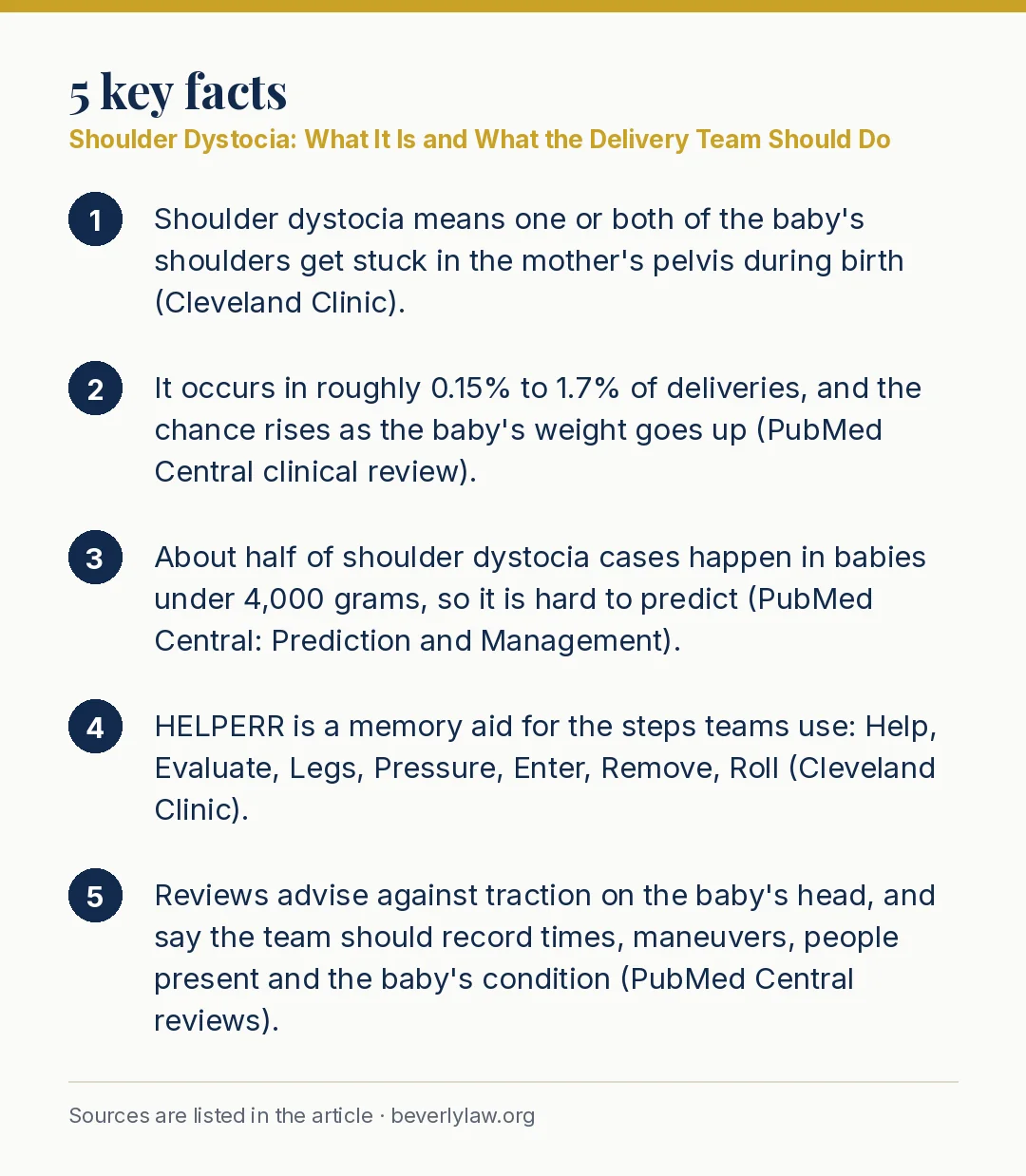
- Shoulder dystocia means one or both of the baby's shoulders get stuck in the mother's pelvis during birth (Cleveland Clinic).
- It occurs in roughly 0.15% to 1.7% of deliveries, and the chance rises as the baby's weight goes up (PubMed Central clinical review).
- About half of shoulder dystocia cases happen in babies under 4,000 grams, so it is hard to predict (PubMed Central: Prediction and Management).
- HELPERR is a memory aid for the steps teams use: Help, Evaluate, Legs, Pressure, Enter, Remove, Roll (Cleveland Clinic).
- Reviews advise against traction on the baby's head, and say the team should record times, maneuvers, people present and the baby's condition (PubMed Central reviews).
Free birth-injury case review
We review the delivery records with medical experts and tell you honestly whether there is a case. You pay nothing unless we win.
Questions parents ask
Can shoulder dystocia be prevented?
Not completely. Cleveland Clinic says true prevention is not possible, and a PubMed Central review notes that about half of cases occur in babies under 4,000 grams. Managing diabetes, discussing induction or cesarean birth with your provider when there are risk factors, and delivering in a place prepared for emergencies may help reduce risk.
Does my baby’s arm injury mean someone made a mistake?
Not necessarily. Brachial plexus injuries can happen with shoulder dystocia even when the team follows every step, and they can also occur without it. Many recover over time, and early therapy is often recommended. Whether care met the standard depends on the specific facts and records.
How can I get my delivery records?
Contact the hospital’s medical records office and ask for the labor and delivery chart, including nursing notes, and the newborn chart. Ask for the full record, not a summary. The process and fees differ by state and by hospital, so ask the office what they require.
Sources
Cleveland Clinic
PubMed Central (NIH): Shoulder Dystocia: Prediction and Management
PubMed Central (NIH): Shoulder Dystocia: A Comprehensive Literature Review
Shoulder dystocia is a rare but serious delivery emergency that trained teams handle with a set of steps, careful timing and a clear written record. Reviews advise against pulling on the baby's head, and most brachial plexus injuries improve, though some are lasting. If your baby had an arm or nerve injury after a difficult delivery, ask for your records and your baby's medical follow-up. If you would like help understanding what happened, you are welcome to request a free case review with Beverly Law; this article is general information only and is not legal or medical advice.
Ask a question
Not ready to call? Write your question and a member of our team answers you — no cost, no commitment.
Shoulder Dystocia: What It Is and What the Delivery Team Should Do — Beverly Law
Free case review for families in California, Texas and Washington. We obtain the delivery records, have them reviewed by medical experts and deal with the hospital and its insurer — you focus on your child. You pay nothing unless we win.
Related pages
Cerebral Palsy · Erb’s Palsy / Brachial Plexus Injury · HIE / Oxygen Deprivation at Birth · Statute of Limitations · All birth-injury guides · Birth injury news
Important: This page is general information about birth injuries and California law, not legal advice, and reading it does not create an attorney-client relationship with Beverly Law. Every case is different — talk to a lawyer about your own situation. Attorney advertising. Prior results do not guarantee a similar outcome. No fee unless we win. Last reviewed: 2026-09-18.