


If your newborn is not moving one arm the way the other one moves, it is natural to feel worried and to have many questions. Erb’s palsy, also called neonatal or obstetric brachial plexus palsy, is a condition in which the nerves that control the shoulder and arm were stretched or injured around the time of birth.
The good news is that many babies improve, and the first weeks and months give doctors important clues about what to expect. This guide explains, in plain words, how the nerves work, how shoulder dystocia is connected, what recovery may look like, what therapy involves and when specialists may talk about surgery.
Was your baby hurt during delivery?
Tell us your name and phone. We call you back today, in English or Spanish, and the consultation is free.
Free consultation · English y Español · No fee unless we win
The brachial plexus in plain words
The brachial plexus is a network of nerves that starts at the spinal cord in the neck and runs through the shoulder into the arm. Think of it as a bundle of electrical cables: they carry messages from the brain that tell the shoulder, elbow, wrist and fingers to move, and they carry feelings such as touch back to the brain.
Erb’s palsy usually refers to injury to the upper part of this network. According to MedlinePlus, a baby with a brachial plexus injury may show no movement in the upper or lower arm or hand, or an absent Moro (startle) reflex on the affected side. The arm may lie straight and close to the body.
Not every injury is the same. Nerves can be stretched but still connected, which often heals on its own, or they can be torn or pulled away from the spinal cord, which is more serious. A specialist team works out which situation a baby is in over time.
Shoulder dystocia and other risk factors
Shoulder dystocia happens when a baby’s head has been born but a shoulder gets stuck behind the mother’s pelvic bone. Because the head and neck may be pulled to one side while the shoulders pass, the nerves can stretch. MedlinePlus lists shoulder dystocia, breech delivery, maternal obesity and larger babies among the risk factors.
A review in the National Library of Medicine’s PubMed Central reported that about 63% of the cases it examined involved shoulder dystocia, while 47% did not involve shoulder dystocia or downward traction. The same review notes that these injuries are largely unpredictable. In other words, an injury can occur with or without a difficult delivery, and a diagnosis alone does not tell a family why it happened.
If you want to understand what happened in your baby’s birth, you can ask the hospital for a copy of the delivery and newborn records. Those records are a common starting point for any medical or legal question.

Recovery: what the first months may look like
Many babies improve quickly. MedlinePlus states that most babies fully recover within 3 to 4 months, and that babies who have not recovered in that window have a poorer outlook for full recovery. The PubMed Central review also explains that early improvement is a strong sign of a good result.
That review adds an important caution: long-term studies suggest fewer children recover completely than older estimates of “90%” implied, and some children keep lasting weakness. This is why doctors follow progress closely instead of simply waiting.
Every baby is different. A pediatrician, neurologist or brachial plexus team can measure movement at regular visits, such as bending the elbow, lifting the arm or opening the hand, and compare it to earlier visits.
Physical and occupational therapy
For mild cases, MedlinePlus says the provider may suggest gentle massage of the arm and range-of-motion exercises, and that pediatric physical therapists can teach these. The goal is to keep the joints loose and the muscles active while the nerves heal.
Therapists usually teach parents simple routines to do at home, such as careful positioning, stretching the shoulder and encouraging the baby to reach and play with the weaker arm. A therapist can show you what is safe, because pulling or forcing the arm is not recommended.
Therapy does not replace medical follow-up. If progress stalls, the therapist can tell your baby’s doctor, which may lead to a referral to a specialist team.
When surgery is considered: the 3- and 6-month checkpoints
MedlinePlus says surgery may be considered if strength does not improve by 3 to 9 months of age. Surgery on the nerves can include nerve grafts or nerve transfers, and healing afterward takes time. The PubMed Central review describes the best decision point as around 3 to 4 months, using standard movement assessments, and says that a baby who has not improved by about one month should be seen by a multidisciplinary team.
A systematic review of surgical timing, also in PubMed Central, looked at 256 patients from 25 studies. It found that nerve surgery before 6 months of age was linked to better hand-to-mouth movement, while other measures such as elbow bending and shoulder lifting did not show the same link. The authors do not claim that one date fits every child.
Practical red flags to bring to your doctor: little or no elbow bending or arm lifting at around 3 months, or continued weakness at around 6 months. These are reasons to ask for a referral, not reasons to assume the worst, because the specialists decide together with you.
Key facts
Read the key facts as text
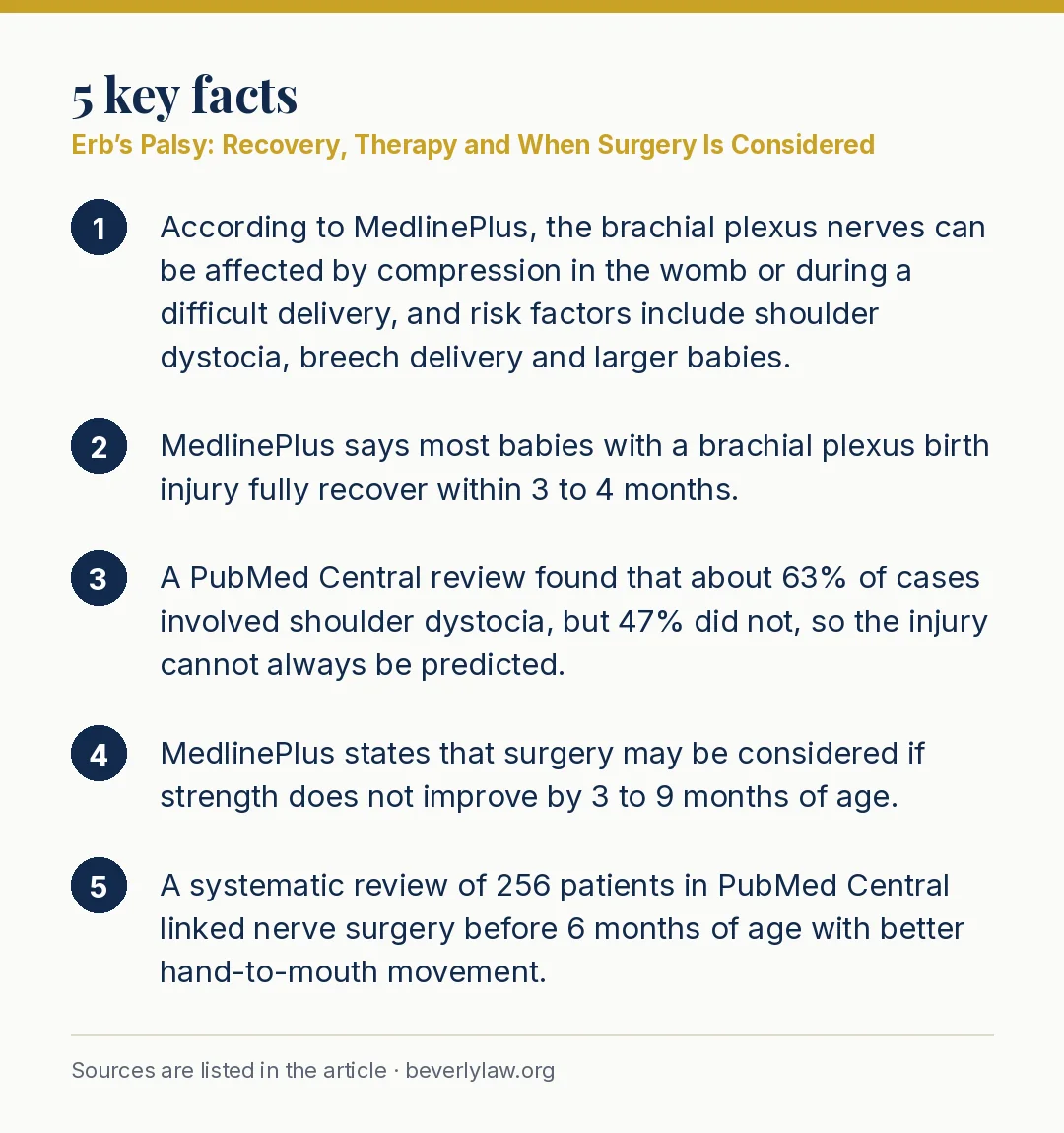
- According to MedlinePlus, the brachial plexus nerves can be affected by compression in the womb or during a difficult delivery, and risk factors include shoulder dystocia, breech delivery and larger babies.
- MedlinePlus says most babies with a brachial plexus birth injury fully recover within 3 to 4 months.
- A PubMed Central review found that about 63% of cases involved shoulder dystocia, but 47% did not, so the injury cannot always be predicted.
- MedlinePlus states that surgery may be considered if strength does not improve by 3 to 9 months of age.
- A systematic review of 256 patients in PubMed Central linked nerve surgery before 6 months of age with better hand-to-mouth movement.
Free birth-injury case review
We review the delivery records with medical experts and tell you honestly whether there is a case. You pay nothing unless we win.
Questions parents ask
Will my baby’s arm fully recover?
Many babies do. MedlinePlus says most recover within 3 to 4 months, and early improvement is a good sign. Some children keep lasting weakness, so regular check-ups with a pediatrician or brachial plexus team are important.
Is it safe to move my baby’s arm at home?
Gentle massage and range-of-motion exercises are commonly recommended, and pediatric physical therapists can teach them. Ask the therapist to show you the right technique, and do not force or pull the arm.
Does every baby with Erb’s palsy need surgery?
No. Many babies improve with time and therapy. Surgery may be considered when strength does not improve, and MedlinePlus gives a window of 3 to 9 months. A specialist team decides based on your baby’s own movement tests.
Sources
MedlinePlus (National Library of Medicine, NIH)
Perinatal brachial plexus palsy, PubMed Central (NIH)
Surgical timing in neonatal brachial plexus palsy: a PRISMA-IPD systematic review, PubMed Central (NIH)
Erb’s palsy is a nerve injury that many babies improve from, but progress in the first 3 to 6 months matters, so keep every follow-up, do the therapy your team recommends and ask for a specialist referral if movement is not improving. This article is general information, not medical or legal advice, and it cannot say what caused your child’s injury or what treatment is right for them. If you would like to understand whether the birth records raise questions, Beverly Law offers a free case review, with no promises about the outcome.
Ask a question
Not ready to call? Write your question and a member of our team answers you — no cost, no commitment.
Erb’s Palsy: Recovery, Therapy and When Surgery Is Considered — Beverly Law
Free case review for families in California, Texas and Washington. We obtain the delivery records, have them reviewed by medical experts and deal with the hospital and its insurer — you focus on your child. You pay nothing unless we win.
Related pages
Cerebral Palsy · Erb’s Palsy / Brachial Plexus Injury · HIE / Oxygen Deprivation at Birth · Statute of Limitations · All birth-injury guides · Birth injury news
Important: This page is general information about birth injuries and California law, not legal advice, and reading it does not create an attorney-client relationship with Beverly Law. Every case is different — talk to a lawyer about your own situation. Attorney advertising. Prior results do not guarantee a similar outcome. No fee unless we win. Last reviewed: 2026-09-18.