

By Michael Shemtoub, Esq., Managing Attorney, Beverly Law
Dealing with an insurance adjuster?
Leave your name and phone. We call back today, in English or Spanish. The consultation is free and confidential.
Free consultation · English y Español · No fees or costs unless we win
Why your own insurer is different
When the other driver’s company asks for records, you owe it nothing under a contract. Your own company stands in a different place. MedPay, PIP and uninsured or underinsured motorist coverage are first-party coverages: you bought them, and the policy is a contract with duties on both sides.
Most auto policies have a section on what you must do after an accident or loss. Read yours. Look for language about cooperating with the company, giving written proof of claim, authorizing the company to obtain medical reports and records, and submitting to examinations by doctors the company picks. What your policy says controls, and wording differs from company to company. If you cannot find your policy, ask your agent or the company for a complete copy in writing.
A flat refusal can give the company an argument that you did not hold up your end. A limited form usually gives the adjuster what it needs and keeps your unrelated history out of the file.
HIPAA still governs the release, not the file
The release of records from your doctors is still controlled by federal rules, because your doctors are covered entities. Under 45 CFR 164.508, the authorization must describe the information specifically, name who releases and who receives it, state its purpose and carry an expiration date or event.
The insurer’s file is another story. Federal law lists automobile medical payment insurance and automobile liability insurance as excepted benefits (42 U.S.C. 300gg-91(c)), and the HIPAA definition of a health plan in 45 CFR 160.103 leaves them out. Your own car insurer is not a HIPAA health plan when it handles these claims, so what it does with records once it has them depends on state law and its own policies.
One more federal detail. The right to revoke an authorization has an exception when the authorization was obtained as a condition of obtaining insurance coverage and other law lets the insurer contest a claim. If your company says you cannot revoke, ask it to identify that law in writing. More on revoking is on how to revoke a medical authorization.
What one insurer’s form asked for
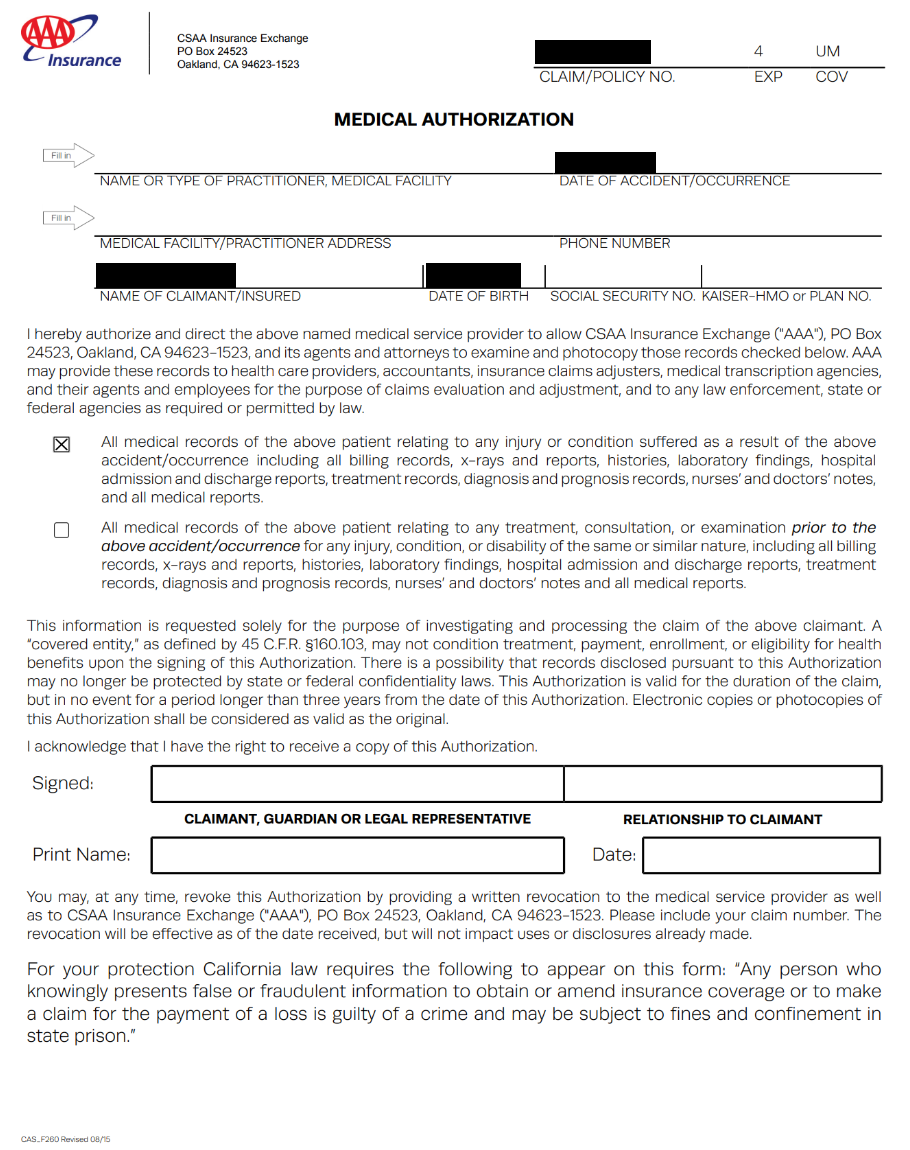
A form AAA sent to our office in 2026 shows what to look for on a first-party authorization. It had two checkboxes. The first, for records of this accident, came already checked. The second covered records from before the accident for any injury or condition of a same or similar nature. That second box is the one to think hard about.
The form also let the company share records with health care providers, accountants, insurance claims adjusters and medical transcription agencies, and with law enforcement and state or federal agencies “as required or permitted by law,” and it warned that released records may lose privacy protection. It ran for the length of the claim, up to three years. If the company also asks for a Medicare number or Social Security number, see the insurance company wants my Social Security number. The AAA form page has the full walk-through.
Free case review
Tell us what happened. We will tell you plainly whether there is a case and what to do next. You owe no fees or costs unless we win.
How to limit the form without refusing it
Write a short letter that says you will cooperate and attach a marked-up form or your own version. On the form:
- Name each provider who treated you for the crash, instead of “all providers.”
- Start the dates on the crash date. If you had earlier care for the same body part, decide with your lawyer whether to add a limited window for that body part only.
- Strike categories that have nothing to do with the injury, such as HIV or mental health records, unless your claim involves that care.
- Write in a specific expiration date.
- Keep a copy of the signed version and the cover letter.
Another route is to send the crash-related records and itemized bills yourself and offer the limited form only if the company says it needs more. Either way, ask the adjuster in writing what it still needs before it can pay. How long the adjuster has to review medical records covers the timing rules, including Texas, where Insurance Code chapter 542 sets prompt-payment deadlines for first-party claims.
Other requests that may come with it
Your own insurer may also ask for a recorded statement, a sworn statement or an exam by a doctor it picks. Each has its own rules and its own page: a recorded statement to my own insurance company and the insurance company wants me to see their doctor, which covers the defense medical exam.
Example only: after a crash with an uninsured driver, a woman makes a claim under her own uninsured motorist coverage. She returns the company’s authorization with her three treating providers named, the crash date as the start date and a one-year end date, and a letter saying she will provide anything else reasonably needed. The facts of each case and the words of each policy decide what is required.
What to do next
Get a full copy of your policy and read the duties section. Mark up the company’s form or send your own limited version with a cooperative cover letter. If you are dealing with both your own insurer and the other driver’s, keep the requests and responses in separate folders. The pages on MedPay and PIP adjusters and the uninsured motorist adjuster go further, and the full series is on our insurance adjuster questions page.
Common questions
Do I have to sign my insurance company's medical authorization?
Your policy likely requires some cooperation with records. You can sign a limited version instead of the blanket form.
Can my insurer deny MedPay or PIP if I refuse?
It may try, depending on the policy and state law. Offering the records or a limited form takes away the simplest argument.
Is this the same as signing for the other driver's insurer?
No. The other driver’s company has no contract with you. Compare on should I sign a medical release for the insurance adjuster.
Should I check the box for prior records?
Only after thinking about what those records show. Leave it unchecked unless you and your lawyer decide a narrow window helps. Texas cases are handled by the firm’s Texas-licensed attorneys, Joyce Ondich and John Efstathiou. You owe no fees or costs unless we win. Call toll-free 1-877-427-2752 (1-877-4-ASAP-LAW), 24/7, from anywhere in the country.
Ask a question
Not ready to call? Write your question and someone on our team will answer. No cost, no commitment.
Injury lawyer — Beverly Law
Hurt because of someone else in California, Texas and Washington? Talk to an injury attorney. Free, confidential, English or Spanish. You owe no fees or costs unless we win.
Related pages
Insurance adjuster questions · Injury law FAQs
Sources
Important: This page is general information, not legal or medical advice, and reading it does not create an attorney-client relationship. Every case is different; talk to a lawyer about yours. Texas cases are handled by the firm’s Texas-licensed attorneys, Joyce Ondich and John Efstathiou. Last reviewed: November 23, 2026.