

By Michael Shemtoub, Esq., Managing Attorney, Beverly Law
Dealing with an insurance adjuster?
Leave your name and phone. We call back today, in English or Spanish. The consultation is free and confidential.
Free consultation · English y Español · No fees or costs unless we win
What the form really is
Adjusters call it a medical authorization, a records release or a HIPAA form. It is a signed permission slip addressed to your doctors, hospitals and pharmacies. Federal privacy rules generally keep those providers from handing your records to an insurer on their own, and your signature removes that barrier. Under 45 CFR 164.508, a valid authorization has to describe the information in a specific way, say who may release it and who may receive it, state a purpose, and carry an expiration date or event along with your signature and the date.
One point surprises most people. HIPAA’s privacy rules apply to health care providers, health plans and clearinghouses (45 CFR 160.103). Federal law lists automobile liability insurance and automobile medical payment insurance as “excepted benefits” (42 U.S.C. 300gg-91(c)), and the HIPAA definition of a health plan leaves excepted benefits out. So once your chart lands in a car insurer’s claim file, HIPAA stops following it. The regulation even requires the form to warn you that released records can be shared again and lose federal protection.
The lines to read before you sign
Take the form to a table with a pen. Look for these items one at a time.
Who may release records. Wording like “any and all providers” or “all persons with knowledge of my medical history” reaches every doctor you have ever seen.
The date range. A form with no start date covers your whole life.
Sensitive records. Mental health, substance use treatment, HIV and reproductive health care are often named on the form. Psychotherapy notes need their own separate authorization under 164.508(a)(2).
Who gets the records next. Some forms let the insurer pass records to its consultants, its lawyers, other insurance companies or fraud databases. The Allstate form page shows one example.
The end date. Every authorization needs one. Many insurer forms choose the end of the claim or a fixed number of years.
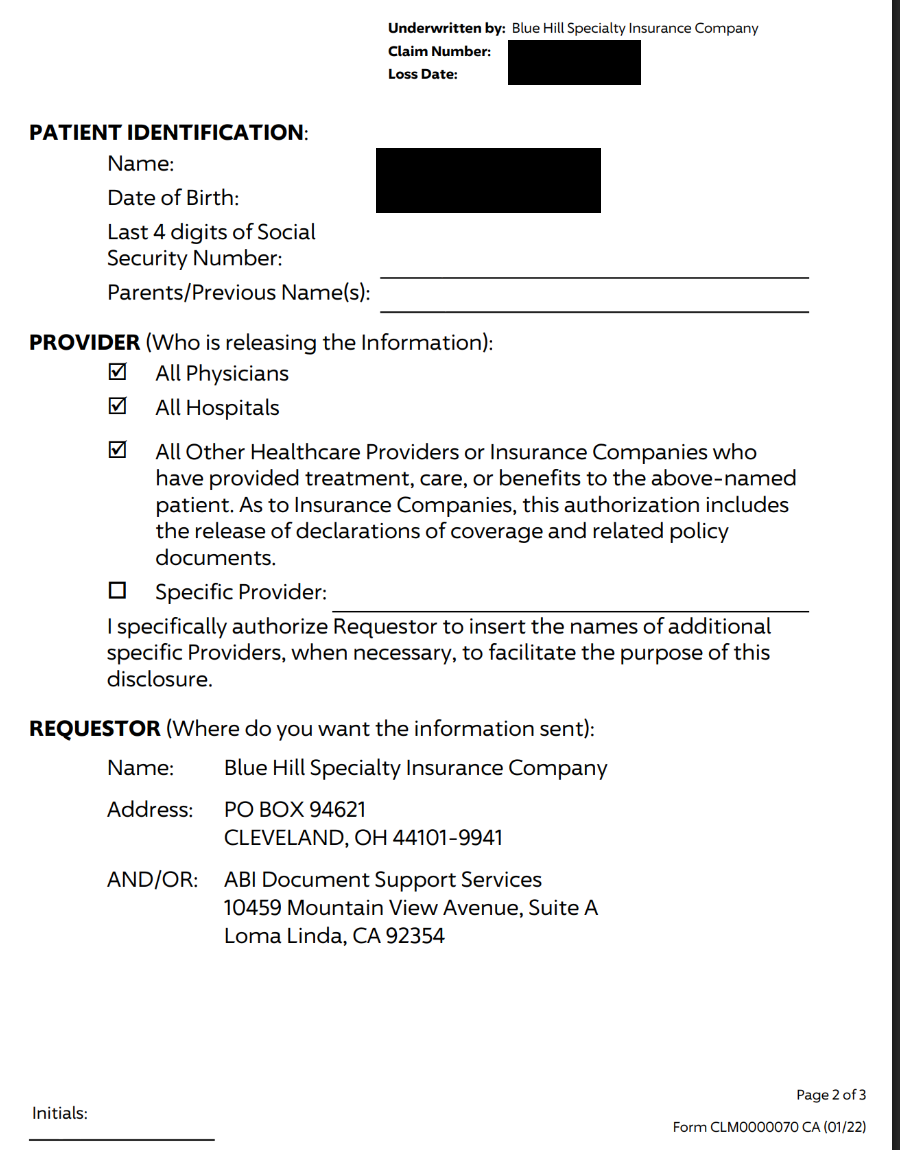
A form that came to our office with a Progressive letter shows how wide these get. Its second page arrived with the boxes for all physicians, all hospitals and all other providers already checked, plus a line letting the company insert more provider names later. Boxes can be unchecked, and you can write in the providers and dates yourself. The Progressive form page walks through each part.
Whose insurer is asking changes the answer
The other driver’s insurer. You never bought that policy, so you owe the company no duties under it. It also has no obligation to pay a claim it cannot document. That makes the real question how you prove the injury, and you can do that without the blanket form.
Your own insurer. On a MedPay, PIP or uninsured motorist claim, you are the policyholder. Policies list your duties after an accident, and many include helping the company get medical records. Read that section before you refuse anything, then ask for a form limited to the crash. The page on your own insurer’s medical authorization covers this, and so does the page on MedPay and PIP adjusters.
After a lawsuit is filed, records move through discovery under court rules, and a judge can settle fights over scope. The page Do I have to sign a medical release? explains that stage.
Free case review
Tell us what happened. We will tell you plainly whether there is a case and what to do next. You owe no fees or costs unless we win.
A narrower way to give the adjuster what it needs
To put a value on an injury, the adjuster needs the records and itemized bills for the care the crash caused. There are two clean ways to supply them.
First, get the records yourself. 45 CFR 164.524 gives you a right to copies of your own records, and HHS explains that providers normally have up to 30 days to respond. You read them first and send only the crash-related visits. The steps are on how to send medical records to the adjuster yourself.
Second, sign a limited authorization. Name each provider who treated you for the crash, start the date range on the crash date, cross out the sensitive categories that have nothing to do with your injury, and write in an end date. The federal rule asks for a specific description of the information. Nothing in it makes you choose the broadest one.
When the adjuster pushes back
The usual line is that the company cannot evaluate your claim without the signed form. Answer in writing. Say you are sending, or have sent, the records and bills for every provider who treated you for the crash, list them by name and date, and ask what else the adjuster needs and why. Keep a copy of the letter.
If the same request keeps coming after you have answered it, the page on insurance adjuster delay tactics may help. If you already signed a broad form, it is not too late to stop future releases. See how to revoke a medical authorization.
What to do next
Hold off on signing the day the form arrives. Find out which company sent it and on which claim. Then decide between sending the records yourself and marking up a narrow form. Before anything goes out, read your own chart the way an adjuster would; what adjusters look for in medical records lists the notes they flag. More answers are on our insurance adjuster questions page.
Common questions
Should you release medical records to an insurance company?
For the injuries you are claiming, yes. An injury claim needs proof. The choice is whether the insurer pulls your records under a broad form or you send the relevant ones.
Should you sign a medical release form at all?
A narrow one can make sense, especially for your own insurer. A blanket form from the other driver’s company rarely helps you.
Will refusing the form slow down my claim?
It can, if you send nothing. Sending the crash-related records and bills yourself takes away the reason for the delay.
What about records from before the crash?
Adjusters often ask for them to argue your pain started earlier. See can the insurance company ask for my medical records.
What is the biggest mistake people make with the paperwork?
One we see often is signing every form in the first envelope without reading the date range or the list of providers. Texas cases are handled by the firm’s Texas-licensed attorneys, Joyce Ondich and John Efstathiou. You owe no fees or costs unless we win. Call toll-free 1-877-427-2752 (1-877-4-ASAP-LAW), 24/7, from anywhere in the country.
Ask a question
Not ready to call? Write your question and someone on our team will answer. No cost, no commitment.
Injury lawyer — Beverly Law
Hurt because of someone else in California, Texas and Washington? Talk to an injury attorney. Free, confidential, English or Spanish. You owe no fees or costs unless we win.
Related pages
Insurance adjuster questions · Injury law FAQs
Sources
- 45 CFR 164.508, Uses and disclosures for which an authorization is required (eCFR)
- 45 CFR 160.103, Definitions of covered entity and health plan (eCFR)
- 42 U.S.C. 300gg-91(c), Excepted benefits (U.S. Code, GovInfo)
- 45 CFR 164.524, Access of individuals to protected health information (eCFR)
- HHS, Your right to access your health information
Important: This page is general information, not legal or medical advice, and reading it does not create an attorney-client relationship. Every case is different; talk to a lawyer about yours. Texas cases are handled by the firm’s Texas-licensed attorneys, Joyce Ondich and John Efstathiou. Last reviewed: November 23, 2026.