

By Michael Shemtoub, Esq., Managing Attorney, Beverly Law
Dealing with an insurance adjuster?
Leave your name and phone. We call back today, in English or Spanish. The consultation is free and confidential.
Free consultation · English y Español · No fees or costs unless we win
Asking and getting are different things
An adjuster can ask for anything. Getting it is another matter. Your doctors and hospitals are covered by HIPAA, and under 45 CFR 164.508(a)(1) they generally may not disclose your health information without a valid authorization, unless another part of the rule allows it. That is why the adjuster sends you a form to sign. The form is the key.
Once a lawsuit is filed, there is a second route. 45 CFR 164.512(e) lets providers release records in response to a court order, or to a subpoena or discovery request when certain notice or protective-order steps are met. Before suit, the adjuster has no subpoena power, so your signature is what opens the door.
Why adjusters reach for older records
The usual goal is to find an earlier complaint about the same body part. If your neck hurt in 2022, the adjuster will argue the pain you report now started then. The page the adjuster says it was a pre-existing condition explains why an old problem does not end a claim when the crash made it worse.
The forms show how far the reach can go. A GEICO packet that one insurer sent to our office in 2026 included an accident injury history in which the person affirms the answers are “true and complete.” Its first page asked about every accident over the person’s lifetime and every medical provider seen in the past five years for any reason.
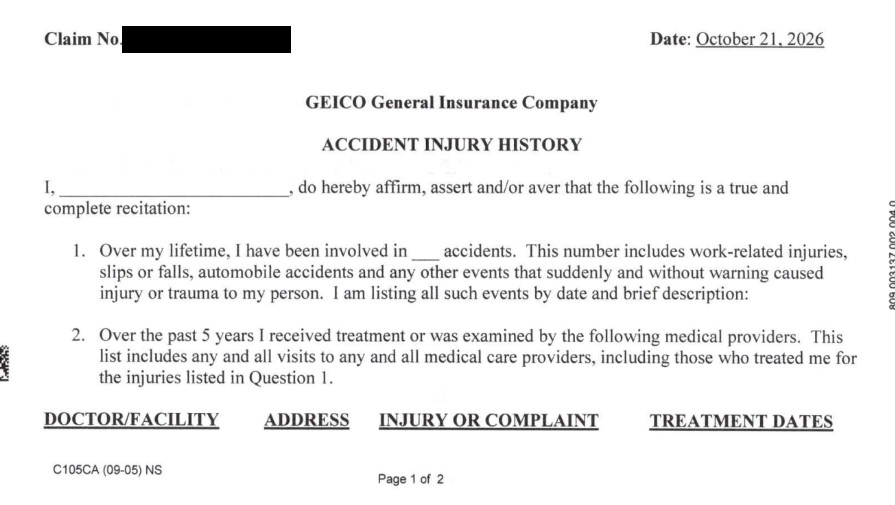
An AAA authorization from the same year had two boxes: one for records of this accident and one for records from before it for any condition “of the same or similar nature.” The second box is the one to watch. See the GEICO form page and the AAA form page.
How far back is reasonable
Before a lawsuit, no federal rule sets a number of years. It is a negotiation. A request focused on the body parts you are claiming is easier to justify than a request for every provider over a decade. If you had treatment for the same area before the crash, expect the adjuster to see it eventually. Hiding it tends to cost more credibility than it saves.
After a lawsuit, court rules decide. In federal court, Rule 26(b)(1) allows discovery of nonprivileged matter relevant to a claim or defense and proportional to the needs of the case. State courts apply their own rules and privacy decisions, and they vary.
Example only: a driver claims a shoulder injury. Three years earlier she saw a doctor once for shoulder strain and then had no care. Those older notes are likely to come up, and the gap of three years without treatment may help her. Her dermatology and dental records have nothing to do with the claim. The facts of each case decide where the line falls.
Free case review
Tell us what happened. We will tell you plainly whether there is a case and what to do next. You owe no fees or costs unless we win.
Your health insurance is a separate track
Your health plan pays your medical bills and already sees diagnosis and billing codes. That plan is a HIPAA covered entity under 45 CFR 160.103, so it is bound by the same authorization rules as your doctors. A car insurer adjusting an injury claim is a different business with a different file. Watch for authorization forms that list “health plans” or “other insurance companies” as sources, since that widens the request beyond your providers.
What to send instead of a blanket authorization
Gather the records and itemized bills from each provider who treated you for the crash, from the first visit forward. Read them. Send them with a dated cover letter that lists every document by provider and date of service. Keep a full copy. The page how to send medical records to the adjuster yourself gives the steps.
If the adjuster still wants an authorization, edit one: name the providers, set the dates, strike unrelated categories and add an end date. Should I sign a medical release for the insurance adjuster shows what to look for.
What to do next
Write down every provider who treated you for the crash and any provider who treated the same body part in the years before. That list tells you what the adjuster will care about. Read those records before anyone else does, using what adjusters look for in medical records as a guide. Other topics are on our insurance adjuster questions page.
Common questions
How far back do insurance companies check medical records?
As far as the form you sign allows. Blanket forms with no start date reach your whole life. A form you edit can start years earlier for the same body part, or on the crash date.
How long does an insurance adjuster have to review medical records?
There is usually no separate clock for reviewing records. See how long the adjuster has to review medical records for the state claim-handling rules that do apply.
Can the insurer get my records without my permission?
Before a lawsuit, it generally needs your signed authorization to get records from your providers. After a lawsuit, subpoenas and court orders become possible.
Do I have to fill out the injury history questionnaire?
It is a request. The GEICO version asks you to affirm that your answers are true and complete, and signed answers can be used later. Many people send the crash records instead and talk to a lawyer before signing a written history. The page do I have to sign a medical release covers the duty question. Texas cases are handled by the firm’s Texas-licensed attorneys, Joyce Ondich and John Efstathiou. You owe no fees or costs unless we win. Call toll-free 1-877-427-2752 (1-877-4-ASAP-LAW), 24/7, from anywhere in the country.
Ask a question
Not ready to call? Write your question and someone on our team will answer. No cost, no commitment.
Injury lawyer — Beverly Law
Hurt because of someone else in California, Texas and Washington? Talk to an injury attorney. Free, confidential, English or Spanish. You owe no fees or costs unless we win.
Related pages
Insurance adjuster questions · Injury law FAQs
Sources
Important: This page is general information, not legal or medical advice, and reading it does not create an attorney-client relationship. Every case is different; talk to a lawyer about yours. Texas cases are handled by the firm’s Texas-licensed attorneys, Joyce Ondich and John Efstathiou. Last reviewed: November 23, 2026.