

By Michael Shemtoub, Esq., Managing Attorney, Beverly Law
Dealing with an insurance adjuster?
Leave your name and phone. We call back today, in English or Spanish. The consultation is free and confidential.
Free consultation · English y Español · No fees or costs unless we win
Where these copies came from
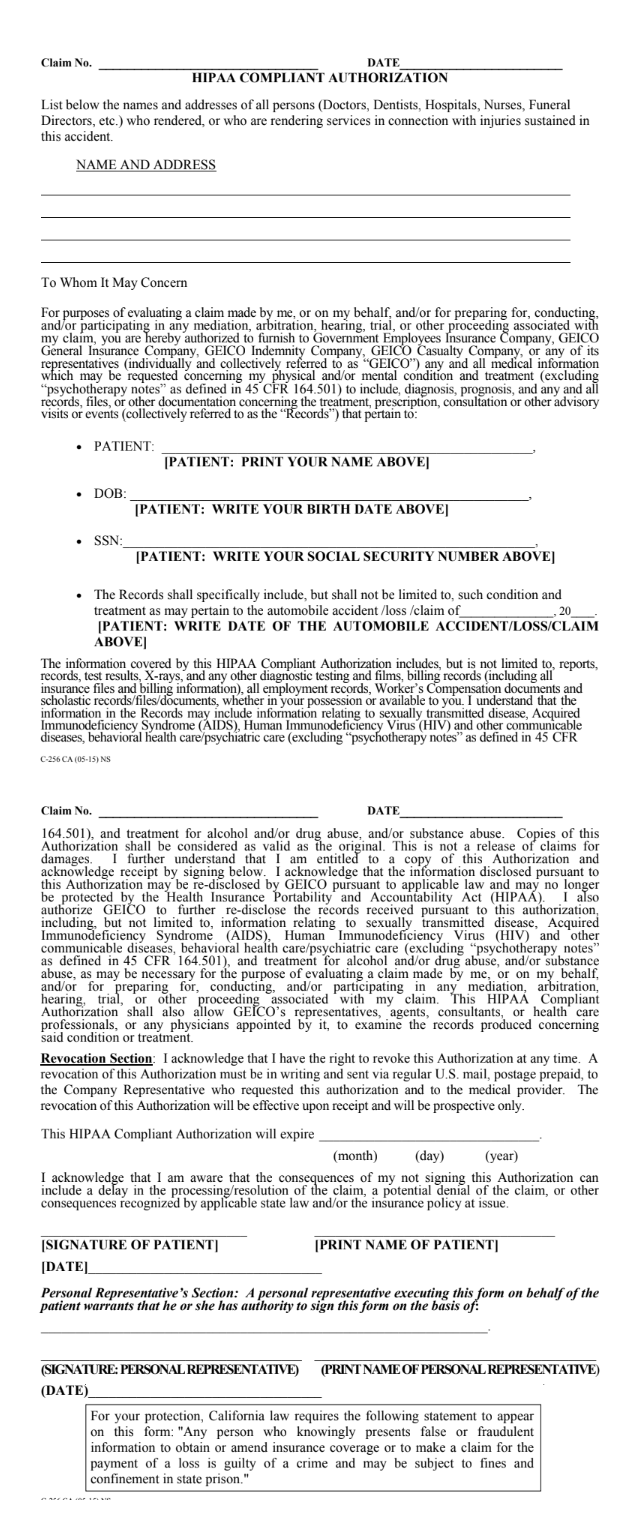
The authorization shown is a blank copy of GEICO’s California version, titled HIPAA Compliant Authorization (C-256 CA, revision 05-15). It is the same form GEICO enclosed in a 2026 letter to our office. The Accident Injury History page further down is a copy sent to our office in 2026, with the claim number blacked out. We describe only what these pages show. Carriers revise their forms and use different versions by state, so read the one in your own envelope.
The clauses that matter, by number
- Who sends records. The top of the form asks you to list everyone who treated you for the accident: doctors, dentists, hospitals, nurses and others. Each name you write becomes a source GEICO can request from.
- How far it reaches. The records “shall specifically include, but shall not be limited to” your accident treatment. The form then lists reports, test results, X-rays and films, billing and insurance files, all employment records, workers’ compensation documents and school records. The accident is the starting point, and nothing in the text stops there.
- Sensitive records are written in. By signing, you acknowledge the records may include sexually transmitted disease, AIDS and HIV, behavioral health and psychiatric care, and alcohol and drug treatment. The only carve-out is psychotherapy notes. Federal rules already require a separate authorization for those notes under 45 CFR 164.508(a)(2), so the exception gives up very little.
- Who reads them, and where they go next. GEICO’s representatives, agents, consultants, health care professionals and physicians it appoints may examine the records. A separate sentence authorizes GEICO to re-disclose them, sensitive categories included. The form itself warns that released records may lose HIPAA protection. HHS says automobile liability and auto medical payment insurance are not HIPAA health plans, so once records reach the insurer, the federal privacy rule no longer follows them.
- Purpose goes past the claim. The records may be used to evaluate the claim and also to prepare for mediation, arbitration, a hearing or a trial. Records gathered under this signature can be used against you if the claim turns into a lawsuit.
- Social Security number. There is a line for it. See why insurers ask for your Social Security number.
- Expiration is blank. You fill in a month, day and year. Federal rules require a valid authorization to state an expiration date or event (45 CFR 164.508(c)(1)(v)). Write a short one.
- Revoking takes two letters. A revocation must be in writing, sent by regular U.S. mail, postage prepaid, to the GEICO representative and to the provider. It works only from the day it is received.
- The refusal sentence. The form says not signing can mean delay, a possible denial, or other consequences under state law or the policy. That language is broad. What actually follows depends on your state and on whether the claim is under your own policy or the other driver’s.
- What it is not. The form says it is not a release of claims for damages. Signing it does not settle anything.
The Accident Injury History questionnaire
GEICO sends a second form with the authorization. You write your name on a line stating that you “affirm, assert and/or aver” that your answers are a true and complete recitation.
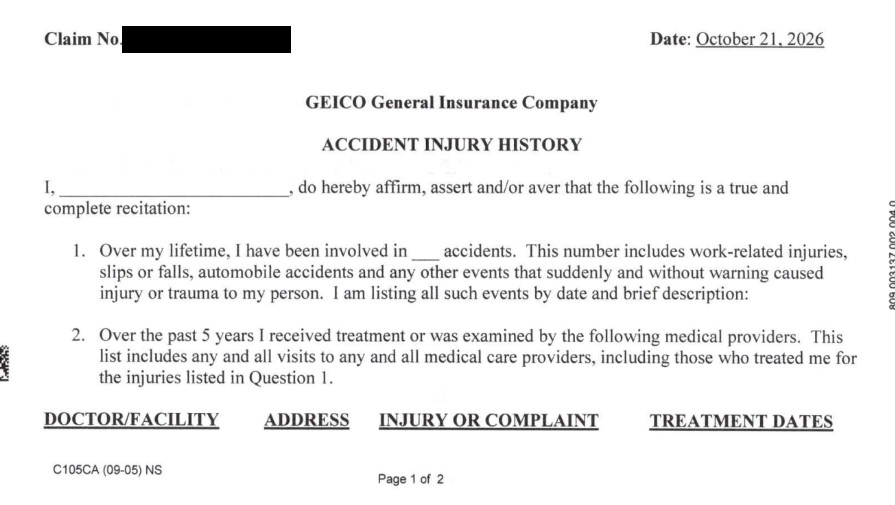
- Every accident of your life. Question 1 asks how many accidents you have had over your lifetime, counting work injuries, slips and falls, car crashes and any sudden event that hurt you, each listed by date and description.
- Every provider for five years. Question 2 asks for every medical provider who treated or examined you in the past five years, for anything, with address, complaint and treatment dates.
Few people can list a lifetime of falls and fender-benders from memory. A signed list that leaves out a sprained ankle from twenty years ago can later be described as hiding a prior injury. Many injury lawyers give the adjuster relevant prior history in the demand package instead, with the records attached, so the facts come from documents. If the adjuster raises old injuries, read what to do when the adjuster says it was a pre-existing condition.
Free case review
Tell us what happened. We will tell you plainly whether there is a case and what to do next. You owe no fees or costs unless we win.
What to ask for instead
You or your lawyer can cross out the broad language or send a limited authorization of your own. A narrower version usually covers:
- Treatment dates from the accident forward. If an earlier injury to the same body part matters, a short lookback you choose.
- Named providers only, the ones who treated you for this crash.
- The body parts and conditions you are claiming.
- No mental health, HIV or substance treatment records unless your claim puts them at issue.
- An expiration date about 90 days out.
- A line that the records are for evaluating this claim only, with no redisclosure to other companies or databases.
Our sample letters to an adjuster include a limited authorization. Some people skip the form and send the records themselves, which keeps control over what goes out.
What to do next
Do not sign and return the packet the day it arrives. If you have a lawyer, forward both forms to the lawyer and let the adjuster know through a letter of representation. If GEICO is your own insurer on a MedPay, PIP or uninsured motorist claim, read what changes when your own insurer asks. Other carriers use similar forms; compare the Allstate form and the Progressive form. More answers are in our insurance adjuster questions guide.
Common questions
Do I have to sign GEICO's medical authorization?
GEICO needs some records to evaluate injuries, but that does not mean this exact form. A limited authorization or records sent by your lawyer often does the same job. See do I have to sign a medical release.
Can I cross out parts of the GEICO form?
Yes, you can strike language, add limits and initial the changes. GEICO may push back, and then the discussion is about which records it actually needs.
Is the Accident Injury History a sworn statement?
The first line has you affirm that the answers are true and complete. Treat it with the care you would give testimony.
I already signed it. Can I take it back?
You can revoke going forward by mailing written notice to GEICO and to each provider, as the form describes. Records already sent stay sent. Our page on revoking a medical authorization has the steps.
Does signing mean I settled?
No. The form states it is not a release of claims for damages. A settlement release is a different document. See should I sign a medical release for the adjuster. Texas cases are handled by the firm’s Texas-licensed attorneys, Joyce Ondich and John Efstathiou. You owe no fees or costs unless we win. Call toll-free 1-877-427-2752 (1-877-4-ASAP-LAW), 24/7, from anywhere in the country.
Ask a question
Not ready to call? Write your question and someone on our team will answer. No cost, no commitment.
Injury lawyer — Beverly Law
Hurt because of someone else in California, Texas and Washington? Talk to an injury attorney. Free, confidential, English or Spanish. You owe no fees or costs unless we win.
Related pages
Insurance adjuster questions · Injury law FAQs
Sources
Important: This page is general information, not legal or medical advice, and reading it does not create an attorney-client relationship. Every case is different; talk to a lawyer about yours. Texas cases are handled by the firm’s Texas-licensed attorneys, Joyce Ondich and John Efstathiou. Last reviewed: November 23, 2026.