

By Michael Shemtoub, Esq., Managing Attorney, Beverly Law
Dealing with an insurance adjuster?
Leave your name and phone. We call back today, in English or Spanish. The consultation is free and confidential.
Free consultation · English y Español · No fees or costs unless we win
About this copy
The form is titled Authorization to Release Medical Records and names Allstate Northbrook Indemnity Company as the recipient. It came to our office with an Allstate acknowledgment letter in late 2025. We blacked out the date of loss and the claim number; the name, birth date and Social Security lines were blank when it arrived. Allstate writes different versions, and some Allstate companies use other templates. National General and Encompass, both Allstate companies, have sent us a different form, covered on our National General page.
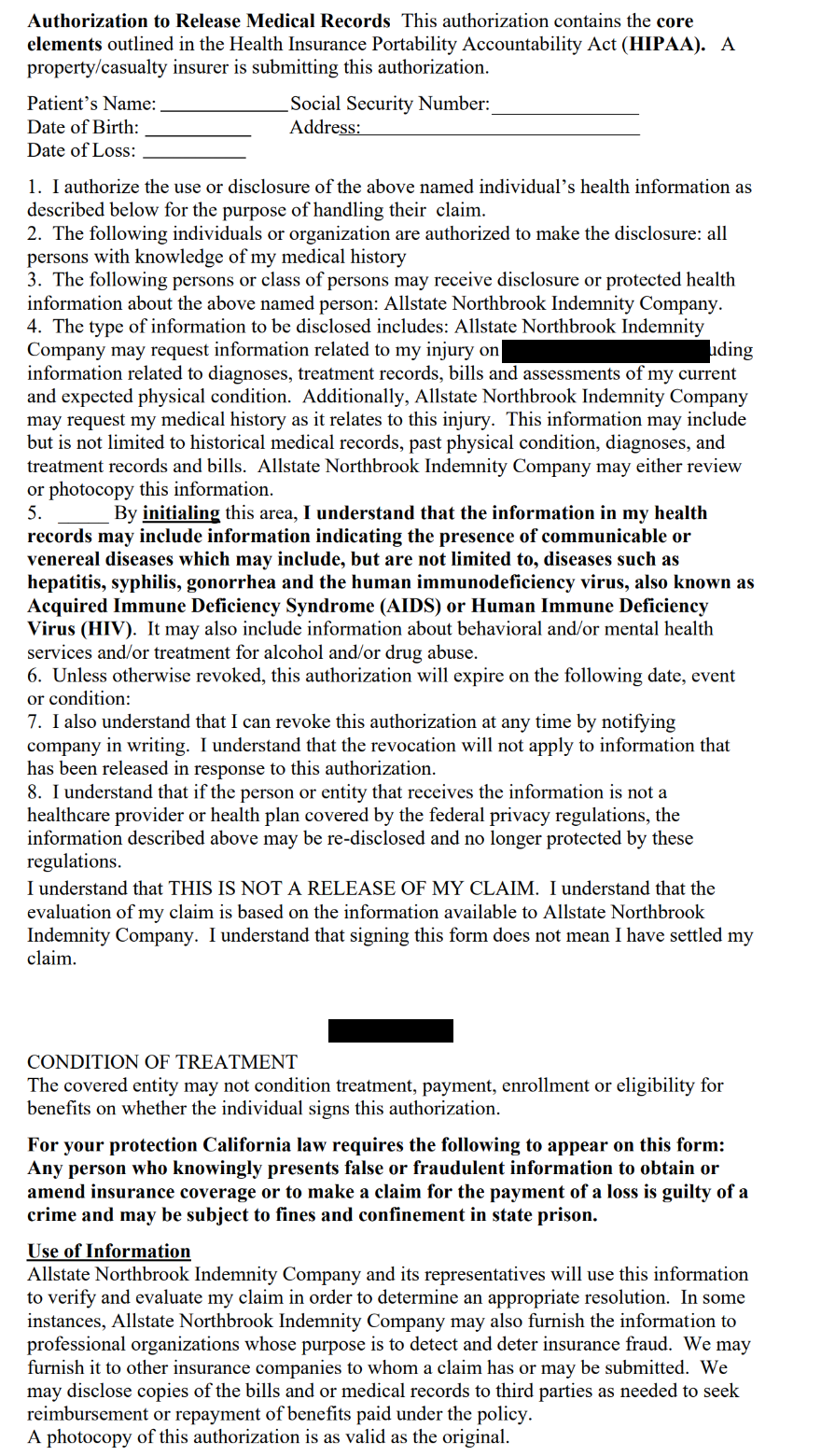
The clauses that matter, by number
- Anyone can send records. Item 2 names who may disclose: “all persons with knowledge of my medical history.” No doctor, hospital or date range is listed. Any office that has ever treated you fits that description.
- Your history comes along. Item 4 covers diagnoses, treatment records, bills and assessments of your current and expected condition for the injury on the loss date. It then adds your medical history as it relates to that injury, including historical records and past physical condition. The form does not say who decides what relates, so an adjuster can read it broadly. This is the clause that feeds a pre-existing condition argument.
- The initial line. Item 5 has a blank for your initials acknowledging that the records may show communicable or venereal diseases such as hepatitis, syphilis, gonorrhea and HIV or AIDS, plus behavioral and mental health treatment and alcohol or drug treatment. Initialing it does not limit anything. It confirms you know those records may go out.
- No end date unless you write one. Item 6 says the authorization expires on a date, event or condition, followed by an empty space. Federal rules list an expiration date or event as a core element of a valid authorization (45 CFR 164.508(c)(1)(v)). Fill it in yourself before anyone else does.
- Revoking. Item 7 lets you revoke at any time by notifying the company in writing. Records already released stay released.
- Privacy may not follow. Item 8 warns that if the recipient is not a health care provider or health plan, the information may be re-disclosed and lose federal protection. HHS says auto liability and auto medical payment coverage are not HIPAA health plans, so that warning applies to Allstate.
- Use of Information. Near the bottom, Allstate says it and its representatives will use the information to verify and evaluate your claim. In some cases it may give the information to professional organizations that work to detect and deter insurance fraud. It may give it to other insurance companies to which a claim has been or may be submitted. It may send copies of bills or records to third parties to seek reimbursement or repayment of benefits paid under the policy. A photocopy of the form counts as the original.
- What it is not. In capital letters, the form says this is not a release of your claim. It adds that signing does not mean you settled.
The top of the form also asks for your Social Security number and says it contains the core elements of HIPAA and is being submitted by a property and casualty insurer. See why insurers want your Social Security number.
What to ask for instead
The Allstate form has no checkboxes or limit lines, so any narrowing has to be written in or done with a separate authorization. Ask for:
- A list of named providers in item 2, replacing the open-ended wording.
- Treatment dates from the accident forward, with any prior-records window spelled out by years and body part.
- Only the body parts and conditions you are claiming.
- Item 5 crossed out, with a line excluding mental health, HIV, sexually transmitted disease and substance treatment records unless your claim involves them.
- A short expiration date in item 6, such as 90 days.
- A line limiting use to evaluating this claim, with the fraud-organization and other-insurer sharing struck.
Our sample letters to an adjuster include a limited authorization. Another route is to send the records yourself so you choose exactly what Allstate sees.
Free case review
Tell us what happened. We will tell you plainly whether there is a case and what to do next. You owe no fees or costs unless we win.
What to do next
Write in the expiration date and the provider list before you sign, or hand the form to your lawyer and let the lawyer respond. Keep a copy of whatever goes back. To compare, read our pages on the GEICO form and the Progressive form, or browse the insurance adjuster questions guide.
Common questions
Should I sign the Allstate medical authorization as written?
As written, it has no provider list and no end date, and it allows sharing with other insurers and fraud groups. Most people are better served by a limited version. See should I sign a medical release for the insurance adjuster.
Do I have to sign it at all?
Allstate needs some records to evaluate injuries. Whether this form, a narrower one, or records sent by your lawyer is the right way depends on the claim. Our page on whether you have to sign a medical release explains more.
What does Allstate do with my records?
The form says it uses them to evaluate the claim, and may share them with fraud-prevention organizations, other insurers and third parties seeking repayment of benefits.
What if I leave the expiration line blank?
Then the form does not state when it ends. Write a date in before signing.
Can I cancel it after I sign?
Yes, by written notice to Allstate. Read how to revoke a medical authorization for the details. Texas cases are handled by the firm’s Texas-licensed attorneys, Joyce Ondich and John Efstathiou. You owe no fees or costs unless we win. Call toll-free 1-877-427-2752 (1-877-4-ASAP-LAW), 24/7, from anywhere in the country.
Ask a question
Not ready to call? Write your question and someone on our team will answer. No cost, no commitment.
Injury lawyer — Beverly Law
Hurt because of someone else in California, Texas and Washington? Talk to an injury attorney. Free, confidential, English or Spanish. You owe no fees or costs unless we win.
Related pages
Insurance adjuster questions · Injury law FAQs
Sources
Important: This page is general information, not legal or medical advice, and reading it does not create an attorney-client relationship. Every case is different; talk to a lawyer about yours. Texas cases are handled by the firm’s Texas-licensed attorneys, Joyce Ondich and John Efstathiou. Last reviewed: November 23, 2026.