


When a baby is hurt around the time of birth, parents often ask a simple question: who is responsible? The answer is rarely just one person. A delivery can involve an obstetrician, a nurse, an anesthesiologist, a pediatrician, a medical group and the hospital itself.
This article explains, in plain words, how the law may look at each of them in California, Texas and Washington. It covers the difference between an employee and an independent contractor, a legal idea called ostensible agency, the role of nurses and the medical chart, and why the list of people and organizations in a claim can matter for insurance.
Was your baby hurt during delivery?
Tell us your name and phone. We call you back today, in English or Spanish, and the consultation is free.
Free consultation · English y Español · No fees or costs unless we win
Employees and independent contractors: why the label matters
In general, an employer may be responsible for mistakes made by its employees while they do their jobs. Most hospital nurses are hospital employees, so a hospital may answer for their work. Many doctors are different. They often have privileges to treat patients at a hospital but run their own practice or belong to a separate medical group. The law may treat them as independent contractors.
The key question is usually control. A Texas Supreme Court opinion restating a long-standing Texas case, Baptist Memorial Hospital System v. Sampson, explains that the absence of a right of control is what commonly separates an independent contractor from an employee, and that a hospital is generally not liable for the acts of independent contractors.
That does not mean the doctor is off the hook. It usually means the doctor, and the medical group that employs the doctor, may be responsible for the doctor's own care, while a different legal path is needed to involve the hospital. That is where the next idea comes in.
Ostensible agency: when a patient reasonably believes the doctor works for the hospital
Ostensible agency, sometimes called apparent agency, can apply even when a doctor is not a hospital employee. California Civil Code section 2300 says an agency is ostensible when a person or company, intentionally or by lack of ordinary care, causes someone to believe another person is its agent when that person is not really employed by it.
A California Court of Appeal opinion (Second Appellate District, filed August 2022) describes two elements: conduct by the hospital that would lead a reasonable person to believe the physician was the hospital's agent, and the patient's reliance on that appearance. The same opinion notes that the rule may not apply if the hospital gave the patient actual notice that doctors are not employees, or if the patient was treated by their own personal physician. In that case, the court ruled for the hospital because the patient had chosen his own surgeon.
The Texas Supreme Court document noted above states that a hospital may be vicariously liable through the elements of ostensible agency, citing Sampson. Washington's statute on health care negligence, RCW 7.70.040, sets the standard that each provider must meet: the care, skill and learning of a reasonably prudent provider in the same profession. Whether a hospital answers for a doctor who is not its employee is a separate question that depends on the facts, such as signs, forms, how the patient arrived and who chose the doctor.
Nurses and the medical chart
Nurses are often the people at the bedside during labor. They watch the mother and baby, follow doctors' orders, and may be responsible for telling a physician when something looks wrong. Their notes in the chart, including fetal heart rate monitoring and the times of calls to doctors, create a record of what was seen and what was done.
Because many nurses are hospital employees, a claim about nursing care is often directed at the hospital. The chart can help show what happened and when. Gaps, late entries or unclear notes do not by themselves prove a mistake, but they may be among the things that medical experts review.
In Washington, RCW 7.70.040 applies the same reasonably prudent provider standard to health care providers in general, which can include nurses. Courts in California and Texas also generally look at whether a provider met the accepted standard of care, usually with the help of qualified experts.
Corporate negligence: when the hospital's own choices are questioned
Separate from responsibility for people who work there, a hospital may also be asked about its own decisions. Some courts have recognized claims often called corporate negligence. These look at whether the hospital itself acted reasonably in areas such as staffing, training, written policies, equipment, or how it checks and supervises the doctors who are allowed to practice there.
Whether this type of claim is available, and how it is framed, can differ by state and by the facts. It is usually based on the hospital's own conduct, not just on what one person did on one day.
Because these questions turn on records, policies and expert opinions, they are rarely answered from a single document. Families often start by gathering the medical chart, the discharge papers and any bills, so that a reviewer can see who was involved at each stage.
Why the list of defendants matters for insurance
Doctors, medical groups and hospitals usually carry their own professional liability insurance. Each policy has its own terms and limits. If a claim leaves out a person or organization that may be responsible, the insurance that could have helped cover a child's long-term needs may never be considered.
Naming the right parties also helps with fairness. Each one can explain its role, and a court can decide how responsibility is shared. Time limits for filing differ by state and can be short, so it is wise to speak with a lawyer soon rather than guess.
This article is general information, not legal or medical advice. Every family's situation is different, and only a review of the records can show who may have been involved.
Key facts
Read the key facts as text
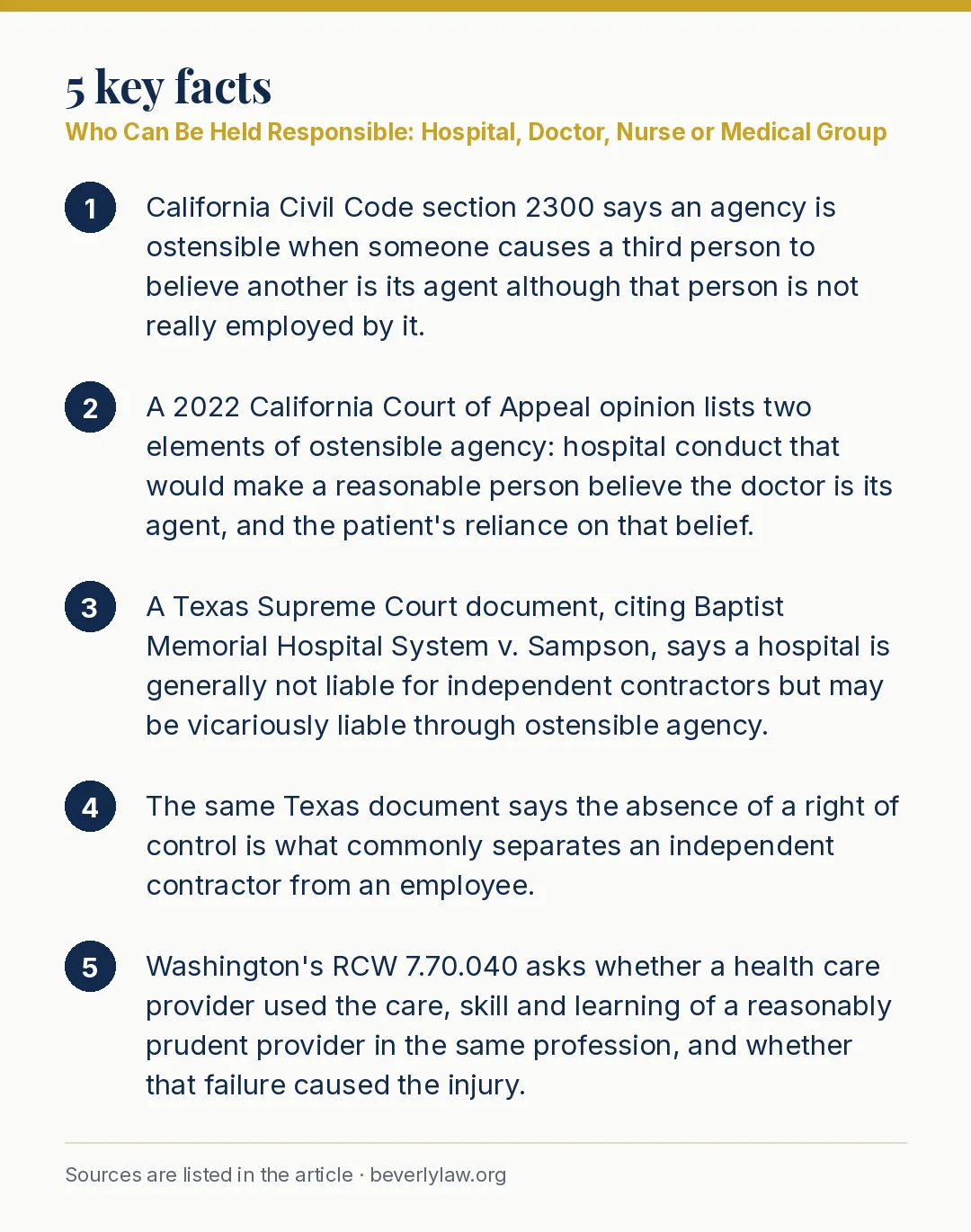
- California Civil Code section 2300 says an agency is ostensible when someone causes a third person to believe another is its agent although that person is not really employed by it.
- A 2022 California Court of Appeal opinion lists two elements of ostensible agency: hospital conduct that would make a reasonable person believe the doctor is its agent, and the patient's reliance on that belief.
- A Texas Supreme Court document, citing Baptist Memorial Hospital System v. Sampson, says a hospital is generally not liable for independent contractors but may be vicariously liable through ostensible agency.
- The same Texas document says the absence of a right of control is what commonly separates an independent contractor from an employee.
- Washington's RCW 7.70.040 asks whether a health care provider used the care, skill and learning of a reasonably prudent provider in the same profession, and whether that failure caused the injury.
Free birth-injury case review
We review the delivery records with medical experts and tell you honestly whether there is a case. You pay no fees or costs unless we win.
Questions parents ask
Can I include the hospital if my doctor was not a hospital employee?
It may be possible. Depending on the state and the facts, the law sometimes allows a claim against a hospital for a doctor who was an independent contractor, for example under ostensible agency. Courts often look at what the patient was told, what signs or forms were used, and who chose the doctor. A records review can help sort this out.
Why does it matter if a nurse was a hospital employee?
An employer may be responsible for the work of its employees. If a nurse worked for the hospital, concerns about nursing care may be directed to the hospital. If a nurse worked for a staffing agency or medical group, a different organization may be involved.
Can I find out who was involved before I decide anything?
Usually, yes. The medical chart lists the doctors, nurses and other staff who took part in care, and it may show who they worked for. A free case review can help you understand your options without any commitment.
Sources
Washington State Legislature, RCW 7.70.040
California Court of Appeal, Second District, Division Six (opinion filed 8/8/22, No. B311482)
Supreme Court of Texas, No. 23-0460 (Bush v. Columbia Medical Center of Arlington)
After a birth injury, more than one person or organization may have played a part: a doctor, a nurse, a medical group, a hospital, or several of them. Whether each one may be responsible can depend on who employed them, what the patient was led to believe, and the hospital's own decisions. The medical chart usually holds many of the answers. If you have questions about who may be involved in your child's care, Beverly Law invites you to request a free case review. There are no promises about any result, only a careful look at your records and your options.
Ask a question
Not ready to call? Write your question and a member of our team answers you — no cost, no commitment.
Who Can Be Held Responsible: Hospital, Doctor, Nurse or Medical Group — Beverly Law
Free case review for families in California, Texas and Washington. We obtain the delivery records, have them reviewed by medical experts and deal with the hospital and its insurer — you focus on your child. You pay no fees or costs unless we win.
Related pages
Cerebral Palsy · Erb’s Palsy / Brachial Plexus Injury · HIE / Oxygen Deprivation at Birth · Statute of Limitations · All birth-injury guides · Birth injury news · Birth injury lawyers by California hospital
Important: This page is general information about birth injuries and California law, not legal advice, and reading it does not create an attorney-client relationship with Beverly Law. Every case is different — talk to a lawyer about your own situation. Attorney advertising. Prior results do not guarantee a similar outcome. No fees or costs unless we win. Last reviewed: 2026-09-18.