


Many parents who have had a cesarean birth wonder whether they can try to deliver vaginally the next time. Doctors call this a trial of labor after cesarean, or TOLAC. When it ends in a vaginal birth, it is called a VBAC. For many families it is a reasonable choice, and for others a repeat cesarean is the safer plan.
The main concern with TOLAC is uterine rupture, a rare event in which the scar from the earlier cesarean opens during labor. This article explains, in plain words and according to medical sources, how candidates are chosen, how labor is watched, what the warning signs are, and what outcomes have been reported. It also notes that families in California, Texas and Washington give birth in many different kinds of hospitals, so it is worth asking any hospital how it prepares for this situation.
Was your baby hurt during delivery?
Tell us your name and phone. We call you back today, in English or Spanish, and the consultation is free.
Free consultation · English y Español · No fee unless we win
Who may be a candidate for a trial of labor
According to a summary of obstetric guidance published by the American Academy of Family Physicians, most women with one previous low-transverse cesarean and no other reason to avoid vaginal birth are candidates. Other criteria include no other uterine scars, no previous rupture, and a pelvis judged to be adequate.
The same source says a previous classical incision or extensive surgery on the upper part of the uterus is a reason not to attempt labor. For women with two previous low-transverse cesareans, only those who have also had a vaginal birth should be considered for a spontaneous trial of labor.
Some factors change the odds. The AAFP summary reports that a gap of less than 24 months between births carries a two- to three-fold higher risk of rupture than a longer gap, and that a previous vaginal birth lowers the risk. Overall, it reports VBAC success in about 60 to 80 percent of attempts in most studies. This is a decision to make with your own obstetric provider, who knows your history.
How common is uterine rupture?
Rupture is uncommon but serious. A 2016 systematic review in the Archives of Gynecology and Obstetrics states that women attempting TOLAC have less than a 1 percent chance of complete uterine rupture. A Danish population study in PLoS One found complete rupture at term in 181 of 62,475 women with a prior cesarean, or 0.46 percent.
Risk is not the same for everyone. The AAFP summary notes that some medicines used to start labor, particularly prostaglandins, are linked to a higher chance of rupture, and that induction can lower the chance of a successful VBAC.
Because the risk cannot be reduced to zero, the safety plan matters as much as the number.

Continuous monitoring and immediate availability
The AAFP summary says a physician must be immediately available throughout active labor, able to monitor labor and to perform an emergency cesarean, and that VBAC should be attempted only in institutions equipped to handle emergencies. It adds that most of the studies supporting VBAC safety were done at university or tertiary-level centers, and that few studies have looked at smaller hospitals with limited resources.
The 2016 review recommends continuous electronic fetal monitoring during TOLAC. It also notes that guidelines do not agree on how best to track contractions, and suggests aiming for about three to five contractions per ten minutes, with action taken if there are more than five.
In plain terms, a well-managed TOLAC means a hospital that can watch the baby's heartbeat and the contractions closely, and can move quickly to an operating room if something changes. Parents can ask before labor starts who will be in the hospital, and how fast a team can be ready.
Signs that a rupture may be happening
The 2016 review lists possible signs: changes in the baby's heart rate, severe abdominal pain that continues between contractions, tenderness over the scar, unusual vaginal bleeding, blood in the urine, contractions that suddenly weaken, the baby's head moving back up, and low blood pressure or shock in the mother. It says these signs can appear late or not at all.
The baby's heart rate is often the first clue. In the Danish study, 10 or more severe variable decelerations in early labor were more common in women who later had a rupture, and the heart rate slowed severely at the end in 47 percent of rupture cases. The authors also caution that an abnormal tracing is common in many labors and cannot predict rupture by itself.
That is why teams are expected to respond to the whole picture, and why a mother who feels sudden severe pain should tell her nurse right away.
What outcomes have been reported
When a rupture happens during labor, outcomes for the baby can be serious. The 2016 review estimates about a 10 percent risk of perinatal death with complete rupture. In the Danish study, 38 percent of babies in rupture cases had an Apgar score of 7 or lower at five minutes, compared with 5 percent in the comparison group, and 4 of 53 babies died within the first week.
For mothers, the AAFP summary lists hysterectomy, transfusion and surgical injury among the complications linked to failed trials of labor. In the Danish study, most women with a rupture, 66 percent in the first stage of labor, were delivered by cesarean.
The same AAFP summary reports that a successful VBAC is linked to shorter hospital stays, fewer infections, less blood loss and fewer clots than a repeat cesarean, and that overall perinatal death is under 1 percent. Both choices carry risks, which is why the conversation with your provider matters.
Questions to ask, and where to learn more
Good questions include: Does this hospital offer TOLAC? Is an obstetrician and anesthesia team in the building around the clock? How is labor monitored? What is the plan if the heart rate changes? You can ask these in the prenatal visits and write the answers in your birth plan.
If something went wrong in a birth and you have questions about what happened, you may request your medical records. Time limits for legal claims differ by state and by situation, so speak with a licensed attorney in California, Texas or Washington rather than relying on a general article.
This article is general information, not legal or medical advice. Talk with your own doctor about your care, and with a lawyer about your legal rights.
Key facts
Read the key facts as text
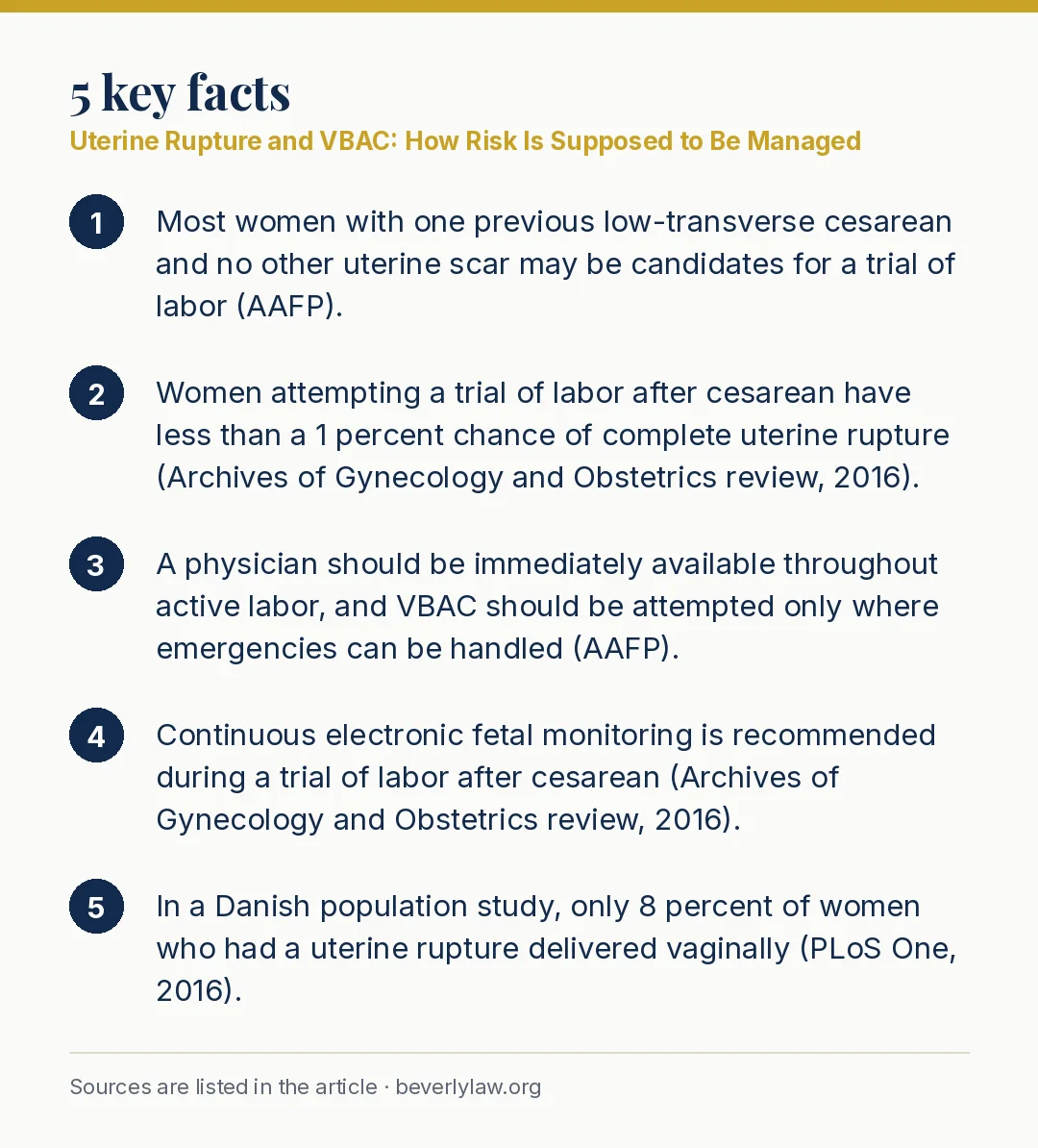
- Most women with one previous low-transverse cesarean and no other uterine scar may be candidates for a trial of labor (AAFP).
- Women attempting a trial of labor after cesarean have less than a 1 percent chance of complete uterine rupture (Archives of Gynecology and Obstetrics review, 2016).
- A physician should be immediately available throughout active labor, and VBAC should be attempted only where emergencies can be handled (AAFP).
- Continuous electronic fetal monitoring is recommended during a trial of labor after cesarean (Archives of Gynecology and Obstetrics review, 2016).
- In a Danish population study, only 8 percent of women who had a uterine rupture delivered vaginally (PLoS One, 2016).
Free birth-injury case review
We review the delivery records with medical experts and tell you honestly whether there is a case. You pay nothing unless we win.
Questions parents ask
Is a VBAC safe?
For many women it is a reasonable option, and the AAFP summary links a successful VBAC to shorter stays and fewer infections than a repeat cesarean. Both options carry risks, though, and rupture, while uncommon, can be serious. Your obstetric provider can explain how your history changes the picture.
Can I try a VBAC at any hospital?
Not always. Medical sources say a physician should be immediately available during active labor and that VBAC should be attempted only where emergencies can be handled. Some hospitals do not offer it, so ask early in your pregnancy.
What should I do if I feel sudden, severe pain during labor?
Tell your nurse or doctor right away. Severe pain that continues between contractions is one of the signs described in the medical literature, although it does not always mean a rupture.
Sources
American Family Physician (AAFP): ACOG Releases Guidelines for Vaginal Birth After Cesarean Delivery
Archives of Gynecology and Obstetrics via PubMed Central: Tocogram characteristics of uterine rupture, a systematic review
PLoS One via PubMed Central: Can intrapartum cardiotocography predict uterine rupture among women with prior caesarean delivery?
A trial of labor after cesarean can be a reasonable choice for many families, but it depends on careful candidate selection, continuous monitoring, and a hospital that can act immediately if the scar opens. If you believe a rupture or a delay in responding harmed your baby or you, you do not have to sort it out alone. Beverly Law offers a free case review to listen to what happened and explain your options, with no promises about the outcome.
Ask a question
Not ready to call? Write your question and a member of our team answers you — no cost, no commitment.
Uterine Rupture and VBAC: How Risk Is Supposed to Be Managed — Beverly Law
Free case review for families in California, Texas and Washington. We obtain the delivery records, have them reviewed by medical experts and deal with the hospital and its insurer — you focus on your child. You pay nothing unless we win.
Related pages
Cerebral Palsy · Erb’s Palsy / Brachial Plexus Injury · HIE / Oxygen Deprivation at Birth · Statute of Limitations · All birth-injury guides · Birth injury news
Important: This page is general information about birth injuries and California law, not legal advice, and reading it does not create an attorney-client relationship with Beverly Law. Every case is different — talk to a lawyer about your own situation. Attorney advertising. Prior results do not guarantee a similar outcome. No fee unless we win. Last reviewed: 2026-09-18.