


Many newborns look a little yellow in their first days of life. This is called jaundice, and according to the CDC, about 60% of all babies have it. For most babies it is mild and goes away on its own.
In a small number of babies, bilirubin, the yellow substance behind jaundice, can climb too high. If that is not found and treated in time, it can lead to a type of brain damage called kernicterus. The good news is that, according to the CDC, early diagnosis and treatment can prevent it. This article explains how screening and follow-up are meant to work, whether your baby is born in California, Texas, Washington or anywhere else in the United States.
Was your baby hurt during delivery?
Tell us your name and phone. We call you back today, in English or Spanish, and the consultation is free.
Free consultation · English y Español · No fee unless we win
What jaundice and bilirubin are
Before birth, the mother's liver removes bilirubin for the baby. After birth, the baby's liver has to do this job. According to the CDC, in some babies the liver is not yet developed enough to clear bilirubin efficiently, so it builds up in the blood and gives the skin a yellow color.
Jaundice usually shows first on the face and then moves down to the chest, belly, arms and legs as levels rise, according to the CDC and the American Academy of Pediatrics (AAP). Skin color can be hard to judge, especially in babies with darker skin, which is one reason a measurement is more reliable than looking alone.
Bilirubin screening and the Bhutani nomogram
The AAP's parent website says every newborn should have at least one bilirubin measurement before leaving the hospital, and a baby who looks jaundiced in the first 24 hours needs testing right away. The CDC adds that, at a minimum, babies should be checked for jaundice every 8 to 12 hours during the first 48 hours of life.
Bilirubin can be measured with a skin device or a small blood sample. For years, many hospitals plotted the result on the Bhutani nomogram, a chart that places a level by the baby's age in hours into risk zones. The AAP updated its guideline in 2022. Based on the published summaries we reviewed, the newer approach uses thresholds that depend on the baby's gestational age and on risk factors, rather than relying on that chart alone. Ask your care team which method your hospital uses and where your baby's number falls.

Phototherapy and exchange transfusion
The usual treatment is phototherapy. The baby is placed undressed under special lights, which helps the body get rid of bilirubin. The CDC and the AAP both note this can be done in the hospital and sometimes at home. Feeding often also needs attention, because feeding helps the baby clear bilirubin; the CDC suggests 8 to 12 feedings a day for breastfed babies.
Exchange transfusion is for severe cases. The baby's blood is slowly replaced with donor blood, which can lower bilirubin quickly, and it usually requires intensive care, according to the AAP and Cleveland Clinic. The 2022 AAP guideline raised the bilirubin levels at which phototherapy and exchange transfusion are recommended, according to a study published in PubMed Central. The exact number depends on the baby's age in hours, gestational age and risk factors, so we do not list single numbers here. Your baby's doctors use the AAP tables for that.
Follow-up after you go home
Bilirubin usually peaks when a baby is between 3 and 5 days old, which is often after a family has gone home. The CDC says every baby should be seen by a nurse or doctor in that window, and that babies discharged before 72 hours should be seen within 2 days.
Follow-up may need to be sooner for some babies, including those born early, those with a higher bilirubin level before discharge, or those who are not feeding well, according to the AAP. Under the 2022 AAP approach, the closer the pre-discharge level is to the treatment threshold, the sooner the next check is meant to happen. If you are told to come back, keep that visit even if the baby looks fine.
Signs to watch and long-term effects
Call your pediatrician if yellow color increases or spreads, if your baby is very sleepy or hard to wake, is feeding poorly, or has few wet diapers. The AAP also advises calling if jaundice lasts beyond 2 weeks in a formula-fed baby or 4 weeks in a breastfed baby. Cleveland Clinic lists poor feeding, extreme sleepiness, low muscle tone, high-pitched crying and arching or stiff muscles as signs of worsening bilirubin effects, and these need urgent care.
According to the CDC, kernicterus can cause athetoid cerebral palsy, hearing loss, problems with vision and teeth, and sometimes intellectual disability. These are lifelong. Cleveland Clinic notes that when jaundice is found and treated quickly, a baby can make a full recovery, which is why timely screening and follow-up matter.
Questions to ask and where to learn more
Before discharge, you can ask: What was my baby's bilirubin number and when was it taken? Is my baby at higher risk? When and where is the follow-up visit? Writing the answers down helps if you see a different clinician later. These questions apply in California, Texas and Washington alike; state health departments in each can point to newborn care resources.
This article is general information, not legal or medical advice. If you think your baby's jaundice was not checked or treated, talk to your baby's doctor right away about care. For legal questions, deadlines depend on the state and the facts, so it helps to speak with a qualified attorney.
Key facts
Read the key facts as text
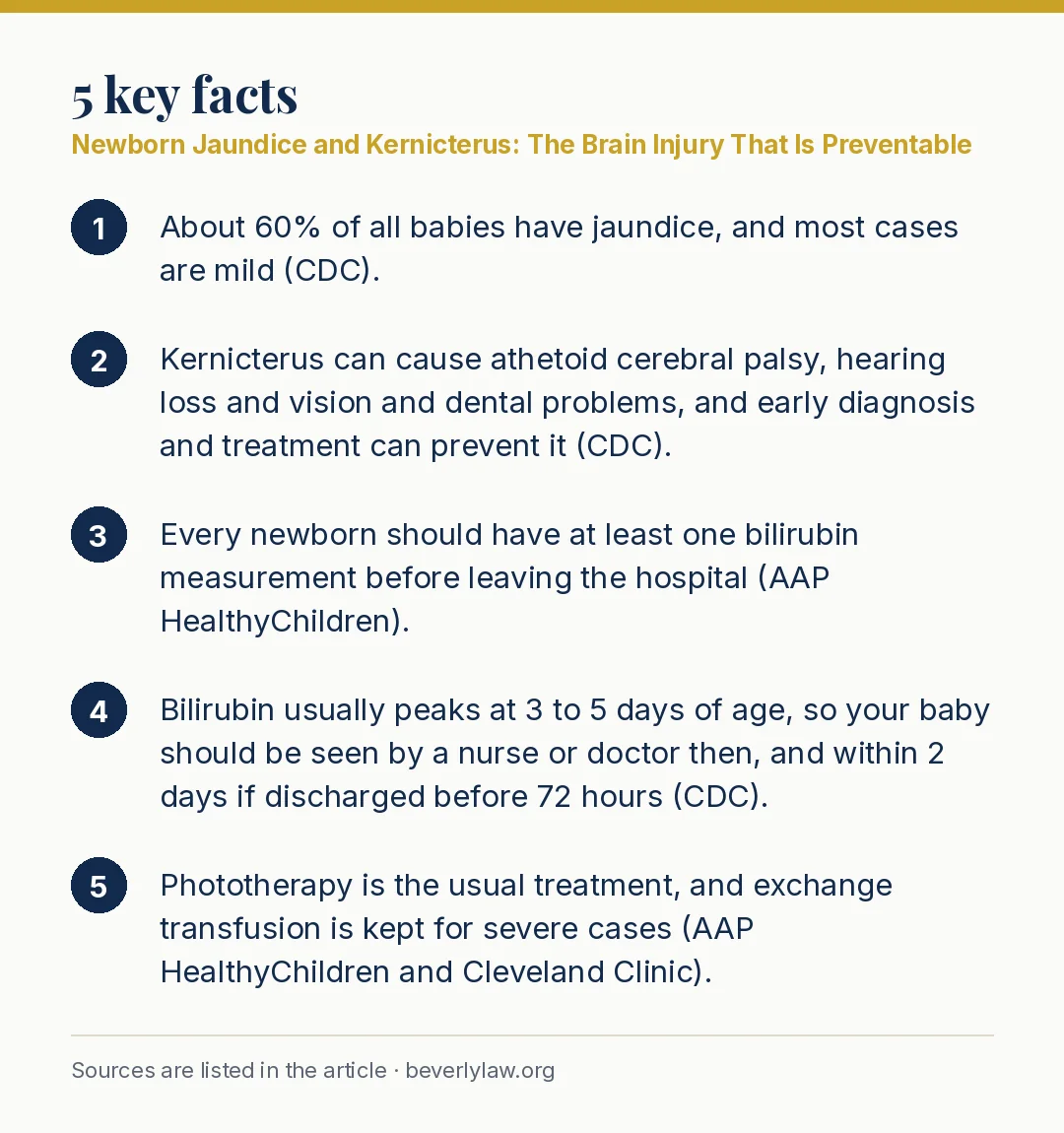
- About 60% of all babies have jaundice, and most cases are mild (CDC).
- Kernicterus can cause athetoid cerebral palsy, hearing loss and vision and dental problems, and early diagnosis and treatment can prevent it (CDC).
- Every newborn should have at least one bilirubin measurement before leaving the hospital (AAP HealthyChildren).
- Bilirubin usually peaks at 3 to 5 days of age, so your baby should be seen by a nurse or doctor then, and within 2 days if discharged before 72 hours (CDC).
- Phototherapy is the usual treatment, and exchange transfusion is kept for severe cases (AAP HealthyChildren and Cleveland Clinic).
Free birth-injury case review
We review the delivery records with medical experts and tell you honestly whether there is a case. You pay nothing unless we win.
Questions parents ask
Is jaundice in a newborn normal?
It is very common. The CDC says about 60% of babies have it, and it is often mild. Still, every baby should have bilirubin measured before going home and be seen again in the first days, because some babies need treatment.
Can I treat jaundice with sunlight?
The sources we reviewed describe treatment with special phototherapy lights under medical direction, not sunlight. Ask your baby’s doctor before trying anything at home. Never delay a call or visit because the baby seems to be getting sun.
What should I do if my baby is very yellow and sleepy?
Call your pediatrician or seek emergency care right away. Extreme sleepiness, poor feeding and stiff muscles are signs listed by Cleveland Clinic that bilirubin may be affecting the baby. Quick treatment is the goal.
Sources
CDC – What are Jaundice and Kernicterus?
AAP HealthyChildren – Jaundice in Newborns
Cleveland Clinic – Kernicterus
NIH PubMed Central – Implementation of the 2022 AAP guidelines for neonatal hyperbilirubinemia
Newborn jaundice is common and usually mild, but severe cases can cause lifelong brain injury if they are missed. Screening before discharge, a follow-up visit at 3 to 5 days and quick treatment are the steps that help prevent kernicterus. If your baby had severe jaundice or a delay in testing or treatment and you have questions, Beverly Law offers a free case review to talk through what happened and what options may exist.
Ask a question
Not ready to call? Write your question and a member of our team answers you — no cost, no commitment.
Newborn Jaundice and Kernicterus: The Brain Injury That Is Preventable — Beverly Law
Free case review for families in California, Texas and Washington. We obtain the delivery records, have them reviewed by medical experts and deal with the hospital and its insurer — you focus on your child. You pay nothing unless we win.
Related pages
Cerebral Palsy · Erb’s Palsy / Brachial Plexus Injury · HIE / Oxygen Deprivation at Birth · Statute of Limitations · All birth-injury guides · Birth injury news
Important: This page is general information about birth injuries and California law, not legal advice, and reading it does not create an attorney-client relationship with Beverly Law. Every case is different — talk to a lawyer about your own situation. Attorney advertising. Prior results do not guarantee a similar outcome. No fee unless we win. Last reviewed: 2026-09-18.