

Many California babies are born at public hospitals run by a county or a local health care district. Examples include Los Angeles General Medical Center (formerly LAC+USC), Harbor-UCLA and Olive View-UCLA, which Los Angeles County runs, Riverside University Health System in Riverside County and Arrowhead Regional Medical Center in San Bernardino County. These hospitals care for thousands of families every year.
Because these hospitals are public entities, a different set of rules applies if a family believes a birth injury was caused by a medical mistake. The most important rule is a short deadline to present a written claim. University of California hospitals follow different rules, and this guide explains both so you know what to ask and when.
Was your baby hurt during delivery?
Tell us your name and phone. We call you back today, in English or Spanish, and the consultation is free.
Free consultation · English y Español · No fees or costs unless we win
Which hospitals does the six-month claim cover?
The claim rules cover hospitals run by public entities such as counties, cities and local health care districts (Government Code section 811.2). County hospitals such as Los Angeles General, Harbor-UCLA and Olive View-UCLA are in this group. The “UCLA” in two of those names does not make them University of California hospitals; Los Angeles County runs them, so the six-month claim applies.
University of California hospitals, such as UCLA, UC Irvine, UC San Diego and UC Davis, are run by the Regents of the University of California, and the rules are different. Government Code section 905.6 says the claim rules do not apply to claims against the Regents, so no six-month government claim is needed before suing a UC hospital. The case still has to be filed within the regular malpractice deadlines in Code of Civil Procedure section 340.5, and the 90-day notice of intent to sue a health care provider under section 364 still applies.
Private and nonprofit hospitals are not public entities and follow the regular malpractice rules. Some district-owned hospitals are leased to and run by a private health system, which can change the answer. If you are not sure who runs the hospital where your baby was born, ask the hospital’s patient-relations office, or ask a lawyer to check.
What is the Government Claims Act?
The Government Claims Act is a set of California laws that apply when someone wants to seek money from a public entity. In general, you must first present the entity with a written claim. Only after that process can a lawsuit be filed. According to the California Courts self-help site, a claim is how you ask a government agency to pay you before going to court.
The claim is a short written document. Under Government Code section 910, it states who the claimant is, where notices should be sent, the date, place and circumstances of the injury, a general description of the injury, the names of the public employees involved if known, and the amount claimed. If the amount is more than $10,000, no dollar figure is stated; the claim says instead whether the case would be a limited civil case. Many counties publish a claim form on their websites, and the claim usually goes to a designated office, such as the clerk of the board of supervisors.
The six-month claim deadline
Government Code section 911.2 says a claim for injury to a person must be presented to the public entity no later than six months after the cause of action accrues. The California Courts self-help site describes this as six months from the injury when you are suing over an injury.
This is far shorter than the time a family has to sue a private hospital or a University of California hospital. California gives a child’s own birth-injury case its own deadline under Code of Civil Procedure section 340.5: a minor generally must sue within three years of the wrongful act, but a child who was under six when it happened has until the eighth birthday if that is longer. That longer deadline does not replace the six-month claim rule for a county or district hospital. Parents’ own claims can also have much shorter deadlines.
Because the date a claim 'accrues' can be argued about in some cases, many families ask a lawyer to count the days as soon as they have questions.
After the claim: rejection and the next six months
The public entity has 45 days to respond. If it rejects the claim in writing, Government Code section 945.6 gives the claimant six months to file a lawsuit. The California Courts self-help site says that period runs from the date the rejection was mailed, not the date it arrived.
If the entity does not respond within 45 days, the claim is generally treated as rejected. In that case, the same self-help page says you generally have up to two years from the date the claim accrued, which is usually the date of the injury to start a case. Both clocks matter, so keep every letter and envelope you receive from the hospital or county.
What if the claim is late?
A missed deadline does not always end the matter. Under Government Code section 911.4, a person can apply to the public entity for permission to present a late claim. The application must be made within a reasonable time, and no later than one year after the cause of action accrued.
In a 2017 decision, J.M. v. Huntington Beach Union High School District, the California Supreme Court explained that the grounds for relief include mistake or excusable neglect, and that a person who was a minor during the six-month period may qualify. Being a minor does not stop the one-year limit for the late-claim application. The court also explained that if the entity denies the application, or does not act on it for 45 days, a petition asking a judge for relief must be filed within six months under section 946.6. In that case the lawsuit was barred because the petition came too late.
Late-claim relief is not automatic and depends on the facts. It is much safer to present a claim on time than to rely on an exception.
Key facts
Read the key facts as text
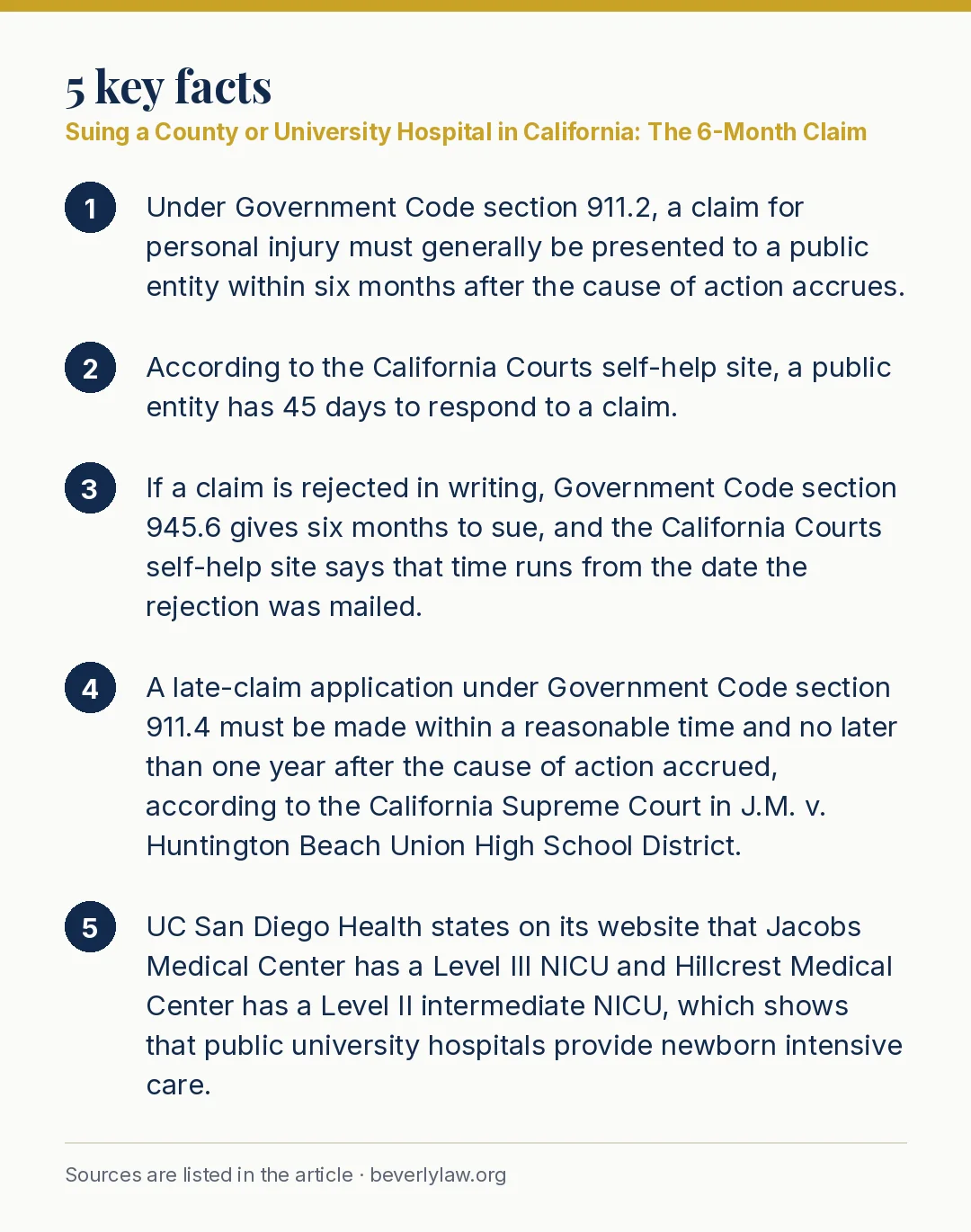
- Under Government Code section 911.2, a claim for personal injury must generally be presented to a public entity within six months after the cause of action accrues.
- According to the California Courts self-help site, a public entity has 45 days to respond to a claim.
- If a claim is rejected in writing, Government Code section 945.6 gives six months to sue, and the California Courts self-help site says that time runs from the date the rejection was mailed.
- A late-claim application under Government Code section 911.4 must be made within a reasonable time and no later than one year after the cause of action accrued, according to the California Supreme Court in J.M. v. Huntington Beach Union High School District.
- Under Government Code section 905.6, the claim rules do not apply to claims against the Regents of the University of California, so the six-month claim does not apply to UC hospitals. The regular malpractice deadlines still do.
What California law says
California gives a child’s birth-injury case its own deadline. Under Code of Civil Procedure § 340.5, a minor must sue within three years of the wrongful act, but a child who was under six when it happened has until his or her eighth birthday if that is longer. For a baby hurt during labor or delivery, that usually means the eighth birthday. The clock runs from the act itself, not from the day the family learned what went wrong, and it is paused only in limited cases, such as fraud, intentional concealment or a foreign object left in the body. Parents’ own claims can have much shorter deadlines, so it is safer to get advice early.
California’s MICRA law limits one part of a medical malpractice recovery. Under Civil Code § 3333.2, as amended by AB 35, non-economic damages (pain, suffering, loss of enjoyment of life) are capped. In 2026 the cap is $470,000 for injury and $650,000 for wrongful death, and it rises every January 1 ($40,000 and $50,000 a year until 2033, then 2% a year). Separate caps can apply to doctors, hospitals and unaffiliated providers. Economic damages are not capped: lifetime medical care, therapy, equipment, home modifications and lost earning capacity can be recovered in full, and in a birth-injury case they are usually the largest part of the claim.
Free birth-injury case review
We review the delivery records with medical experts and tell you honestly whether there is a case. You pay no fees or costs unless we win.
Questions parents ask
How do I know if my baby’s hospital is a public entity?
Look at who owns and runs it. County hospitals and hospitals run by a local health care district are public entities, and the six-month claim applies to them. University of California hospitals are public too, but Government Code section 905.6 exempts claims against the UC Regents from the claim rules. If you are unsure, ask the hospital’s patient-relations office or ask a lawyer to confirm, because the answer changes which deadlines apply.
Is the six-month deadline the same as the child’s deadline to sue?
No. California gives a child’s birth-injury case its own deadline under Code of Civil Procedure section 340.5, which for a baby hurt during labor or delivery usually means the eighth birthday. But a claim against a public hospital under Government Code section 911.2 generally has to be presented within six months, so it is safer to get advice early.
What should I do if more than six months have passed?
Do not assume it is too late. Government Code section 911.4 lets a person apply to present a late claim within a reasonable time, no later than one year after the cause of action accrued, and minors may qualify in some situations. Talk to a lawyer promptly, because later steps have their own short deadlines.
Sources
California Courts Self-Help: Ask a government agency to pay you (submit a claim)
California Supreme Court, J.M. v. Huntington Beach Union High School District (S230510, 2017)
California Legislative Information: Government Code section 911.2
California Legislative Information: Government Code section 945.6
California Legislative Information: Government Code section 905.6
If your baby was hurt at a county or district hospital, the Government Claims Act usually requires a written claim within six months, and then six months to sue if the claim is rejected. Claims against University of California hospitals do not need that claim, but the regular malpractice deadlines still apply. Late-claim options may exist, but they are not guaranteed. If you have questions about your situation, you can ask Beverly Law for a free case review. A review is not a promise of any result, and it will not cost you anything to ask. This article is general information, not legal or medical advice.
Ask a question
Not ready to call? Write your question and a member of our team answers you — no cost, no commitment.
Suing a County or District Hospital in California: The 6-Month Claim
Free case review for families in California. We obtain the delivery records, have them reviewed by medical experts and deal with the hospital and its insurer — you focus on your child. You pay no fees or costs unless we win.
Related pages
Cerebral Palsy · Erb’s Palsy / Brachial Plexus Injury · HIE / Oxygen Deprivation at Birth · Statute of Limitations · All birth-injury guides · Birth injury news
Important: This page is general information about birth injuries and California law, not legal advice, and reading it does not create an attorney-client relationship with Beverly Law. Every case is different — talk to a lawyer about your own situation. Attorney advertising. Prior results do not guarantee a similar outcome. No fees or costs unless we win. Last reviewed: 2026-11-06.