


After a hard birth or a stay in the NICU, many parents are left with questions. What happened in those last hours of labor? Why did the baby need extra care? Your medical records are often the best place to find those answers, and you usually have the right to ask for them.
This guide explains, in plain words, how to request the records for your delivery and your baby's NICU stay, what the main documents are, what hospitals may charge, and what to look for when you read them. We focus on California, Texas and Washington, but the basic steps are similar in most states.
Was your baby hurt during delivery?
Tell us your name and phone. We call you back today, in English or Spanish, and the consultation is free.
Free consultation · English y Español · No fees or costs unless we win
Your right to ask for the records
The federal privacy rule known as HIPAA generally gives patients a right to see and get a copy of their own health information. A parent or legal guardian can usually make the request for a child. The mother's chart and the baby's chart are usually separate, so it is common to need two requests: one for your labor and delivery, and one for your baby's newborn and NICU care.
Each state also has its own rules about how fast a hospital must respond and what it may charge. Washington's rules are in RCW chapter 70.02. California's are in Health and Safety Code section 123110. Texas hospital rules are in Health and Safety Code section 241.154. Because these rules can be amended, check the current text or ask the hospital's records office what applies to your request.
The main documents and what they show
Fetal monitoring strips (also called tracings) record the baby's heart rate and the mother's contractions during labor. They are often stored electronically and may not be included in a standard records release, so ask for them by name. Nurses' notes are the time-stamped entries that describe what staff saw and did, such as checking on you, calling a doctor, or changing your care. The operative report is written after a cesarean section or other procedure and describes what was done and why.
Cord blood gases are lab results from blood taken from the umbilical cord, and they give information about the baby's condition at birth. Not every hospital tests every birth, so a missing result does not always mean something went wrong. The Apgar score is a quick check of the newborn. According to HealthyChildren.org, a nurse or doctor scores heart rate, breathing, muscle tone, reflexes and color at one minute and five minutes, for a total from 0 to 10.
For NICU stays, you may also want the admission note, daily progress notes, medication and oxygen records, lab and imaging results, and the discharge summary. Asking for the complete record, rather than a summary, gives you the fullest picture.

How to make the request
Start with the hospital's health information management or medical records office. Most hospitals have a written authorization form, often in English and Spanish, and many also accept requests through a patient portal. For example, Seattle Children's asks a parent or guardian to complete an authorization form and send it by email, fax or mail, or to request a formal copy through MyChart if they have an account.
Write down the dates of the stay, the names of the patient (mother or baby), and exactly what you want. A useful list is: the full labor and delivery chart, fetal monitoring tracings, nurses' notes, physician notes, the operative report, cord blood gas results, the Apgar scores, and the newborn and NICU chart. Ask for electronic copies if you can, and keep a copy of what you sent and the date you sent it.
If something in the records is hard to read, you can ask for help. In Washington, the statute says a provider must explain codes or abbreviations in the records when the patient asks.
Fees and timing
Hospitals may usually charge a reasonable fee for copies, and some may ask for payment before they release them. The amounts differ by state. In Washington, RCW 70.02.010 describes a reasonable fee as no more than 65 cents per page for the first 30 pages and 50 cents per page after that, plus a clerical fee of up to $15, with the amounts adjusted every two years by the state. Texas Health and Safety Code section 241.154 sets its own caps for hospital copies, and California Health and Safety Code section 123110 does the same for its providers. Look up the current figures at the official links below or ask the hospital for its fee schedule in writing.
Timing is also set by state law. In Washington, RCW 70.02.080 says a provider must respond to a written request as promptly as the circumstances require and no later than fifteen working days after receiving it. If there is a delay, the provider must tell you why in writing and give the earliest date, which can be no more than twenty-one working days after the request. Seattle Children's states that it responds within 15 business days. Other hospitals may use different time frames, so ask when you submit your request.
What to look for when you read the records
Read the records as a timeline. Note the times when labor started, when staff checked on you, when the heart rate tracing was reviewed, and when decisions were made about delivery. Check that the baby's Apgar scores, birth time and weight match across the mother's and the baby's charts. Small differences can happen, but they are worth writing down.
Remember that records are complex and one number rarely tells the whole story. The Apgar score, for example, is meant to alert staff when a newborn needs help, and HealthyChildren.org notes that it cannot predict how healthy a child will be as they grow up. Fetal monitoring strips also take training to read. A pediatrician, a nurse-midwife, or an obstetrician you trust can walk you through what the documents mean for your baby's care today.
Make a list of questions as you read. Common ones are: Why was a certain test done? Why is something missing? What do these abbreviations mean? You can bring that list to your child's doctor or to the hospital's patient relations office.
Keeping the records safe, and a note about this guide
Once you have the records, store them in a safe place, both on paper and in a digital folder. Keep a log of who you asked, what you asked for, and when. You may need them for your child's future doctors, for school or therapy services, and for any questions you decide to ask later.
This article is general information only. It is not legal or medical advice, and laws and fees can change. For questions about your child's health, talk with your child's doctor. For questions about your legal options, talk with a licensed attorney in your state.
Key facts
Read the key facts as text
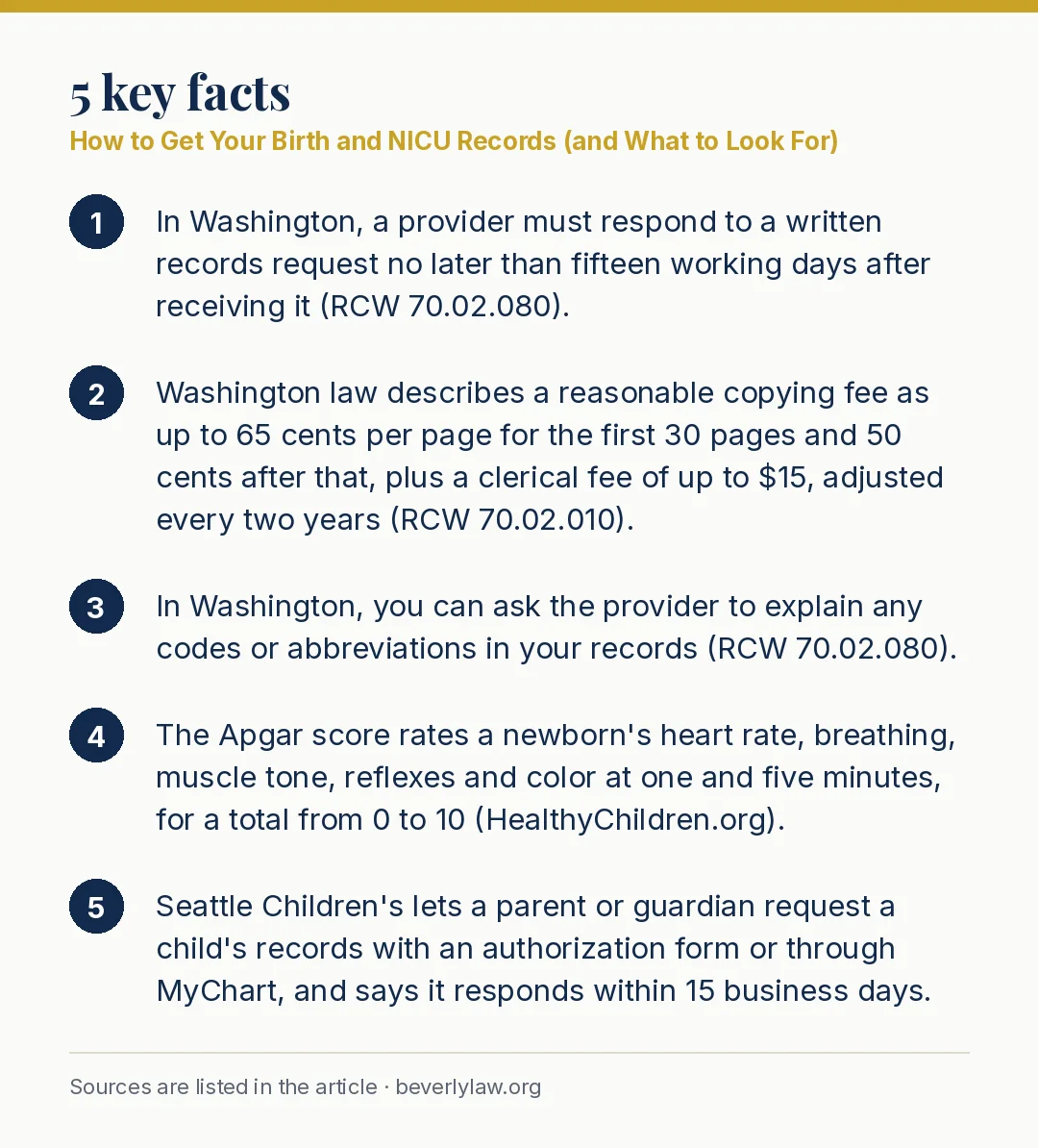
- In Washington, a provider must respond to a written records request no later than fifteen working days after receiving it (RCW 70.02.080).
- Washington law describes a reasonable copying fee as up to 65 cents per page for the first 30 pages and 50 cents after that, plus a clerical fee of up to $15, adjusted every two years (RCW 70.02.010).
- In Washington, you can ask the provider to explain any codes or abbreviations in your records (RCW 70.02.080).
- The Apgar score rates a newborn's heart rate, breathing, muscle tone, reflexes and color at one and five minutes, for a total from 0 to 10 (HealthyChildren.org).
- Seattle Children's lets a parent or guardian request a child's records with an authorization form or through MyChart, and says it responds within 15 business days.
Free birth-injury case review
We review the delivery records with medical experts and tell you honestly whether there is a case. You pay no fees or costs unless we win.
Questions parents ask
Can I get my baby’s records if I am the parent?
Usually yes. A parent or legal guardian can generally request a minor child’s records. Hospitals often ask for a signed authorization form and sometimes proof of guardianship. Ask the hospital’s records office what it needs.
Why are the fetal monitoring strips not in the records I received?
Tracings are often stored in a separate electronic system, and a standard release may not include them. Ask for them by name, and ask whether they come as a paper print or an electronic file. If something cannot be found, the provider should tell you so.
How long does it take, and what will it cost?
It depends on the state and the hospital. In Washington, the statute sets a limit of fifteen working days for a response, with a possible written extension. Fees are usually per page plus a handling charge, and the caps in California, Texas and Washington differ, so ask for the fee schedule in writing.
Sources
Washington State Legislature, RCW 70.02.080
Washington State Legislature, RCW 70.02.010
HealthyChildren.org (American Academy of Pediatrics), Apgar Scores
Seattle Children's, Health Information Management and Medical Records Requests
Your birth and NICU records belong to the story of your family, and you usually have the right to ask for them. Send a written request to the hospital's records office, ask for each document by name (including fetal monitoring tracings, nurses' notes, the operative report, cord blood gases and Apgar scores), and keep a log of your requests. If reading them leaves you with questions about what happened, you are welcome to ask for a free case review with Beverly Law. There is no obligation, and we cannot promise any result.
Ask a question
Not ready to call? Write your question and a member of our team answers you — no cost, no commitment.
How to Get Your Birth and NICU Records (and What to Look For) — Beverly Law
Free case review for families in California, Texas and Washington. We obtain the delivery records, have them reviewed by medical experts and deal with the hospital and its insurer — you focus on your child. You pay no fees or costs unless we win.
Related pages
Cerebral Palsy · Erb’s Palsy / Brachial Plexus Injury · HIE / Oxygen Deprivation at Birth · Statute of Limitations · All birth-injury guides · Birth injury news · Birth injury lawyers by California hospital
Important: This page is general information about birth injuries and California law, not legal advice, and reading it does not create an attorney-client relationship with Beverly Law. Every case is different — talk to a lawyer about your own situation. Attorney advertising. Prior results do not guarantee a similar outcome. No fees or costs unless we win. Last reviewed: 2026-09-18.