

When a baby is born with a health problem, parents often hear two phrases: "birth injury" and "birth defect." They sound alike, but they describe different things, and the difference can shape the questions a family asks the care team.
This article explains, in plain words, how doctors look at timing, brain imaging, genetic testing and the placenta to understand what happened. It also covers the "genetics" explanation that is sometimes raised after a difficult delivery. It is meant to help you ask better questions, not to point to a cause in your child's case.
Was your baby hurt during delivery?
Tell us your name and phone. We call you back today, in English or Spanish, and the consultation is free.
Free consultation · English y Español · No fee unless we win
What each term usually means
The CDC describes birth defects as structural changes present at birth that can affect almost any part of the body and change how it looks, how it works, or both. The CDC says they affect about 1 in every 33 babies born in the United States each year.
A birth injury is a different idea. It usually means harm to the baby that happens around labor and delivery, for example from a lack of oxygen or physical trauma. In practice the line is not always sharp, because a baby can have a condition that began earlier in pregnancy, and some problems have more than one contributing factor.
Parents sometimes feel pressure to pick one label right away. You do not have to. It is common for doctors to say they are still gathering information, and it can take weeks or months of tests and follow-up visits before a clearer picture appears. Asking "what do we know, what don't we know, and what are you still checking?" is a good way to start.
Why timing matters
The first question doctors ask is when the problem began. The National Institute of Child Health and Human Development (NICHD) explains that the brain damage or abnormal development behind cerebral palsy can happen before birth, during birth, shortly after birth, or in early childhood. Most cases are present from birth.
The CDC adds that congenital cerebral palsy, meaning it relates to development problems or damage before or during birth, accounts for 85% to 90% of cases. It also says scientists now think oxygen deprivation during birth causes only a small number of cases, and that in many children the exact cause is never found.
That is why a careful timeline matters: pregnancy records, fetal heart rate tracings, the baby's condition at birth, and the first days in the NICU are all pieces of the same story.

What imaging and newborn tests can show
Imaging is used in two different ways. During pregnancy, NICHD notes that ultrasound can reveal some structural anomalies, such as spina bifida. After birth, doctors may use brain scans such as MRI to look at the pattern of any brain injury.
Doctors who read these scans may look at which parts of the brain are affected and how the damage looks. Some patterns are more often linked with events around labor, while others suggest a problem that developed earlier or a difference in how the brain formed. A pediatric neuroradiologist is usually the right specialist to interpret this, and the timing of the scan also matters.
No single image answers every question. Doctors usually combine it with the exam, the labor record and lab results.
Keep copies of imaging reports and, if you can, ask for the images themselves on disc or through a patient portal. A second opinion from a specialist at another hospital or university center is a normal request, and it can help you feel more confident about what you are being told.
Genetic testing and the placenta
According to NICHD, doctors can use screening and diagnostic tests to look for genetic or chromosomal conditions. Screening tests only show that a chance is higher or lower, and the CDC stresses that a screening test does not give a specific diagnosis. After birth, a baby may have genetic tests such as a chromosomal microarray or sequencing to look for a cause.
The placenta is another source of information. Pathologists can examine it under a microscope for signs of infection, inflammation, clots, or poor blood flow. Many hospitals can send the placenta to pathology if the care team asks, so families may want to ask whether this was done and where the report is.
Genetic results can also take weeks to return, and some come back as "variant of uncertain significance," which means doctors do not yet know whether the change matters. A genetic counselor can help explain these results in plain language.
The genetics explanation hospitals sometimes raise
After a baby has a serious outcome, a hospital or its insurer may say that a genetic condition, rather than something in labor and delivery, explains it. Sometimes that is true. Genes can change how the brain develops, and the CDC notes that for most birth defects the cause is unknown and likely a mix of genes, behaviors and environment.
It is also fair to ask for the evidence. A genetic explanation is stronger when a specific test result supports it and when the imaging, timeline and placental findings fit with it. It is weaker when no test was done, when results are unclear, or when the findings point to a different timing. Independent medical experts, not lawyers, are the ones who weigh this evidence.
State rules differ. California, Texas and Washington each have their own laws on medical negligence claims, including filing deadlines, so it is worth asking a licensed attorney in your state about timing early rather than waiting.
This article is general information, not legal or medical advice. Your child's doctors can speak to your child's health, and a licensed attorney can speak to your legal options. Beverly Law's team also stays neutral here: many unexpected outcomes have no one clear cause, and nothing in this article suggests that any hospital or provider did anything wrong.
Key facts
Read the key facts as text
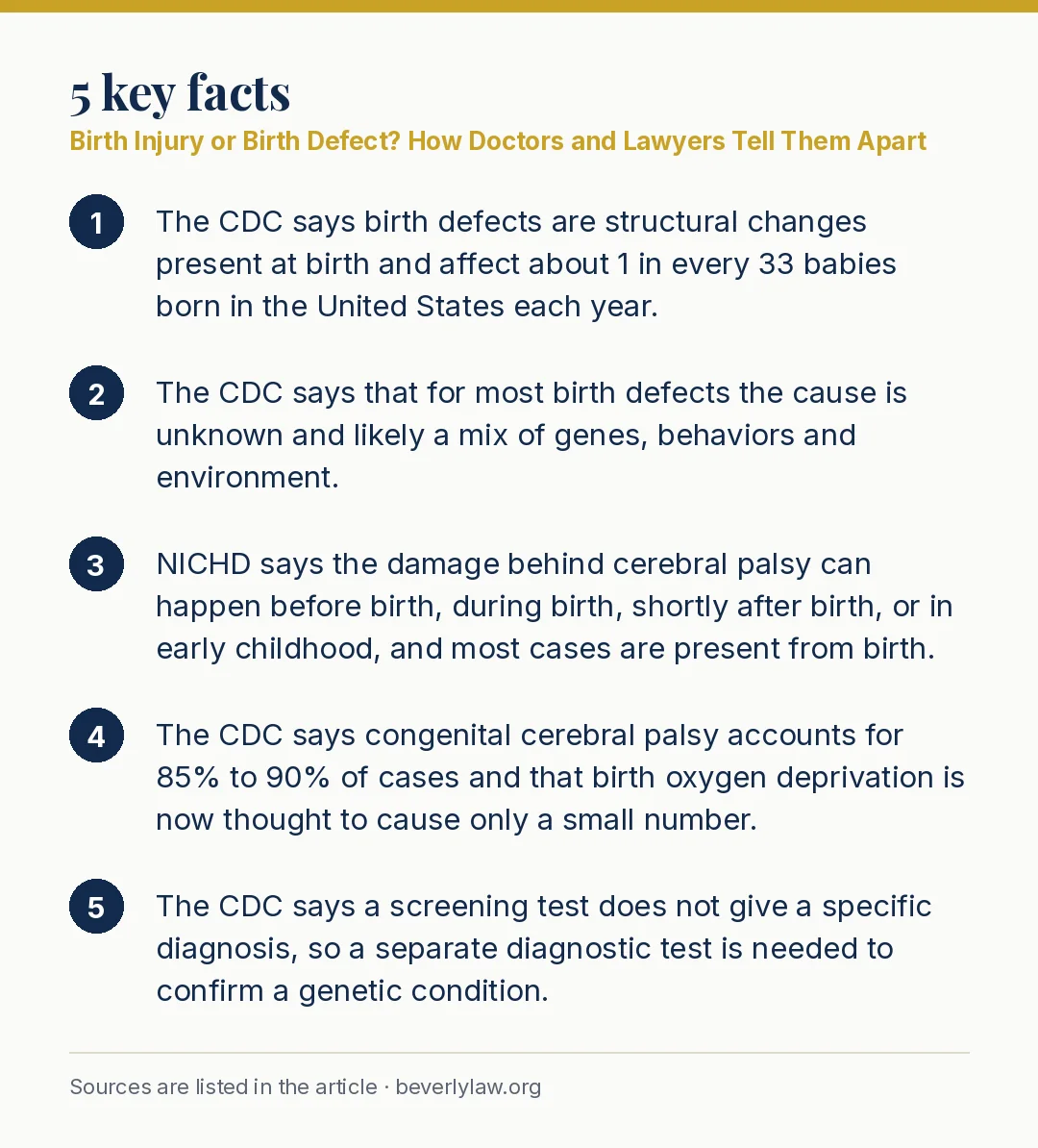
- The CDC says birth defects are structural changes present at birth and affect about 1 in every 33 babies born in the United States each year.
- The CDC says that for most birth defects the cause is unknown and likely a mix of genes, behaviors and environment.
- NICHD says the damage behind cerebral palsy can happen before birth, during birth, shortly after birth, or in early childhood, and most cases are present from birth.
- The CDC says congenital cerebral palsy accounts for 85% to 90% of cases and that birth oxygen deprivation is now thought to cause only a small number.
- The CDC says a screening test does not give a specific diagnosis, so a separate diagnostic test is needed to confirm a genetic condition.
Free birth-injury case review
We review the delivery records with medical experts and tell you honestly whether there is a case. You pay nothing unless we win.
Questions parents ask
Can a baby have both a birth defect and a birth injury?
Yes, it is possible. A baby may have a condition that formed during pregnancy and also be affected by events around delivery. Doctors usually review the whole record and test results to understand how each factor may have played a part.
Does a genetic test result rule out a birth injury?
Not by itself. A specific genetic finding can explain some conditions, but doctors still look at timing, imaging and the delivery record. Many children have no clear genetic cause found, and some genetic results are uncertain. Ask the care team to explain what the result does and does not show.
Should I ask about the placenta?
It is reasonable to ask whether the placenta was sent to pathology and to request a copy of any report. Placental findings may add information about infection, blood flow or timing. Keep in mind that they are one piece of evidence and need to be read with the rest of the records.
Sources
CDC – About Birth Defects
NICHD – How are birth defects diagnosed?
NICHD – Causes of Cerebral Palsy
CDC – About Cerebral Palsy
Telling a birth injury from a birth defect usually takes a careful look at timing, imaging, genetic testing and the placenta, and no single piece settles it. Ask for your records, ask what each test showed, and ask who can explain it in plain language. If you would like someone to look at your family's situation, Beverly Law offers a free case review, with no obligation and no promise about the outcome.
Ask a question
Not ready to call? Write your question and a member of our team answers you — no cost, no commitment.
Birth Injury or Birth Defect? How Doctors and Lawyers Tell Them Apart — Beverly Law
Free case review for families in California, Texas and Washington. We obtain the delivery records, have them reviewed by medical experts and deal with the hospital and its insurer — you focus on your child. You pay nothing unless we win.
Related pages
Cerebral Palsy · Erb’s Palsy / Brachial Plexus Injury · HIE / Oxygen Deprivation at Birth · Statute of Limitations · All birth-injury guides · Birth injury news
Important: This page is general information about birth injuries and California law, not legal advice, and reading it does not create an attorney-client relationship with Beverly Law. Every case is different — talk to a lawyer about your own situation. Attorney advertising. Prior results do not guarantee a similar outcome. No fee unless we win. Last reviewed: 2026-09-18.