
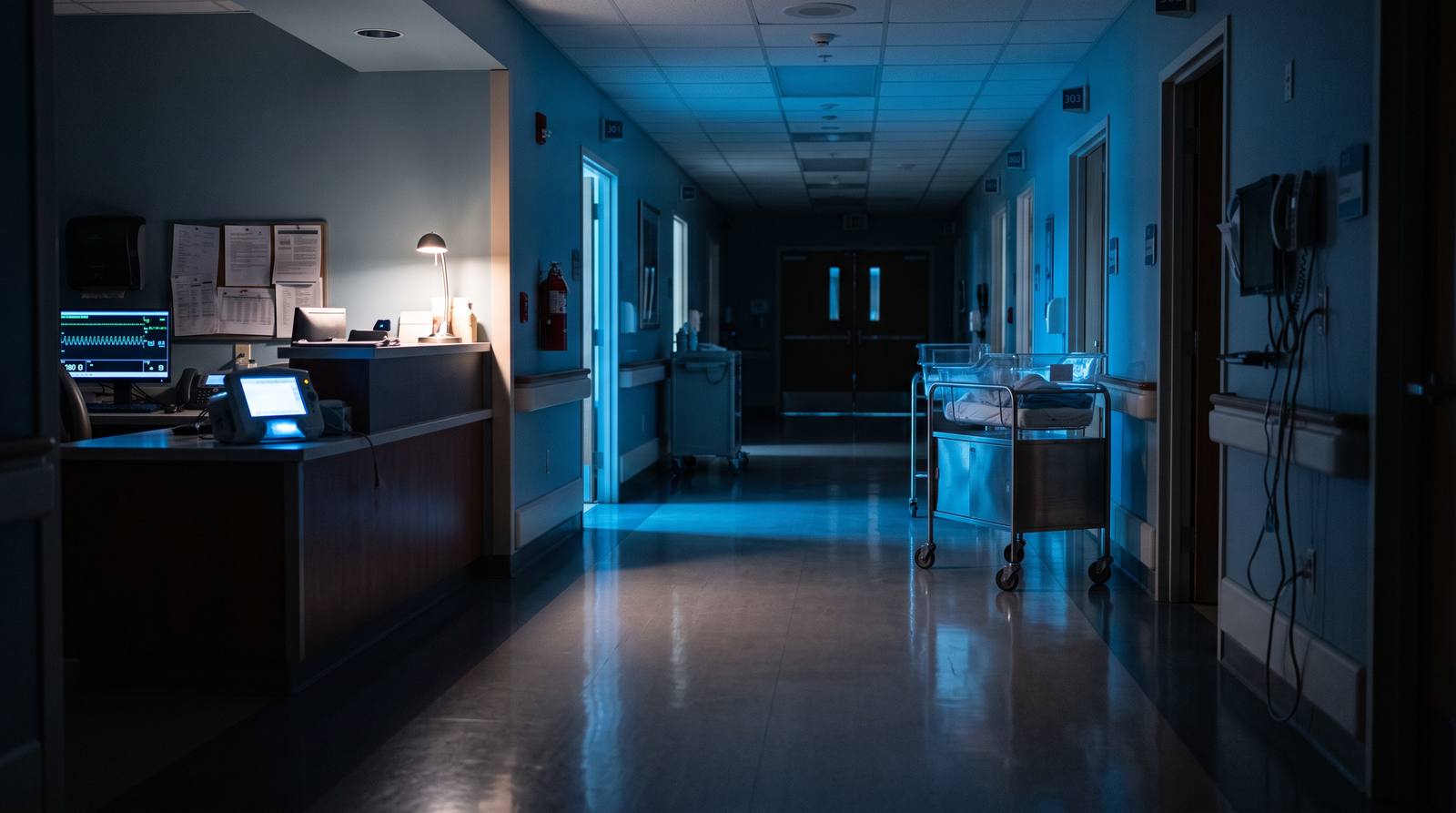

In the first hours after birth, a baby's body has to learn to manage its own blood sugar. For most babies this happens without any trouble. For some, the sugar level drops too low, a condition called neonatal hypoglycemia.
The good news is that a tiny drop of blood from the heel can show the problem early, and treatment is usually simple. This article explains who should be checked, what the numbers mean, how it is treated, and why a missed or delayed check matters.
Was your baby hurt during delivery?
Tell us your name and phone. We call you back today, in English or Spanish, and the consultation is free.
Free consultation · English y Español · No fee unless we win
Why newborns can have low blood sugar
Babies need glucose (sugar) for energy, and the brain depends on it more than any other organ. According to MedlinePlus, from the National Library of Medicine, blood sugar can drop when a baby has too much insulin, cannot make enough glucose, uses glucose faster than it is made, or does not get enough from feeding.
Many babies with low blood sugar show no signs at all. MedlinePlus notes that infants with low blood sugar may not have symptoms. When signs do appear, University Hospitals lists shakiness, sweating, pale or bluish skin, fast or paused breathing, low body temperature, weak muscle tone, poor feeding, low energy, a weak or high-pitched cry, and seizures.
Who should be screened
Hospitals usually check babies who have risk factors, even when the baby looks well. Stanford Medicine's newborn guidelines list babies born to mothers with diabetes (including gestational diabetes), babies who are large or small for their gestational age, and babies born before 37 weeks. Any baby with warning signs, such as jitteriness, sleepiness, poor sucking, or trouble staying warm, should have at least one glucose check.
University Hospitals also lists babies who were born under significant stress, and babies whose birth parent took certain medicines, such as terbutaline or steroids. If you have any of these risk factors, it is reasonable to ask your care team, before delivery, how your hospital checks newborn blood sugar.
Screening is usually done with a small drop of blood from the baby's heel, tested at the bedside. It takes only moments, and it can be repeated several times during the first day, which is common in babies with risk factors.
What the AAP numbers mean
The American Academy of Pediatrics (AAP) published a 2011 clinical report on blood sugar in late-preterm and term babies. A 2023 review in the National Library of Medicine's PubMed Central describes its approach: for at-risk babies, the operational thresholds change with the baby's age, at 25 to 40 mg/dL before 4 hours of age, 35 to 45 mg/dL from 4 to 24 hours, and 45 mg/dL after 24 hours.
The same review says that at-risk babies without symptoms should be fed by 1 hour of age and checked 30 minutes later. Small-for-gestational-age and late-preterm babies are checked before feeds for at least the first 24 hours, while large babies and babies of mothers with diabetes are checked for the first 12 hours. The review also notes that guidelines in different countries use somewhat different numbers, so your hospital's protocol may vary.
These numbers are guides for care teams, not a score for parents to track. A single reading below a threshold usually leads to feeding, a recheck, and sometimes treatment. What matters most is that the check happens on time, the result is acted on, and the baby is rechecked until the level stays steady.
Feeding and dextrose gel
For a baby who is well, the first step is usually extra feeding. MedlinePlus says infants with low blood sugar need extra feedings, and may need formula if breast milk is not enough. Stanford Medicine notes that many hospitals also use oral dextrose gel, which is rubbed on the inside of the cheek, and that for babies who look well, feeding or gel is tried before an IV.
A 2025 trial reported in Frontiers in Pediatrics used 40% dextrose gel at 200 mg/kg and encouraged breastfeeding for every baby. Doses and timing are set by the hospital, so they should not be copied at home. If the sugar stays low, the baby does not feed well, or the level is very low, a sugar solution is given through a vein, and the baby may move to the NICU. Blood sugar is rechecked after treatment.
What can happen when it is not caught
When treated promptly, the outlook is generally good. MedlinePlus says the outlook is good for newborns who have no symptoms or who respond well to treatment. University Hospitals explains that severe or long-lasting low blood sugar may cause seizures and serious brain injury.
The 2023 review adds that delayed diagnosis or poor management has been linked in reports to acute brain injury, visual-motor problems, difficulty with executive function, and developmental delays. It also says that neither the length nor the severity of the low sugar can reliably predict permanent damage, which is why timely screening and treatment matter so much.
What parents can do
Tell the nurses about any diabetes in pregnancy, early delivery, or medicines you took. Ask when your baby's first glucose check will be and what number triggers treatment. Feed your baby early and often, and report sleepiness, jitteriness, a weak cry, or poor feeding right away. It also helps to write down the times your baby fed and any treatment you were told about, so you can share them with your pediatrician later.
This article is general information, not legal or medical advice. Every baby is different, and only your baby's doctors can decide on care. If you are worried that a low blood sugar was missed or treated late, a lawyer can explain your options, and your own medical records are an important starting point.
Key facts
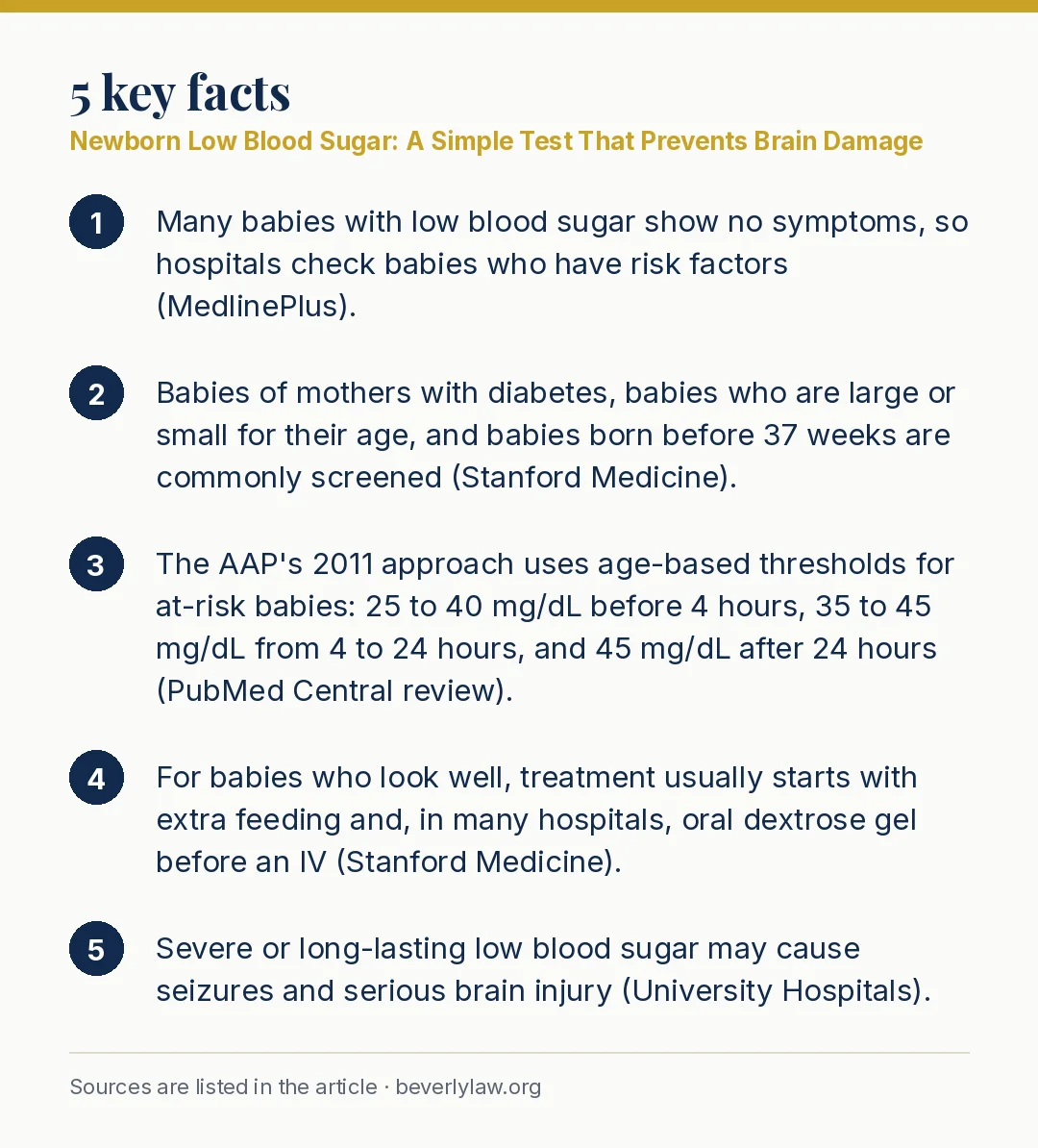
Read the key facts as text
- Many babies with low blood sugar show no symptoms, so hospitals check babies who have risk factors (MedlinePlus).
- Babies of mothers with diabetes, babies who are large or small for their age, and babies born before 37 weeks are commonly screened (Stanford Medicine).
- The AAP's 2011 approach uses age-based thresholds for at-risk babies: 25 to 40 mg/dL before 4 hours, 35 to 45 mg/dL from 4 to 24 hours, and 45 mg/dL after 24 hours (PubMed Central review).
- For babies who look well, treatment usually starts with extra feeding and, in many hospitals, oral dextrose gel before an IV (Stanford Medicine).
- Severe or long-lasting low blood sugar may cause seizures and serious brain injury (University Hospitals).
Free birth-injury case review
We review the delivery records with medical experts and tell you honestly whether there is a case. You pay nothing unless we win.
Questions parents ask
Does every newborn get a blood sugar test?
Not always. According to Stanford Medicine, screening is recommended for babies with increased risk, such as those born to mothers with diabetes, those large or small for gestational age, and premature babies, and for any baby with warning signs. Hospital routines differ, so ask your care team what they do.
Is the heel-prick test painful or harmful?
It uses a tiny sample of blood from the baby’s heel and is brief. The test is how hospitals find low blood sugar in babies who show no symptoms. Holding or feeding your baby can help comfort them.
If my baby had low blood sugar, will there be brain damage?
Not necessarily. MedlinePlus says the outlook is good for newborns who have no symptoms or who respond well to treatment. A 2023 review notes that severity and duration alone cannot reliably predict permanent damage, so ask your baby’s doctor about follow-up.
Sources
MedlinePlus (National Library of Medicine, NIH)
University Hospitals
Stanford Medicine Newborn Nursery
PubMed Central: Diagnosis and Management of Neonatal Hypoglycemia, A Comprehensive Review of Guidelines
PubMed Central: dextrose 40% gel in late preterm and small for gestational age infants (Frontiers in Pediatrics, 2025)
Newborn low blood sugar is common, usually easy to check, and often treated with extra feeding, dextrose gel, or an IV. Knowing who is at risk and asking about your hospital's checks can help you speak up early. If your child was harmed after low blood sugar went unchecked or untreated, Beverly Law invites you to request a free case review so you can understand your options. No outcome is promised.
Ask a question
Not ready to call? Write your question and a member of our team answers you — no cost, no commitment.
Newborn Low Blood Sugar: A Simple Test That Prevents Brain Damage — Beverly Law
Free case review for families in California, Texas and Washington. We obtain the delivery records, have them reviewed by medical experts and deal with the hospital and its insurer — you focus on your child. You pay nothing unless we win.
Related pages
Cerebral Palsy · Erb’s Palsy / Brachial Plexus Injury · HIE / Oxygen Deprivation at Birth · Statute of Limitations · All birth-injury guides · Birth injury news
Important: This page is general information about birth injuries and California law, not legal advice, and reading it does not create an attorney-client relationship with Beverly Law. Every case is different — talk to a lawyer about your own situation. Attorney advertising. Prior results do not guarantee a similar outcome. No fee unless we win. Last reviewed: 2026-09-18.