


When a baby's heart rate drops suddenly, or the placenta separates, or the umbilical cord slips down, doctors may decide the baby needs to be born right away by emergency cesarean. In those moments, parents often wonder one thing: how fast is fast enough?
You may have heard of the "30-minute rule." This article explains where it comes from, what the research says about it, why some hospitals reach it more easily than others, and how the timing of an emergency cesarean is written down in medical records. It is meant to help you understand, not to alarm you. Most emergency cesareans go as planned.
Was your baby hurt during delivery?
Tell us your name and phone. We call you back today, in English or Spanish, and the consultation is free.
Free consultation · English y Español · No fee unless we win
When a cesarean becomes an emergency
According to KidsHealth, a cesarean may be needed quickly when labor stops progressing, when the placenta separates from the wall of the uterus, when the umbilical cord is pinched or prolapses and cuts down the baby's oxygen, or when the baby's heart rate shows signs of distress. KidsHealth also notes that the benefits of a cesarean in these situations usually far outweigh the risks, and that it can be lifesaving.
Not every cesarean is equally urgent. Some are planned, some are done within hours, and a few are "crash" cesareans where every minute counts. The word "delay" only has meaning when you know how urgent the situation was at the time.
What the 30-minute rule says
The guideline most people mean comes from the American College of Obstetricians and Gynecologists (ACOG), together with the American Academy of Pediatrics. As described in published studies, it says hospitals should be able to begin a cesarean within 30 minutes of the decision to operate. Researchers often call this the decision-to-incision or decision-to-delivery interval.
It is a standard for what a hospital should be able to do, not a promise about any single birth. Studies note that the 30-minute figure came largely from what hospitals were able to do, and that no randomized trial has shown a particular cutoff to be best. A study from the United Kingdom points out that its own national guidance also uses 30 minutes, "where possible," for cases of confirmed or suspected acute fetal compromise. In real life, doctors weigh the urgency of each case: some situations call for delivery in far less than 30 minutes, and others allow more time.

Why night, weekend and staffing can matter
A cesarean needs several people at once: an obstetrician, an anesthesia provider, nurses, a surgical team, and a ready operating room. A study in Ethiopia found that emergency cesareans done in the daytime generally had shorter intervals than those at night, and that moving the patient to the operating room within 15 minutes was linked to meeting the 30-minute mark. A UK study found that when a nurse or midwife could not give one-to-one care, the interval was significantly longer.
Results are not the same everywhere. A Swedish study of 135 emergency cesareans found no significant difference between daytime, weeknight on-call and weekend shifts, and 92% were completed within 30 minutes. This suggests that well-organized, well-staffed units can keep the same pace at any hour. The type of anesthesia also plays a part: both studies found that general anesthesia was usually faster to start than a spinal block, which is a medical judgment made for each patient.
These studies come from different countries and health systems, so they do not describe any particular hospital in California, Texas or Washington. They show why parents and reviewers may ask which team members were in the building and how long each step took.
How a delay shows up in the records
A medical chart is a timeline. In an emergency cesarean it usually includes the fetal heart rate tracing, nursing notes, the time the doctor was called, the time the decision to operate was made, the time the patient left the labor room, anesthesia start, the incision time, and the time of birth. Each note is normally stamped with a clock time.
Reading those times side by side can show how the minutes were used. Gaps may be easy to explain, such as waiting for an operating room or starting general anesthesia for safety. Sometimes clocks in different machines do not match, or a decision time is written after the fact. That is why records are read carefully, together with the monitor strips, rather than from a single line.
What families can do, and a note on legal deadlines
If you have questions about your birth, you can ask the hospital's medical records office for a copy of your chart and your baby's chart. You can also ask your doctor to walk you through what happened. Writing down your own memory of the times and who was in the room, while it is fresh, can help.
Time limits for taking legal action in a medical case are set by each state, and they can be shorter than people expect. California, Texas and Washington each have their own rules, and some may be different when the patient is a child. Because we cannot verify the exact numbers here, please check with a licensed attorney in your state soon rather than rely on a general article.
This article is general information. It is not legal or medical advice, and it does not describe any person's case.
Key facts
Read the key facts as text
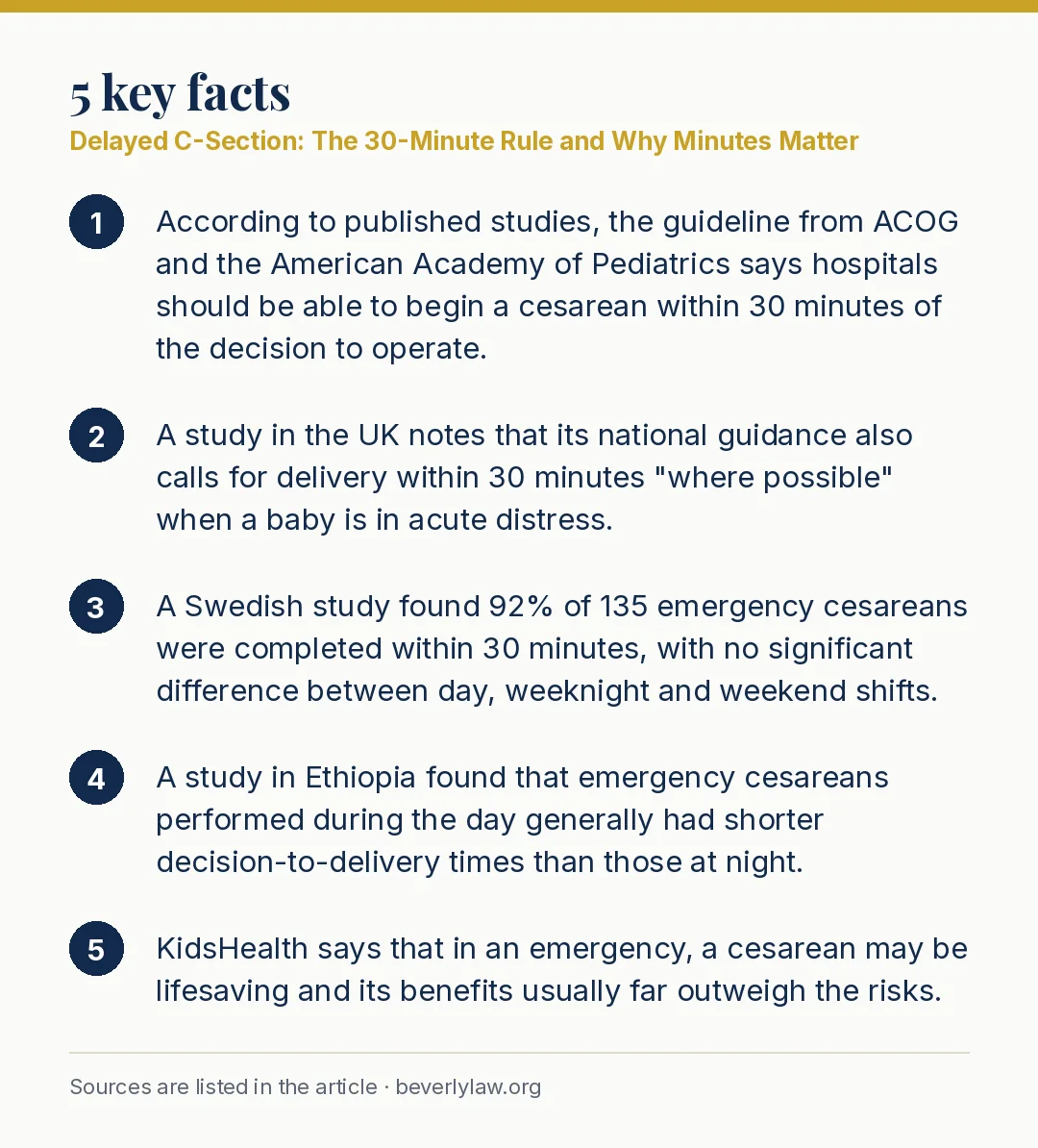
- According to published studies, the guideline from ACOG and the American Academy of Pediatrics says hospitals should be able to begin a cesarean within 30 minutes of the decision to operate.
- A study in the UK notes that its national guidance also calls for delivery within 30 minutes "where possible" when a baby is in acute distress.
- A Swedish study found 92% of 135 emergency cesareans were completed within 30 minutes, with no significant difference between day, weeknight and weekend shifts.
- A study in Ethiopia found that emergency cesareans performed during the day generally had shorter decision-to-delivery times than those at night.
- KidsHealth says that in an emergency, a cesarean may be lifesaving and its benefits usually far outweigh the risks.
Free birth-injury case review
We review the delivery records with medical experts and tell you honestly whether there is a case. You pay nothing unless we win.
Questions parents ask
Is the 30-minute rule a law?
No. It is a guideline from medical groups about what a hospital should be able to do. Researchers note it was not built from a trial showing one exact cutoff. Doctors still judge how urgent each case is.
Does a cesarean that takes longer than 30 minutes mean something went wrong?
Not necessarily. The studies show that many safe emergency cesareans take more than 30 minutes, and some situations allow more time. What matters is how urgent the situation was and what happened during each step. Records help answer that.
How can I get the records of my birth?
You can ask the hospital’s medical records or health information office for your chart and your baby’s chart. You may be asked to sign a request form. Ask for the fetal monitoring strips and nursing notes too, since they carry the clock times.
Sources
PMC (NIH) – Decision to delivery interval and associated factors for emergency cesarean section
PMC (NIH) – Emergency Caesarean Section: Influences on the Decision-to-Delivery Interval
PMC (NIH) – The decision to delivery interval in emergency caesarean sections: Impact of anaesthetic technique and work shift
KidsHealth (Nemours) – Cesarean Sections (C-Sections)
The 30-minute guideline is a measure of what a hospital should be ready to do, and real births are judged by how urgent the situation was and how each step unfolded. Staffing, anesthesia and operating room readiness can all shape the clock, and the chart records those times. If you have questions about the timing of your delivery or your baby's health afterward, we invite you to ask for a free case review so someone can explain your options. There are no promises about any outcome.
Ask a question
Not ready to call? Write your question and a member of our team answers you — no cost, no commitment.
Delayed C-Section: The 30-Minute Rule and Why Minutes Matter — Beverly Law
Free case review for families in California, Texas and Washington. We obtain the delivery records, have them reviewed by medical experts and deal with the hospital and its insurer — you focus on your child. You pay nothing unless we win.
Related pages
Cerebral Palsy · Erb’s Palsy / Brachial Plexus Injury · HIE / Oxygen Deprivation at Birth · Statute of Limitations · All birth-injury guides · Birth injury news
Important: This page is general information about birth injuries and California law, not legal advice, and reading it does not create an attorney-client relationship with Beverly Law. Every case is different — talk to a lawyer about your own situation. Attorney advertising. Prior results do not guarantee a similar outcome. No fee unless we win. Last reviewed: 2026-09-18.