


During labor, many hospitals track a baby's heartbeat and the mother's contractions on a monitor. The monitor prints or displays a long line called a tracing, or a strip. To a parent it can look like a wall of squiggles. To a trained nurse or doctor, it is a running report on how the baby is handling labor.
This article explains, in plain words, how those strips are usually read, what the three categories mean, what a nurse is expected to do when something looks wrong, and why the strips are some of the most important pages in a medical records review. It is general information for families in California, Texas and Washington, and it is not a judgment about any hospital or any birth.
Was your baby hurt during delivery?
Tell us your name and phone. We call you back today, in English or Spanish, and the consultation is free.
Free consultation · English y Español · No fee unless we win
What the monitor is measuring
According to Cleveland Clinic, fetal heart rate monitoring measures the speed and pattern of the baby's heartbeat, which are signs of health. A healthy baseline rate is usually 110 to 160 beats per minute. Monitoring can be external, with a device held on the belly by a belt, or internal, with a thin wire placed on the baby's scalp after the water has broken.
Stanford Medicine Children's Health notes that external monitoring carries minimal risk, while internal monitoring can cause slight discomfort, bruising or, rarely, infection. Monitoring is often used closely when a pregnancy has added risks, such as diabetes or high blood pressure.
The strip shows two lines at once: the baby's heart rate on top and the mother's contractions below. Reading them together is the key. A heart rate dip means very little without knowing when the contraction happened.
Category I, II and III: the three-tier system
The American Academy of Family Physicians describes the three-tier system developed with the National Institute of Child Health and Human Development. Category I is normal: a baseline of 110 to 160, moderate variability, and no late or variable decelerations. No special action is usually needed.
Category II is called indeterminate. It covers any tracing that is not clearly Category I or III, for example a fast heart rate, minimal variability, or variable decelerations that are slow to recover. Category II is a very wide group. Many Category II tracings settle with simple steps, so the team usually keeps watching and acts if the pattern continues or worsens.
Category III is the most concerning. It includes a sinusoidal pattern, or absent variability together with recurrent late decelerations, recurrent variable decelerations, or a very slow heart rate. The AAFP says this category calls for immediate action, including attempts to help the baby and, if there is no quick improvement, expedited delivery.

Late and variable decelerations
A deceleration is a drop in the baby's heart rate. Cleveland Clinic explains that early decelerations are expected during contractions, while late decelerations may suggest decreased blood flow through the placenta and variable decelerations are usually linked to pressure on the umbilical cord.
Timing matters. A late deceleration starts after the contraction has begun. A variable deceleration drops quickly and its shape and timing change from one contraction to the next. The AAFP notes that decelerations are called recurrent when they happen with about half or more of contractions.
One deceleration alone is rarely the whole story. Clinicians look at the baseline, the variability, how often the pattern repeats, and how the baby responds to steps such as changing the mother's position, giving IV fluids, giving oxygen, or stopping medicines that make contractions stronger.
When a nurse escalates: the chain of command
Labor nurses are often the first to notice a worrying pattern. The AAFP describes a standard way of reporting it, using a checklist that covers the contractions, baseline rate, variability, accelerations, decelerations and an overall assessment, so everyone describes the strip in the same language.
Many hospitals also have a chain-of-command policy. In general terms, if a nurse is concerned and the first clinician does not respond or does not act, the nurse is expected to tell the next person up, such as a charge nurse, a department head or another physician. Each hospital writes its own policy, so the details differ.
The AHRQ Patient Safety Network reports that reading these strips can be hard and that readers do not always agree. It also describes a case in which two nurses were watching 16 tracings on one screen and missed bad ones, and it stresses open, clear communication between team members and clear chain-of-command protocols. Missed warnings are often a system problem as well as an individual one.
Why the strips matter in a records review
The strip is a time-stamped record. It can show what the baby's heart rate was doing, when, and how that lined up with notes about who was told and what was done. Nursing notes, physician notes, orders and the strip are usually read side by side.
In a review, a reader may ask: What category did the tracing appear to be at each point? Is the time of each note consistent with the strip? Was a concern reported, and to whom? What happened next? Strips are often stored electronically and can be lost if nobody asks for them, so families usually request the complete labor record, including the tracing itself, not only a summary.
Reading a strip takes training. A review by a qualified obstetric nurse or physician is usually needed before anyone can say whether care met accepted standards. In California, Texas and Washington, families request records from the hospital's medical records department; the exact process and timelines are set by each hospital and by state and federal rules.
This article is general information only. It is not legal or medical advice, and it cannot tell you what happened in any particular birth.
Key facts
Read the key facts as text
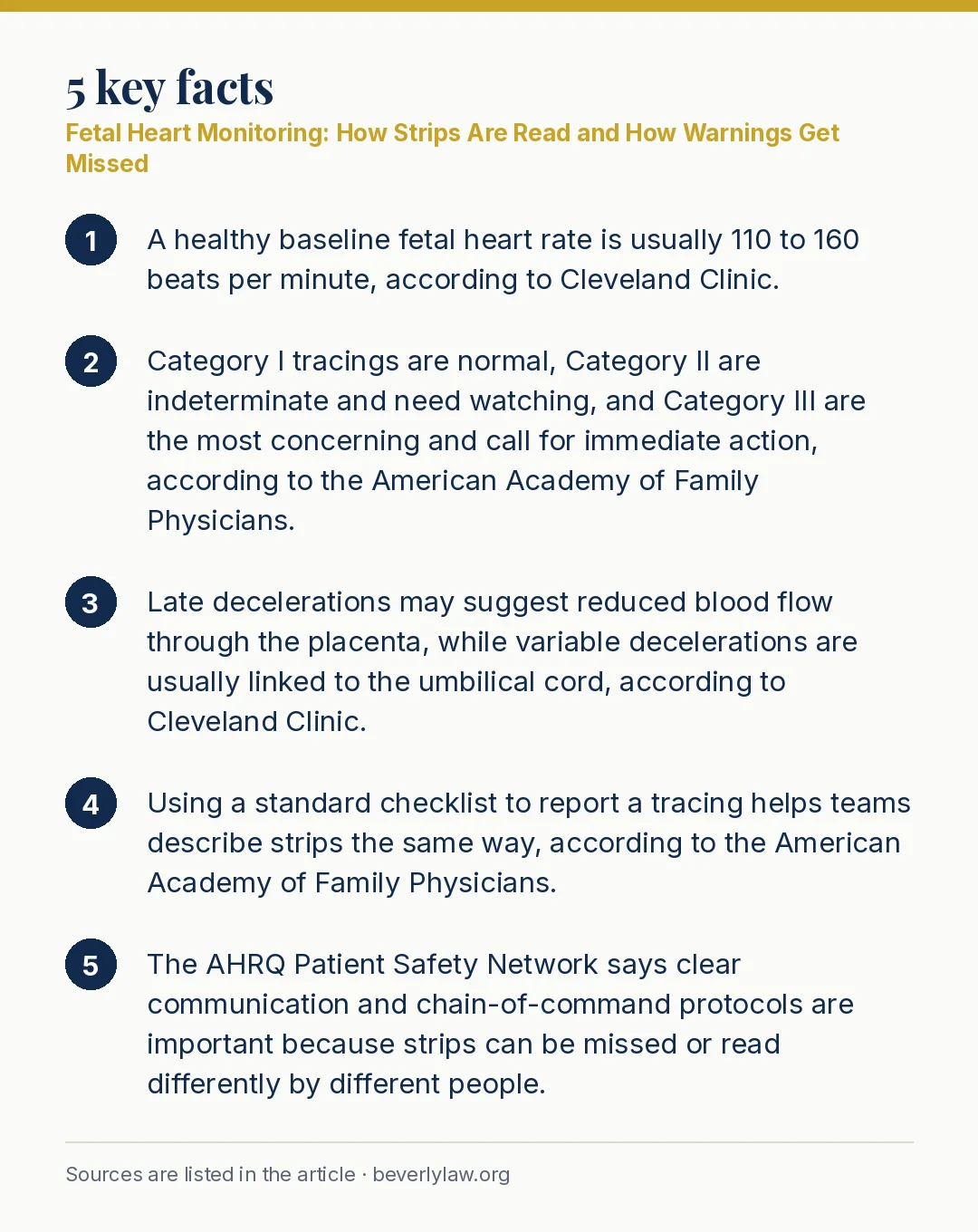
- A healthy baseline fetal heart rate is usually 110 to 160 beats per minute, according to Cleveland Clinic.
- Category I tracings are normal, Category II are indeterminate and need watching, and Category III are the most concerning and call for immediate action, according to the American Academy of Family Physicians.
- Late decelerations may suggest reduced blood flow through the placenta, while variable decelerations are usually linked to the umbilical cord, according to Cleveland Clinic.
- Using a standard checklist to report a tracing helps teams describe strips the same way, according to the American Academy of Family Physicians.
- The AHRQ Patient Safety Network says clear communication and chain-of-command protocols are important because strips can be missed or read differently by different people.
Free birth-injury case review
We review the delivery records with medical experts and tell you honestly whether there is a case. You pay nothing unless we win.
Questions parents ask
Does a Category II tracing mean something is wrong with my baby?
Not necessarily. Category II is a broad middle group, and the AAFP describes it as needing assessment and possible steps like repositioning or IV fluids. Many Category II tracings improve. What matters is whether the pattern continues or worsens and how the team responds.
Can I ask to see or get a copy of the monitor strip?
Families can usually request their labor and delivery records, including fetal monitoring tracings, from the hospital’s medical records department. Ask for the full tracing and not only a summary. Hospital procedures and timelines vary, so ask the department what they require.
What is a chain of command?
It is a hospital’s written process for what a nurse or other team member does if they are worried about a patient and are not getting a response. In general it means telling the next person up, such as a charge nurse or another physician. Each hospital’s policy is different.
Sources
American Academy of Family Physicians (American Family Physician): Intrapartum Fetal Monitoring
AHRQ Patient Safety Network: Monitoring Fetal Health
Cleveland Clinic: Fetal Heart Rate Monitoring
Stanford Medicine Children's Health: Fetal Heart Monitoring
A fetal monitor strip is a time-stamped record of how a baby handled labor, and reading it correctly depends on training, clear communication and a working chain of command. If you have questions about the monitoring during your delivery, the full labor record, including the tracing, is the best place to start. Beverly Law offers a free case review where our team can listen to your questions and explain next steps, with no promises about any outcome.
Ask a question
Not ready to call? Write your question and a member of our team answers you — no cost, no commitment.
Fetal Heart Monitoring: How Strips Are Read and How Warnings Get Missed — Beverly Law
Free case review for families in California, Texas and Washington. We obtain the delivery records, have them reviewed by medical experts and deal with the hospital and its insurer — you focus on your child. You pay nothing unless we win.
Related pages
Cerebral Palsy · Erb’s Palsy / Brachial Plexus Injury · HIE / Oxygen Deprivation at Birth · Statute of Limitations · All birth-injury guides · Birth injury news
Important: This page is general information about birth injuries and California law, not legal advice, and reading it does not create an attorney-client relationship with Beverly Law. Every case is different — talk to a lawyer about your own situation. Attorney advertising. Prior results do not guarantee a similar outcome. No fee unless we win. Last reviewed: 2026-09-18.