

Most babies move, roll, sit, and reach within a wide range of what's considered normal, but sometimes a parent notices something that doesn't quite fit — a hand that stays fisted, a baby who doesn't push up during tummy time, or a lean to one side. These are often the first things parents bring up with a pediatrician, and sometimes they turn out to be an early sign of cerebral palsy (CP), a group of disorders that affect movement, muscle tone, and posture, according to the Centers for Disease Control and Prevention (CDC).
CP is the most common motor disability of childhood, and most children who have it are diagnosed sometime during their first or second year of life, per the CDC. There is no single test and no single moment when a diagnosis is made — it's usually a combination of what a pediatrician sees at well-child visits, developmental screening results, and, when needed, a referral to a specialist for further evaluation. This guide walks through what movement typically looks like in the first year, the signs worth a second look, and how the diagnostic process works for families in California, Texas, and Washington.
Was your baby hurt during delivery?
Tell us your name and phone. We call you back today, in English or Spanish, and the consultation is free.
Free consultation · English y Español · No fee unless we win
Movement Milestones in the First Year: What to Expect Around 3-4, 6, 9, and 12 Months
Around 3 to 4 months, per CDC milestone checklists, most babies hold their head steady without support when held, push up onto their elbows or forearms during tummy time, hold a toy briefly when it's placed in their hand, and bring their hands to their mouth. Babies who consistently let their head fall back, keep their fists tightly closed past this age, or feel unusually stiff or floppy when handled are sometimes flagged for closer follow-up.
By 6 months, the CDC's Learn the Signs. Act Early. milestones include rolling from tummy to back, pushing up with straight arms during tummy time, and leaning on the hands for support while sitting. By 9 months, most babies can get into a sitting position by themselves, sit without support, and move a toy from one hand to the other. By 12 months, most are pulling up to stand, walking while holding on to furniture, and picking up small objects between thumb and finger.
A baby who isn't doing these things doesn't automatically have cerebral palsy — development varies, and premature babies in particular are often assessed against their adjusted age rather than their birth date. But a pattern of lagging several months behind, especially across more than one area, is one of the reasons families end up asking for an evaluation.
Muscle Tone and Asymmetry: Signs Parents Notice First
Beyond missed milestones, tone and symmetry are often what catches a parent's eye first. The CDC describes two opposite patterns: increased tone, or spasticity, where muscles stay stiff even at rest and arms or legs are hard to bend; and decreased tone, where a baby feels floppy and has trouble holding their head up or sitting. About 80% of children diagnosed with cerebral palsy have the spastic type, according to the CDC.
Asymmetry is another signal doctors watch for — using one hand much more than the other before about a year old, reaching with only one arm while the other stays fisted, or crawling by pushing off with one side of the body instead of moving both sides evenly. In children with one-sided cerebral palsy, known as hemiplegia, the CDC notes the arm is typically more affected than the leg on the same side.
Other things pediatricians ask about include scissoring of the legs when a baby is picked up, an arched back or overextended neck when held, and stiff or jerky, involuntary movements. None of these signs on its own confirms cerebral palsy, but together with a motor delay, they're usually enough for a doctor to recommend the next step.

When to Ask Your Pediatrician for a Referral
Well-child visits are built around exactly this kind of tracking. The American Academy of Pediatrics recommends developmental screening at 9, 18, and 24-30 months, in addition to ongoing developmental monitoring at every visit, according to the CDC. Parents don't have to wait for a scheduled screening, though — if something feels off between visits, it's reasonable to call and ask to be seen sooner.
It helps to describe specifically what's being noticed: which hand, which side, what the baby does or doesn't do during tummy time, and whether it's been consistent over weeks rather than a single day. Babies born preterm, who had a difficult delivery, or who spent time in the NICU are sometimes followed more closely from the start, but any parent can ask for a referral to a specialist, such as a pediatric neurologist or developmental pediatrician, if a screening raises concerns.
A referral for a closer look isn't the same as a diagnosis, and most babies referred for a motor-delay evaluation do not turn out to have cerebral palsy. But asking early costs nothing and, if there is a delay, opens the door to services sooner.
How Cerebral Palsy Is Diagnosed
There's no single blood test or scan that confirms cerebral palsy by itself. According to the National Institute of Child Health and Human Development (NICHD), diagnosis usually starts with a clinical exam — a doctor checking a baby's growth, muscle tone, reflexes, posture, hearing, and vision over more than one visit, since motor patterns can become clearer over time.
If the exam raises concerns, a doctor may order brain imaging. MRI gives the most detail and is generally preferred when available, while cranial ultrasound is often used first in premature infants because it's simpler to perform; CT scans and an EEG are sometimes added, the EEG mainly if a baby has had seizures, per NICHD. Genetic or metabolic testing may also be used to rule out other conditions that can look similar.
The CDC notes that most children are diagnosed during their first or second year, though children with milder symptoms are sometimes not confirmed until later, since some signs are easier to see once a child should be walking or talking. A diagnosis usually involves a team — a primary pediatrician plus specialists like a pediatric neurologist or developmental pediatrician — rather than a single appointment.
Why an Early Diagnosis Matters — and Early Intervention in California, Texas, and Washington
According to NICHD, early identification allows families and doctors to plan intervention and bring in specialists sooner to address a child's specific developmental needs. That's part of why doctors tend to treat a parent's early concern as worth investigating rather than something to wait out.
Families don't need a confirmed diagnosis to start services. In California, a child under 36 months can be referred to Early Start through the Department of Developmental Services, which assigns a service coordinator within 45 days of referral at no cost for the evaluation. In Texas, Early Childhood Intervention (ECI), run by the Health and Human Services Commission, accepts referrals for children from birth to 36 months based on a suspected delay, with no diagnosis required. In Washington, Early Support for Infants and Toddlers (ESIT), through the Department of Children, Youth, and Families, can be reached through the Help Me Grow Washington hotline or a direct referral from a pediatrician.
This article is general information, not medical or legal advice, and no two children's situations are the same. If your child was diagnosed with cerebral palsy and you're wondering whether something during pregnancy, delivery, or newborn care may have contributed to a delay in catching it, a free case review can help you understand your options with no obligation.
Key facts
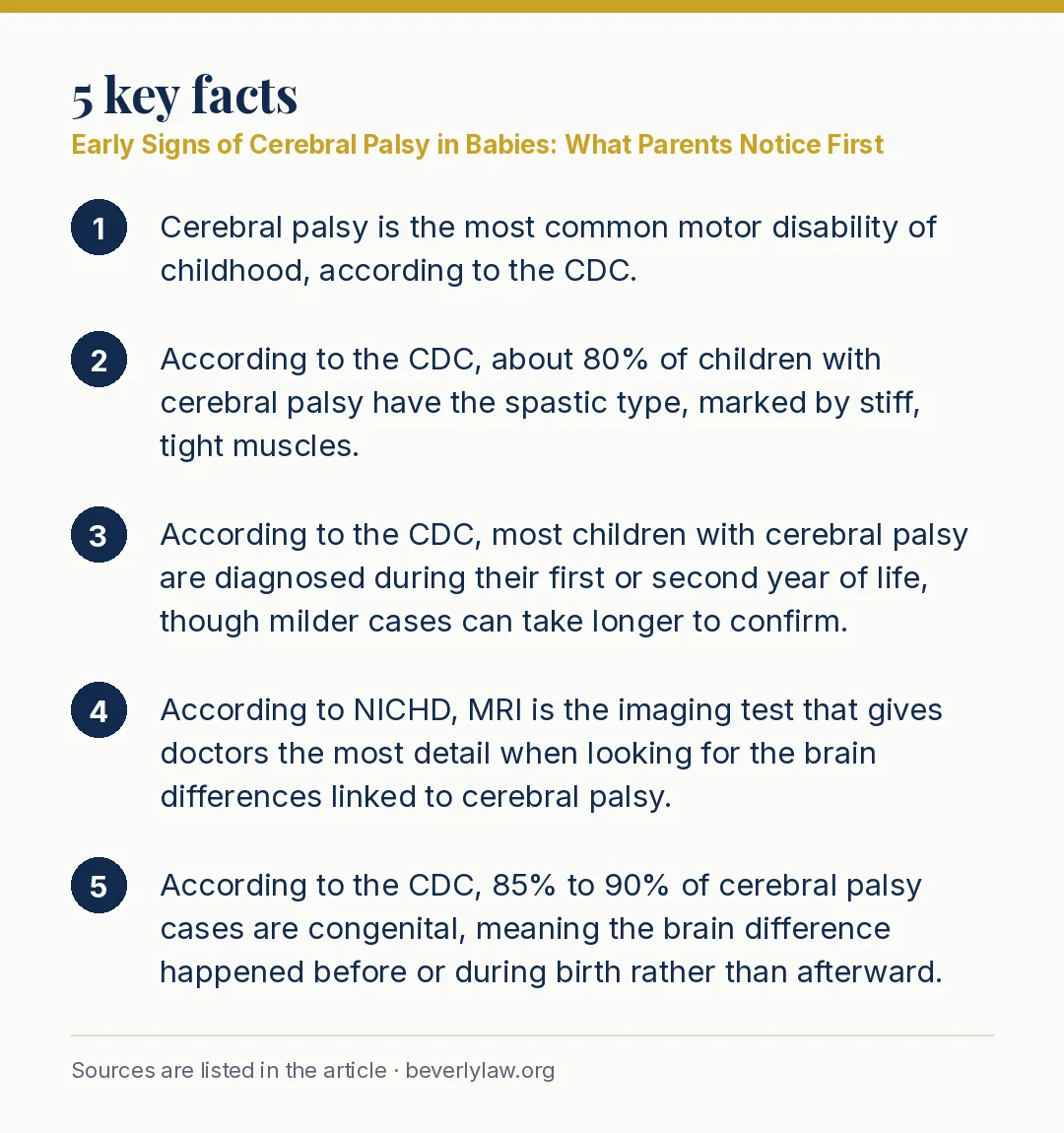
Read the key facts as text
- Cerebral palsy is the most common motor disability of childhood, according to the CDC.
- According to the CDC, about 80% of children with cerebral palsy have the spastic type, marked by stiff, tight muscles.
- According to the CDC, most children with cerebral palsy are diagnosed during their first or second year of life, though milder cases can take longer to confirm.
- According to NICHD, MRI is the imaging test that gives doctors the most detail when looking for the brain differences linked to cerebral palsy.
- According to the CDC, 85% to 90% of cerebral palsy cases are congenital, meaning the brain difference happened before or during birth rather than afterward.
Free birth-injury case review
We review the delivery records with medical experts and tell you honestly whether there is a case. You pay nothing unless we win.
Questions parents ask
Does missing one milestone mean my baby has cerebral palsy?
No. Missing a single milestone doesn’t mean a baby has cerebral palsy — development varies from child to child. What doctors look for is a pattern: delays in more than one area, changes in muscle tone, or asymmetry that persists over time. Either way, it’s always reasonable to mention any concern to your pediatrician.
Is an MRI safe for a baby?
MRI doesn’t use radiation, unlike an X-ray or CT scan, according to NICHD. Depending on the baby’s age, they may need to be asleep or sedated to stay still during the scan, which the medical team will explain beforehand.
What happens after I ask for a referral to early intervention?
Generally, a service coordinator contacts the family, a developmental evaluation is scheduled, and if the child qualifies, an individualized service plan is created. In California, Texas, and Washington, the initial evaluation is free, and a confirmed diagnosis isn’t required to request one.
Sources
CDC
CDC – Learn the Signs. Act Early.
CDC
NICHD (Eunice Kennedy Shriver National Institute of Child Health and Human Development)
California Department of Developmental Services
Texas Health and Human Services Commission
Noticing something different in how a baby moves doesn't mean something is wrong, but asking about it early rarely hurts. This article is general information, not medical or legal advice, and it doesn't replace an evaluation by a health care professional. If your child was diagnosed with cerebral palsy and you're wondering whether care during pregnancy, delivery, or the newborn period may have delayed the diagnosis, you can request a free, no-obligation case review.
Ask a question
Not ready to call? Write your question and a member of our team answers you — no cost, no commitment.
Early Signs of Cerebral Palsy in Babies: What Parents Notice First — Beverly Law
Free case review for families in California, Texas and Washington. We obtain the delivery records, have them reviewed by medical experts and deal with the hospital and its insurer — you focus on your child. You pay nothing unless we win.
Related pages
Cerebral Palsy · Erb’s Palsy / Brachial Plexus Injury · HIE / Oxygen Deprivation at Birth · Statute of Limitations · All birth-injury guides · Birth injury news
Important: This page is general information about birth injuries and California law, not legal advice, and reading it does not create an attorney-client relationship with Beverly Law. Every case is different — talk to a lawyer about your own situation. Attorney advertising. Prior results do not guarantee a similar outcome. No fee unless we win. Last reviewed: 2026-09-18.