

By Michael Shemtoub, Esq., Managing Attorney, Beverly Law
Dealing with an insurance adjuster?
Leave your name and phone. We call back today, in English or Spanish. The consultation is free and confidential.
Free consultation · English y Español · No fees or costs unless we win
The other driver’s insurance company
You did not buy the at-fault driver’s policy, so its duties do not bind you. The adjuster’s authorization is a request. We have not found a general rule in any state that forces an injured person to sign it before suit.
That freedom has a practical limit. The insurer has no reason to pay for injuries it cannot see in the records. If you refuse the form and send nothing, the claim will sit. The better move is to give proof on your terms, either by sending the crash-related records and bills yourself, as explained on how to send medical records to the adjuster yourself, or by signing a narrow form you have edited.
Your own insurance company
The picture changes when the claim is under your own policy. MedPay, PIP and uninsured motorist claims are first-party claims, and your policy is a contract between you and the company. Many policies list duties after an accident that include helping the company obtain medical records. If you refuse outright, the company may argue you did not hold up your end.
You can still ask for limits. Request a form that names the providers who treated you for the crash, starts on the crash date and has a short end date. The page on your own insurer’s medical authorization goes through that conversation.
After a lawsuit is filed
Once the case is in court, the authorization fight usually moves into discovery. The defense asks for records through formal requests or subpoenas, and you can object to requests that reach too far. In federal court, Rule 26(b)(1) allows discovery of nonprivileged matter that is relevant to a claim or defense and proportional to the needs of the case. State courts have their own rules and privacy case law, and they differ.
Court rules also allow a physical examination by a licensed examiner, usually one the defense picks, when your condition is in controversy. In federal court that is Rule 35, which lets the court order the exam only on a motion showing good cause. Insurers call it by other names; we call it a defense medical exam. See the insurance company wants me to see their doctor.
Free case review
Tell us what happened. We will tell you plainly whether there is a case and what to do next. You owe no fees or costs unless we win.
What makes an authorization valid
If you do sign, the form has to meet federal requirements. Under 45 CFR 164.508(c), it needs a specific description of the information, the people who may release it and receive it, a purpose, an expiration date or event, and your signature and date. A form that has not been filled out completely, or whose expiration date has passed, is not valid under the same section.
Some states add their own rules. Washington’s RCW 70.02.030 requires a written, dated and signed authorization that identifies the information, the recipient and the provider, and that contains an expiration date or event.
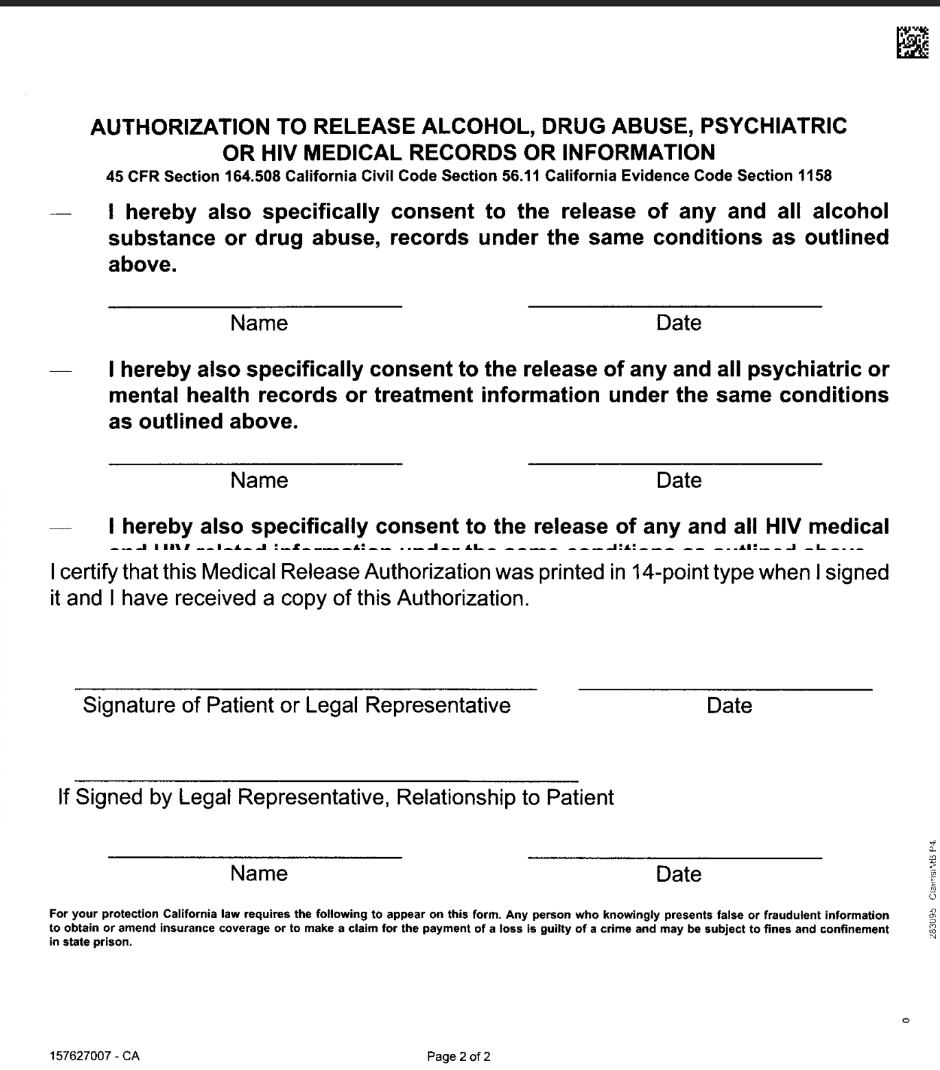
Read every page. A National General form that one insurer sent to our office in 2026 has a second page with three separate sign-offs: alcohol and drug treatment records, psychiatric and mental health records, and HIV records. Each is a separate consent with its own signature line. Leave them blank unless your injury claim involves that care. The National General form page shows the rest of that form.
Who signs for a child or an adult who cannot sign
Under HIPAA’s personal representative rule, 45 CFR 164.502(g), a provider treats a person with legal authority to make health care decisions for someone as that person’s representative. For most children that means a parent or guardian, with exceptions set by state law for certain kinds of care. For an adult who cannot sign, it means someone with legal authority such as a guardian or an agent under a health care power of attorney. The federal rule also requires the form to describe the representative’s authority when a representative signs.
Children’s claims have extra steps at settlement. See settling a child’s injury claim with an adjuster.
What to do next
Figure out which company sent the form and whether the claim is under your policy or the other driver’s. For the other driver’s insurer, send the crash-related records and bills yourself or a narrow form you have edited. For your own insurer, read the duties section of your policy, then ask for a limited form. If you already signed a broad one, you can revoke the medical authorization going forward. The full list of topics is on our insurance adjuster questions page.
Common questions
Is a medical release form necessary to settle an injury claim?
Proof of your injuries is necessary. A signed release form is one way to provide it. Sending your own records is another.
Should I release medical records to an insurance company?
Release the ones that show your crash injuries and treatment. The page should I sign a medical release for the insurance adjuster explains how to limit what goes out.
How long does an authorization last?
Until the date or event written on it. Federal rules require every authorization to have one. Check it before you sign and write in a short date if the line is blank.
Can the adjuster ask about my old injuries?
It can ask. What you send is a separate question, covered on can the insurance company ask for my medical records.
Can the insurer refuse to pay if I don't sign?
It can refuse to pay for injuries it cannot document. If you give it the crash-related records another way, that reason goes away. Texas cases are handled by the firm’s Texas-licensed attorneys, Joyce Ondich and John Efstathiou. You owe no fees or costs unless we win. Call toll-free 1-877-427-2752 (1-877-4-ASAP-LAW), 24/7, from anywhere in the country.
Ask a question
Not ready to call? Write your question and someone on our team will answer. No cost, no commitment.
Injury lawyer — Beverly Law
Hurt because of someone else in California, Texas and Washington? Talk to an injury attorney. Free, confidential, English or Spanish. You owe no fees or costs unless we win.
Related pages
Insurance adjuster questions · Injury law FAQs
Sources
Important: This page is general information, not legal or medical advice, and reading it does not create an attorney-client relationship. Every case is different; talk to a lawyer about yours. Texas cases are handled by the firm’s Texas-licensed attorneys, Joyce Ondich and John Efstathiou. Last reviewed: November 23, 2026.