

When a baby is hurt at birth, one of the first worries for many parents is money: "How would we even pay a lawyer?" California has a specific law about this. It is Business and Professions Code § 6146, and it sets limits on what a lawyer may charge when the claim is against a health care provider.
This article explains, in plain words, how those fees usually work, what "no fee unless there is a recovery" means, how case costs are different from fees, and why a judge reviews the money in a child's case. It is general information. Details can vary from case to case, so always read your own written agreement.
Was your baby hurt during delivery?
Tell us your name and phone. We call you back today, in English or Spanish, and the consultation is free.
Free consultation · English y Español · No fees or costs unless we win
What B&P 6146 does
Section 6146 of the Business and Professions Code applies when a lawyer is paid on a contingency basis (a percentage of the money recovered) for a claim that a health care provider was negligent. The law sets a maximum. A lawyer may charge less than the maximum, but not more.
The maximum is built as a sliding scale. In general, the limits depend on how much is recovered and on the stage of the case when it is resolved. The Legislature amended this section in 2022 (AB 35), so the exact percentages are not repeated here. You can read the current text on the official California Legislative Information site, leginfo.legislature.ca.gov, by searching for Business and Professions Code § 6146.
The State Bar of California explains that a fee agreement for this kind of claim must say that the rates in § 6146 are maximum limits and that the attorney and client may negotiate a lower rate. That means the percentage is something you can ask about and discuss before you sign.
Fee rules are only one part of choosing a lawyer. It is also reasonable to ask about experience with birth-injury claims, who will handle your case day to day, and how often you will receive updates. A good agreement is clear, in writing, and leaves you feeling informed rather than rushed.
What "no fee unless we recover" means
A contingency fee means the lawyer's fee depends on the result. If there is no settlement or judgment, the family generally does not owe the lawyer a fee for the lawyer's time. If there is a recovery, the fee is a percentage of it, within the limits of § 6146.
California requires a contingency agreement to be in writing. According to the State Bar's sample fee-agreement guidance, it must state the percentage and explain how costs and disbursements will affect both the fee and the family's recovery. It must also say whether the client could owe anything for related matters not covered by the agreement.
Ask the lawyer to walk you through a sample calculation on paper: the gross amount, the fee, the costs, and what is left for the child. Seeing the numbers in order often removes a lot of worry.
Fees and case costs are different
Fees pay for the lawyer's work. Costs are the out-of-pocket expenses of building a case. In a birth-injury claim these can include obtaining medical records, expert review by physicians and other specialists, court filing fees, depositions and similar items.
Many agreements have the law firm advance these costs and repay itself from the recovery. The State Bar's guidance says the agreement should explain how costs will affect the fee and the client's recovery, and that costs should be described in enough detail for the client to understand them. Ask whether the percentage is figured before or after costs are subtracted, because that can change the amount the family receives.
Also ask what happens to costs if there is no recovery. Agreements differ on this point, and the answer should be written in the contract.
Why a judge approves a child's settlement
When the injured person is a minor, parents cannot simply accept a settlement and divide the money. California law requires court approval of a minor's compromise. The Judicial Council's petition form (MC-350) cites Code of Civil Procedure § 372 and Probate Code §§ 3500 and 3600–3613 for this process.
The petition asks the family to show the full picture: the total amount, medical bills to be repaid, the attorney's fees requested, other expenses, and the net amount for the child. If fees are requested, the form calls for a declaration from the attorney explaining the basis for them, taking into account the factors in California Rules of Court, rule 7.955. A judge reviews whether the fee and the deal are reasonable and in the child's best interest.
The form notes that the parent and the child must attend the hearing unless the court excuses their appearance, and that the judge may ask questions about the injury and the care the child has needed.
Where the child's money goes
The same petition asks how the child's remaining balance will be handled. The options on the form include deposit into an insured account in a California financial institution that can be withdrawn only with court permission, a single-premium deferred annuity, or a trust. The form states that one type of trust can be revoked when the child turns 18.
Families often find it helpful to bring a list of questions to the hearing or to the lawyer beforehand: how much will be deducted, who will be repaid for medical bills, and how the child's share will be protected until adulthood. Asking these questions early helps the whole process feel less confusing.
Each county's Superior Court has its own local steps and self-help center, so it is worth asking the court clerk how it handles these hearings. This article is general information, not legal or medical advice. Because legal deadlines and fee rules can differ from case to case, speak with a licensed California attorney about your own situation.
Key facts
Read the key facts as text
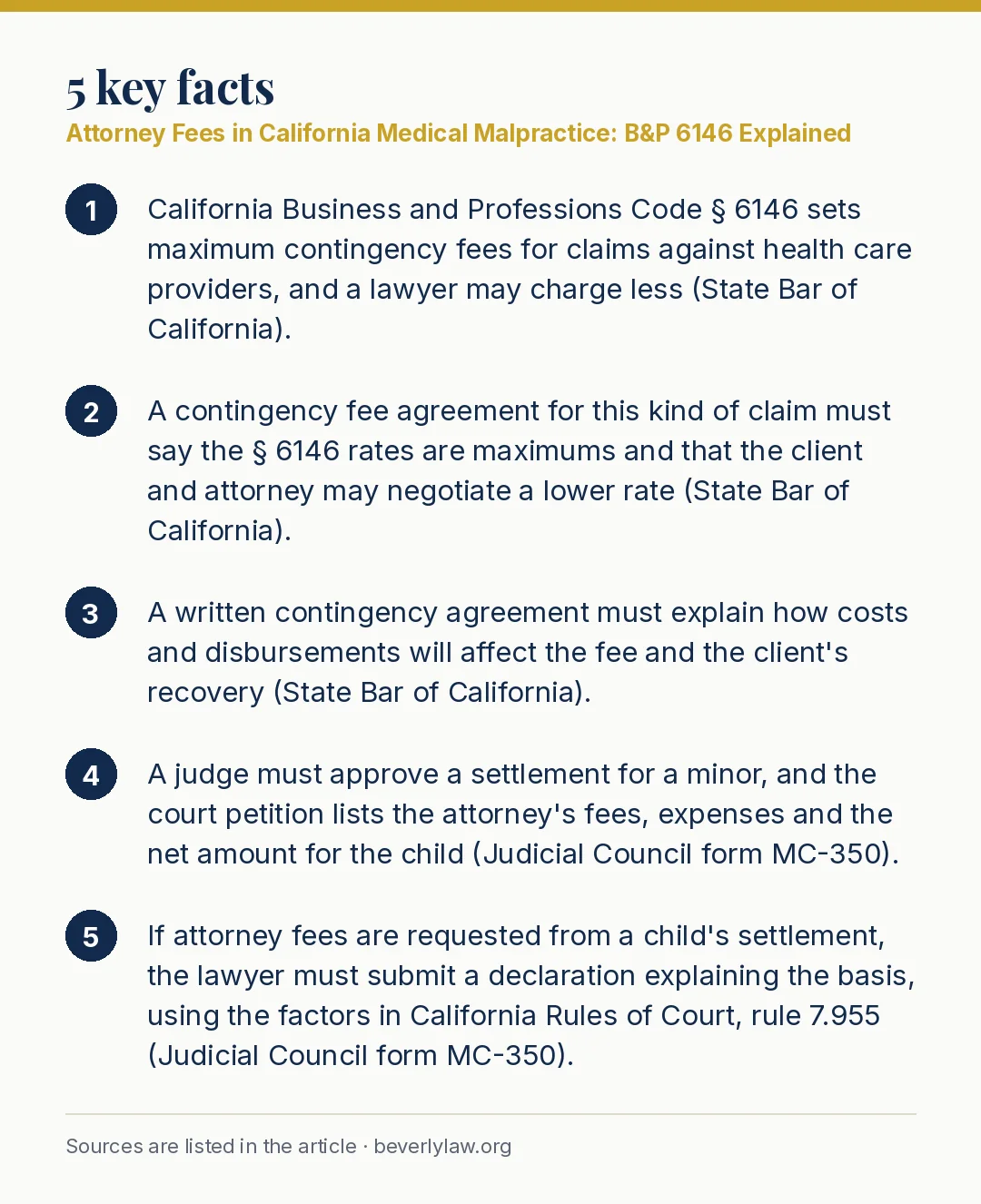
- California Business and Professions Code § 6146 sets maximum contingency fees for claims against health care providers, and a lawyer may charge less (State Bar of California).
- A contingency fee agreement for this kind of claim must say the § 6146 rates are maximums and that the client and attorney may negotiate a lower rate (State Bar of California).
- A written contingency agreement must explain how costs and disbursements will affect the fee and the client's recovery (State Bar of California).
- A judge must approve a settlement for a minor, and the court petition lists the attorney's fees, expenses and the net amount for the child (Judicial Council form MC-350).
- If attorney fees are requested from a child's settlement, the lawyer must submit a declaration explaining the basis, using the factors in California Rules of Court, rule 7.955 (Judicial Council form MC-350).
What California law says
California gives a child’s birth-injury case its own deadline. Under Code of Civil Procedure § 340.5, a minor must sue within three years of the wrongful act, but a child who was under six when it happened has until his or her eighth birthday if that is longer. For a baby hurt during labor or delivery, that usually means the eighth birthday. The clock runs from the act itself, not from the day the family learned what went wrong, and it is paused only in limited cases, such as fraud, intentional concealment or a foreign object left in the body. Parents’ own claims can have much shorter deadlines, so it is safer to get advice early.
California’s MICRA law limits one part of a medical malpractice recovery. Under Civil Code § 3333.2, as amended by AB 35, non-economic damages (pain, suffering, loss of enjoyment of life) are capped. In 2026 the cap is $470,000 for injury and $650,000 for wrongful death, and it rises every January 1 ($40,000 and $50,000 a year until 2033, then 2% a year). Separate caps can apply to doctors, hospitals and unaffiliated providers. Economic damages are not capped: lifetime medical care, therapy, equipment, home modifications and lost earning capacity can be recovered in full, and in a birth-injury case they are usually the largest part of the claim.
Free birth-injury case review
We review the delivery records with medical experts and tell you honestly whether there is a case. You pay no fees or costs unless we win.
Questions parents ask
Do I pay anything up front to hire a birth-injury lawyer?
Under a contingency agreement, the lawyer’s fee is paid from a recovery, if there is one. Whether the firm advances case costs, and what happens to them if there is no recovery, depends on the written agreement. Ask for these points in writing before you sign.
Can the fee percentage be negotiated?
According to the State Bar of California, a fee agreement for a claim against a health care provider must state that the § 6146 rates are maximums and that a lower rate may be negotiated. So it is reasonable to ask questions about the percentage and how it is calculated.
Who decides how the child’s money is held?
The judge does, when approving the settlement. The court petition lists options such as an insured account that can be withdrawn only with court permission, an annuity, or a trust. Your county’s Superior Court self-help center can explain its local steps.
Sources
Judicial Council of California – Form MC-350, Petition for Approval of Compromise of Claim for Minor
State Bar of California – Sample Written Fee Agreement Forms, Instructions and Comments
Judicial Council of California – Invitation to Comment SPR20-25 (compromise of minor's claim)
California Legislative Information – Business and Professions Code § 6146
In California, a lawyer's fee in a medical malpractice case is limited by B&P § 6146, must be explained in a written agreement, and can be discussed before you sign. Case costs are separate from fees, and when a child is hurt, a judge reviews the settlement and the fees before any money is paid out. If your baby was hurt at birth and you have questions about how fees and costs would work for your family, Beverly Law invites you to ask for a free case review. There is no obligation, and no outcome is promised.
Ask a question
Not ready to call? Write your question and a member of our team answers you — no cost, no commitment.
Attorney Fees in California Medical Malpractice: B&P 6146 Explained — Beverly Law
Free case review for families in California. We obtain the delivery records, have them reviewed by medical experts and deal with the hospital and its insurer — you focus on your child. You pay no fees or costs unless we win.
Related pages
Cerebral Palsy · Erb’s Palsy / Brachial Plexus Injury · HIE / Oxygen Deprivation at Birth · Statute of Limitations · All birth-injury guides · Birth injury news · Birth injury lawyers by California hospital
Important: This page is general information about birth injuries and California law, not legal advice, and reading it does not create an attorney-client relationship with Beverly Law. Every case is different — talk to a lawyer about your own situation. Attorney advertising. Prior results do not guarantee a similar outcome. No fees or costs unless we win. Last reviewed: 2026-09-18.