


When a baby is born with a lasting disability, parents often hear the words "life care plan" long before they understand them. The idea is simple. A life care plan is a written estimate of what a child may need, and what it may cost, over a lifetime.
Families sometimes ask why this one document matters so much. In a legal claim over a birth injury, it is usually the main way the future cost of care is explained to an insurer, a mediator or a court. This article explains in plain words who prepares a plan, what it may include, how costs are projected, and how damage limits in California, Texas and Washington relate to it.
Was your baby hurt during delivery?
Tell us your name and phone. We call you back today, in English or Spanish, and the consultation is free.
Free consultation · English y Español · No fees or costs unless we win
What a life care plan is
A life care plan is a long-range outline of a person's medical and daily-living needs. It looks at the child's diagnosis, current abilities and expected needs, and then lists the services and items that may be needed and how often. Each item is given a cost.
It is not a medical record and it does not replace the child's own treatment plan. Doctors and therapists decide what care a child receives. The life care plan takes that care, and what the medical team expects over time, and turns it into a document that can be used to estimate future costs.
The CDC notes that cerebral palsy, one of the conditions that can follow a birth injury, is lifelong, and that care needs vary a great deal from one child to another. That variation is the reason each plan is individual rather than a template.
Who prepares it
A life care plan is usually written by a life care planner. This is often a nurse, rehabilitation counselor or therapist with extra training in planning for long-term needs. The planner does not diagnose the child. Instead, the planner reviews medical records, school and therapy records, and talks with the family and the child's providers.
Planners generally rely on opinions from the child's own physicians and specialists about what care is reasonable. In a legal case, the plan is often reviewed by other experts, such as a physician who confirms the medical needs, and an economist who works out the dollar figures. The other side in a case may hire its own planner, so two plans for the same child can differ.
Because a plan depends on records, parents may find it helpful to keep copies of evaluations, therapy notes, equipment orders and school plans.
What it may include
According to the CDC, children with cerebral palsy may need occupational, physical and speech therapy, assistive technology and adaptive equipment, communication systems, nutrition and social work support, family training, transportation and special education. Early intervention services are written into an Individualized Family Service Plan, and school-age services into an Individualized Education Program.
A life care plan may carry these needs forward and add others, depending on the child. Common categories include physician and specialist visits, medicines and supplies, therapies, wheelchairs and other mobility equipment and their replacement, changes to the home such as ramps or accessible bathrooms, a vehicle that can carry a wheelchair, and attendant care, meaning paid help with daily activities that may be needed at home.
Not every child needs every item. Some children need relatively little support, while others need help around the clock. A careful plan reflects the particular child.
How economists project the costs
The planner lists items and how often they are needed. An economist then turns that list into a total. The economist usually starts with current prices for each service, projects them forward over the child's expected lifetime, and may adjust for how medical prices tend to change over time. The total is often reduced to a present value, which is the amount that would be needed today to pay for those future costs.
Life expectancy has a large effect on the total, and experts may disagree about it. This is one reason cases can take time and why different experts can arrive at different totals.
For general context, a CDC report in the Morbidity and Mortality Weekly Report estimated lifetime costs for people with cerebral palsy born in 2000 at about $11.5 billion in 2003 dollars, counting direct and indirect costs. That figure is old and describes a whole group, not any one child, so it should not be used to guess what a single family's plan would show.
How damage limits relate to a life care plan
In a civil claim, damages are often described in two groups. Economic damages are measurable costs, such as medical care and the future care in a life care plan. Noneconomic damages are things like pain and loss of enjoyment of life. Some states limit noneconomic damages in medical negligence cases, but those limits are written to apply to the noneconomic group.
California's MICRA limit on noneconomic damages is found in Civil Code section 3333.2, and its amount has been changed by the Legislature in recent years, so the current text should always be checked on the official site. In Texas, Civil Practice and Remedies Code chapter 74, including section 74.301, sets limits on noneconomic damages in health care liability claims. Washington's older limit, RCW 4.56.250, was repealed by the Legislature in 2023.
In general, future medical and care costs are treated as economic damages, which is why the life care plan is the part of a case that these noneconomic limits are not written to cap. How the law applies to a particular child depends on the facts, the date of the events and the court, so only a licensed attorney can tell a family how it affects them.
Key facts
Read the key facts as text
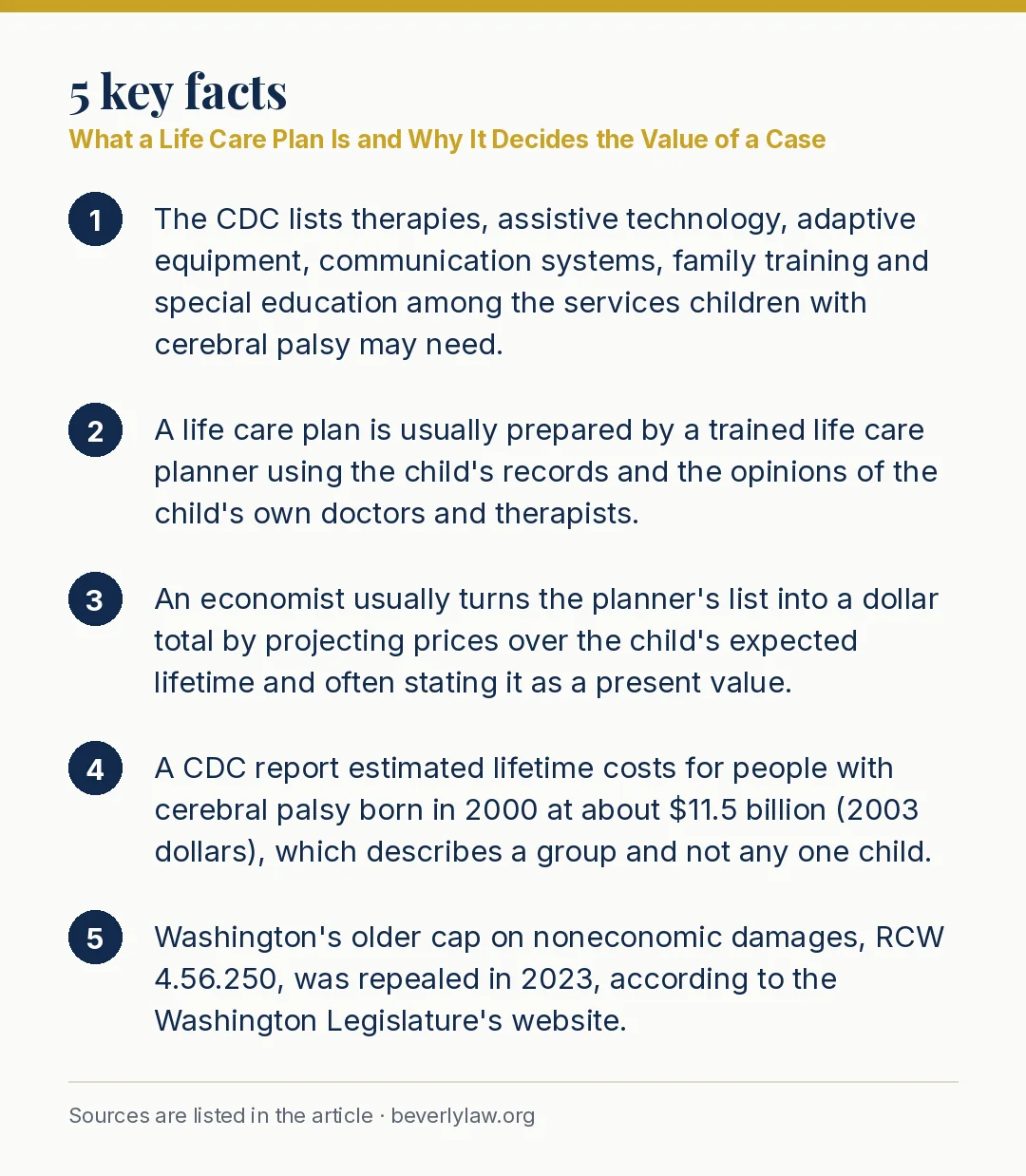
- The CDC lists therapies, assistive technology, adaptive equipment, communication systems, family training and special education among the services children with cerebral palsy may need.
- A life care plan is usually prepared by a trained life care planner using the child's records and the opinions of the child's own doctors and therapists.
- An economist usually turns the planner's list into a dollar total by projecting prices over the child's expected lifetime and often stating it as a present value.
- A CDC report estimated lifetime costs for people with cerebral palsy born in 2000 at about $11.5 billion (2003 dollars), which describes a group and not any one child.
- Washington's older cap on noneconomic damages, RCW 4.56.250, was repealed in 2023, according to the Washington Legislature's website.
Free birth-injury case review
We review the delivery records with medical experts and tell you honestly whether there is a case. You pay no fees or costs unless we win.
Questions parents ask
Do I have to pay for a life care plan?
Costs differ from case to case. In many injury cases the legal team arranges and advances the cost of expert work, and the arrangement is explained in the fee agreement. Ask any attorney you speak with how expert costs are handled before you sign.
Is the life care plan the same as my child’s treatment plan?
No. The treatment plan comes from your child’s doctors and therapists and guides current care. A life care plan is an estimate of future needs and costs that draws on that care. It does not change what treatment your child receives.
Can a life care plan change over time?
Yes. A child’s needs may change as they grow, and new records may be added. Planners and economists can update their work, and the other side may have its own experts who see things differently.
Sources
CDC MMWR via PubMed: Economic costs associated with mental retardation, cerebral palsy, hearing loss, and vision impairment, United States, 2003
CDC: Treatment and Intervention Services for Cerebral Palsy
Washington State Legislature: RCW 4.56.250
California Legislative Information: Civil Code section 3333.2
Texas Statutes: Civil Practice and Remedies Code chapter 74
A life care plan turns a child's likely lifelong needs into a documented, costed projection prepared by a planner and an economist, usually with the child's own doctors' input. Because limits in some states apply to noneconomic damages, the plan's focus on future care is a different part of a claim. The details depend on your child, your state and your dates. This article is general information, not legal or medical advice. If you would like to talk it through, Beverly Law offers a free case review, with no promise about any outcome.
Ask a question
Not ready to call? Write your question and a member of our team answers you — no cost, no commitment.
What a Life Care Plan Is and Why It Decides the Value of a Case — Beverly Law
Free case review for families in California, Texas and Washington. We obtain the delivery records, have them reviewed by medical experts and deal with the hospital and its insurer — you focus on your child. You pay no fees or costs unless we win.
Related pages
Cerebral Palsy · Erb’s Palsy / Brachial Plexus Injury · HIE / Oxygen Deprivation at Birth · Statute of Limitations · All birth-injury guides · Birth injury news · Birth injury lawyers by California hospital
Important: This page is general information about birth injuries and California law, not legal advice, and reading it does not create an attorney-client relationship with Beverly Law. Every case is different — talk to a lawyer about your own situation. Attorney advertising. Prior results do not guarantee a similar outcome. No fees or costs unless we win. Last reviewed: 2026-09-18.