


When a baby is hurt around the time of birth, parents often have two big worries at once: their child's health and what to do next. Most families have never dealt with a legal claim before, and the rules in Washington State have details that are easy to miss.
This article explains, in plain words, how a Washington medical negligence claim for a birth injury generally works. It follows the state's own statutes, which are published on the Washington State Legislature website. Every case is different, so treat this as a map, not a plan for your family.

Was your baby hurt during delivery?
Tell us your name and phone. We call you back today, in English or Spanish, and the consultation is free.
Free consultation · English y Español · No fees or costs unless we win
What counts as a birth injury claim in Washington
A birth injury is harm to a baby that happens before, during or shortly after delivery. Not every birth injury comes from a mistake. The CDC explains, for example, that cerebral palsy is caused by abnormal brain development or damage to the developing brain, and that 85% to 90% of cases are congenital, meaning the cause occurred before or during birth. Many of those have no one at fault.
A legal claim is different. In Washington, a claim for injury from health care is based on alleged professional negligence. That generally means asking whether a doctor, nurse, hospital or clinic failed to give the level of care expected, and whether that failure caused the injury. RCW 4.16.350 says these claims can be brought against licensed providers, their employees or agents, and the hospital, clinic or other facility that employs them.
Because medical questions sit at the center of the claim, a case usually starts with a careful review of the mother's and baby's medical records by qualified medical experts.
The filing deadlines: three years, one year, and eight years
RCW 4.16.350 sets the time limit. A lawsuit must generally be started within three years of the act or omission that allegedly caused the injury, or within one year from when the patient or their representative discovered, or reasonably should have discovered, that the injury was caused by that act or omission. Whichever period ends later applies. This is often called the discovery rule.
The same statute sets an outer limit: in general, no action may be started more than eight years after the act or omission. The time is paused, or tolled, if there is proof of fraud, intentional concealment, or a foreign body left in the patient that had no treatment purpose. In that case the patient has one year from actual knowledge to file.
Parents often ask about children. RCW 4.16.190 is the general law that does not count the years a person is under 18 toward a deadline. But RCW 4.16.350 says that, for these claims, the knowledge of a custodial parent or guardian is imputed to a minor. In other words, you should not assume the clock waits until the child turns 18. Courts have looked at how these rules apply, so the safest step is to have a lawyer check the dates for your child's specific situation soon, rather than waiting.
Public hospital districts: a claim form comes first
Some Washington hospitals are run by local government, such as a public hospital district. Claims against local government have extra steps. RCW 4.96.010 lists a public hospital and a special district among the entities covered, but it does not say which particular hospital is covered, so that has to be confirmed for each case.
Under RCW 4.96.020, a claim must be presented, using the standard tort claim form or the entity's own compliant form, to the agent the entity has named to receive claims. No lawsuit covered by that section can be filed until 60 calendar days after the claim is presented. The limitations period is paused during those 60 days.
The key point for families is that this claim form is a separate step from the lawsuit, and it must happen inside the same overall time limits. Missing it can create avoidable problems.
Mandatory mediation before trial
Washington requires mediation for health care injury cases. RCW 7.70.100 says that, before a superior court trial, claims for damages from injury caused by health care provided after July 1, 1993 are subject to mandatory mediation, with limited exceptions such as cases the parties agreed to arbitrate.
Mediation is a confidential meeting where a neutral person, the mediator, helps both sides talk about settlement. The statute says mediators generally need experience with health care injury cases and must be lawyers admitted for at least five years or retired judges, unless the parties agree otherwise. If the sides cannot agree on a mediator, the superior court designates one. A mediator does not decide who wins, and mediation does not force anyone to settle.
Damages and what comes after filing
In a birth injury case, damages may include a child's future medical care, therapy, equipment, lost future earning ability, and the pain and limits the child lives with. Washington once had a statute that limited noneconomic damages, RCW 4.56.250. The Legislature's website now shows that section as repealed by 2023 c 102 § 5, and this article does not rely on any current statutory cap. That does not mean any amount is guaranteed. Damages still have to be proven, and every case is judged on its own facts.
After the claim form (if needed) and the filing, a case usually moves through the exchange of records and information, expert opinions, mediation, and, if it is not resolved, a trial in the superior court of the county where the case is filed. Timelines vary a lot, and many cases take a long time because children's needs can take years to understand.
What parents can do now
Write down dates and what you remember, and ask the hospital for a complete copy of your labor and delivery records and your baby's records. Keep follow-up visits, therapy notes and bills in one folder. Focus first on your child's care. Medical teams can tell you about treatment and follow-up, and nothing here replaces their guidance.
Because of the deadlines described above, it is wise to speak with a Washington lawyer sooner rather than later. This article is general information, not legal or medical advice, and it does not create an attorney-client relationship.
Key facts
Read the key facts as text
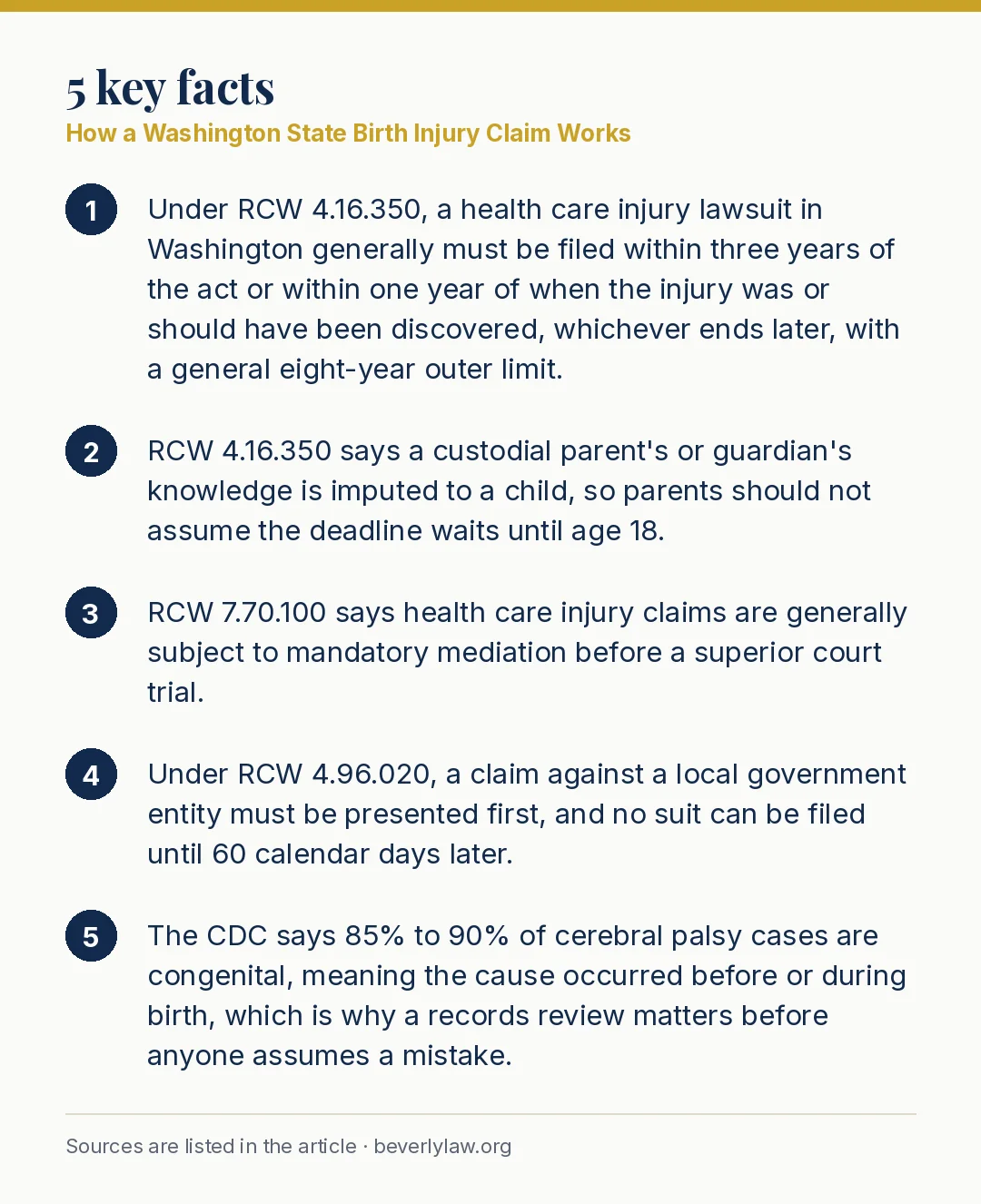
- Under RCW 4.16.350, a health care injury lawsuit in Washington generally must be filed within three years of the act or within one year of when the injury was or should have been discovered, whichever ends later, with a general eight-year outer limit.
- RCW 4.16.350 says a custodial parent's or guardian's knowledge is imputed to a child, so parents should not assume the deadline waits until age 18.
- RCW 7.70.100 says health care injury claims are generally subject to mandatory mediation before a superior court trial.
- Under RCW 4.96.020, a claim against a local government entity must be presented first, and no suit can be filed until 60 calendar days later.
- The CDC says 85% to 90% of cerebral palsy cases are congenital, meaning the cause occurred before or during birth, which is why a records review matters before anyone assumes a mistake.
Free birth-injury case review
We review the delivery records with medical experts and tell you honestly whether there is a case. You pay no fees or costs unless we win.
Questions parents ask
How long do I have to file a birth injury claim in Washington?
RCW 4.16.350 generally allows three years from the act, or one year from when the injury was or should have been discovered, whichever ends later. There is also a general eight-year outer limit, and special rules for minors and for public entities. Because these dates are strict, ask a lawyer to check yours.
Does my child’s age pause the deadline?
Not necessarily. RCW 4.16.190 does not count years under 18 toward some deadlines, but RCW 4.16.350 says a custodial parent’s or guardian’s knowledge is imputed to a child for these claims. Do not rely on waiting until your child is older without legal advice.
Is there a limit on damages in Washington?
The statute that once limited noneconomic damages, RCW 4.56.250, is shown on the Legislature’s website as repealed by 2023 c 102. Even so, damages must be proven, and no result is guaranteed. A lawyer can explain how damages are evaluated in your case.
Sources
Washington State Legislature, RCW 4.16.350
Washington State Legislature, RCW 7.70.100
Washington State Legislature, RCW 4.96.020 and RCW 4.96.010
Washington State Legislature, RCW 4.56.250
CDC, About Cerebral Palsy
A Washington birth injury claim is shaped by firm deadlines under RCW 4.16.350, special steps for public hospital districts, mandatory mediation, and the need to prove damages. The most helpful things a family can do are to care for their child, gather records, and have the dates reviewed early. If you would like someone to look at what happened and explain your options, Beverly Law offers a free case review, with no promise about the outcome.
Ask a question
Not ready to call? Write your question and a member of our team answers you — no cost, no commitment.
How a Washington State Birth Injury Claim Works — Beverly Law
Free case review for families in Washington. We obtain the delivery records, have them reviewed by medical experts and deal with the hospital and its insurer — you focus on your child. You pay no fees or costs unless we win.
Related pages
Cerebral Palsy · Erb’s Palsy / Brachial Plexus Injury · HIE / Oxygen Deprivation at Birth · Statute of Limitations · All birth-injury guides · Birth injury news · Birth injury lawyers by California hospital
Important: This page is general information about birth injuries and California law, not legal advice, and reading it does not create an attorney-client relationship with Beverly Law. Every case is different — talk to a lawyer about your own situation. Attorney advertising. Prior results do not guarantee a similar outcome. No fees or costs unless we win. Last reviewed: 2026-09-18.