


If your baby was hurt around the time of birth in California, you may have heard the word MICRA. It stands for the Medical Injury Compensation Reform Act, a 1975 law that put a limit on one kind of compensation in medical negligence cases. Many families hear "there is a cap" and assume it limits everything. It does not.
This guide explains, in plain words, what the cap limits, what it leaves alone, how the 2022 update known as AB 35 changed the numbers, and how doctors and planners estimate a child's future needs. It is general information to help you ask better questions.
Was your baby hurt during delivery?
Tell us your name and phone. We call you back today, in English or Spanish, and the consultation is free.
Free consultation · English y Español · No fees or costs unless we win
What the MICRA cap actually limits
California Civil Code § 3333.2 limits "noneconomic" damages in a claim against a health care provider or institution based on professional negligence. According to the Senate Judiciary Committee's analysis of AB 35, these are damages for pain, suffering, inconvenience, physical impairment, disfigurement and other nonpecuniary harm.
For almost fifty years the limit was a single $250,000 figure that never changed. The same analysis notes that, adjusted for inflation, that amount had the buying power of roughly $1.3 million by 2022. That gap is a big reason lawmakers revisited the law. The bill was also a legislative compromise, written while a ballot initiative on the same subject was pending, according to the committee's analysis. In short, the cap has always been about one slice of a claim, not the whole claim.
The AB 35 schedule
AB 35 took effect for cases filed or arbitrations demanded on or after January 1, 2023. For an injury claim that does not involve a death, the Senate analysis says the limit started at $350,000 and rises by $40,000 each January 1 for ten years, up to $750,000. Counting from 2023, that places the 2026 figure at $470,000.
The amount in effect at the time of judgment, arbitration award or settlement is the one that applies. Beginning January 1, 2034, both caps are to rise by two percent a year to track inflation. Because the schedule is written into law, it is worth confirming the current number for your own situation.
Separate caps for injury and for wrongful death
AB 35 created two different tracks. If the claim is for wrongful death, the starting limit is $500,000 and rises by $50,000 every January 1 for ten years, up to $1,000,000. By the same count, the 2026 wrongful death figure is $650,000.
The bill also lets the limit apply in up to three separate categories: against one or more health care providers collectively, against one or more institutions collectively, and against unaffiliated providers or institutions whose separate acts of negligence happened elsewhere. A single defendant cannot be held liable in more than one category. How these categories apply depends on the facts of each case.
Why medical costs and lost income are not capped
The cap speaks only to noneconomic damages. Economic damages, such as the reasonable cost of medical care and the income a person is unable to earn, are a different category. The Senate Judiciary analysis quotes the bill's supporters as saying there is no cap on economic damages such as medical costs or lost salaries.
For a child with a lifelong disability, those economic losses can be the largest part of a claim. Courts usually require them to be shown with evidence, meaning care that is reasonably necessary and losses that are reasonably certain rather than guesses.
How a life care plan is built
A life care plan is a written estimate of a person's future needs and their costs. According to PubMed-indexed physician reviews, doctors may be asked to help plan the long-term needs of a child with cerebral palsy or a developmental disability, and the first step is usually to examine how long the child is expected to live. Those reviews list factors such as the severity of physical and cognitive disability, speech, tube feeding, continence and seizures.
From there, the plan usually goes item by item: medical visits, therapies, medicines, equipment, home changes, and daily help, projected across the child's expected lifetime. Treating doctors, therapists and other specialists generally contribute, and an economist may then convert the plan into present-day dollars. Every child is different, so no two plans look alike.
Deadlines matter too. Under Code of Civil Procedure § 340.5, a minor must sue within three years of the wrongful act, but a child under six at the time has until their eighth birthday if that is longer. For a baby hurt during labor or delivery, that usually means the eighth birthday. The clock runs from the act itself, not from the day the family learned what went wrong, and it is paused only in limited cases, such as fraud, intentional concealment or a foreign object left in the body. Parents' own claims, and claims against a public hospital, can have much shorter deadlines. Under Government Code § 911.2, a written claim against a public entity, such as a county or district hospital, must be presented within six months. University of California hospitals are an exception: Government Code § 905.6 exempts claims against the UC Regents from this claim step, but the normal lawsuit deadlines still apply. It is safer to get advice early.
Key facts
Read the key facts as text
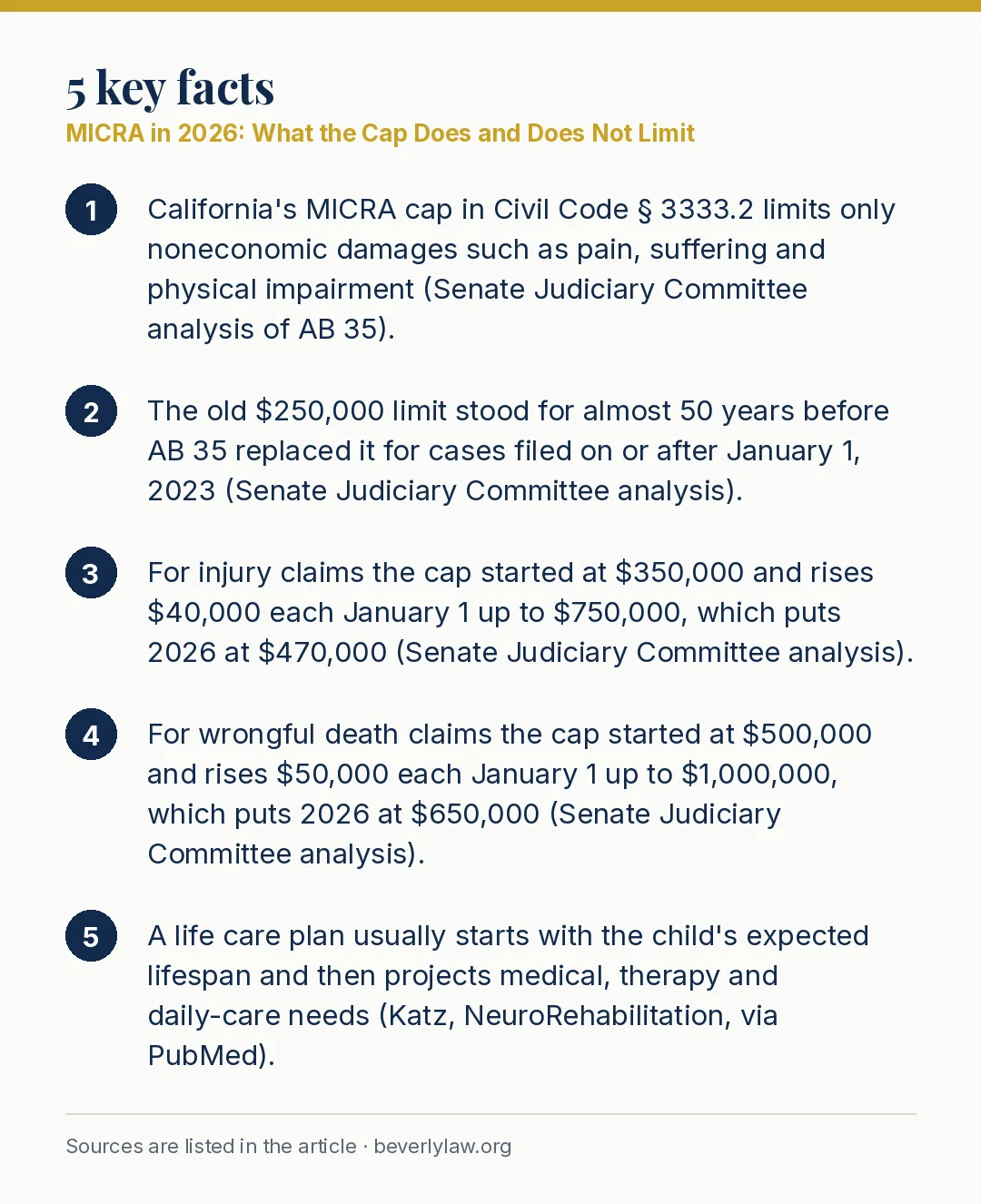
- California's MICRA cap in Civil Code § 3333.2 limits only noneconomic damages such as pain, suffering and physical impairment (Senate Judiciary Committee analysis of AB 35).
- The old $250,000 limit stood for almost 50 years before AB 35 replaced it for cases filed on or after January 1, 2023 (Senate Judiciary Committee analysis).
- For injury claims the cap started at $350,000 and rises $40,000 each January 1 up to $750,000, which puts 2026 at $470,000 (Senate Judiciary Committee analysis).
- For wrongful death claims the cap started at $500,000 and rises $50,000 each January 1 up to $1,000,000, which puts 2026 at $650,000 (Senate Judiciary Committee analysis).
- A life care plan usually starts with the child's expected lifespan and then projects medical, therapy and daily-care needs (Katz, NeuroRehabilitation, via PubMed).
What California law says
California gives a child’s birth-injury case its own deadline. Under Code of Civil Procedure § 340.5, a minor must sue within three years of the wrongful act, but a child who was under six when it happened has until his or her eighth birthday if that is longer. For a baby hurt during labor or delivery, that usually means the eighth birthday. The clock runs from the act itself, not from the day the family learned what went wrong, and it is paused only in limited cases, such as fraud, intentional concealment or a foreign object left in the body. Parents’ own claims can have much shorter deadlines, so it is safer to get advice early.
California’s MICRA law limits one part of a medical malpractice recovery. Under Civil Code § 3333.2, as amended by AB 35, non-economic damages (pain, suffering, loss of enjoyment of life) are capped. In 2026 the cap is $470,000 for injury and $650,000 for wrongful death, and it rises every January 1 ($40,000 and $50,000 a year until 2033, then 2% a year). Separate caps can apply to doctors, hospitals and unaffiliated providers. Economic damages are not capped: lifetime medical care, therapy, equipment, home modifications and lost earning capacity can be recovered in full, and in a birth-injury case they are usually the largest part of the claim.
Free birth-injury case review
We review the delivery records with medical experts and tell you honestly whether there is a case. You pay no fees or costs unless we win.
Questions parents ask
Does the MICRA cap limit my child’s medical bills?
No. According to the Senate Judiciary Committee’s analysis of AB 35, the cap applies to noneconomic damages, and there is no cap on economic damages such as medical costs or lost salaries. Economic losses generally have to be supported by evidence.
Is the cap one number for every case?
No. There is one schedule for injury claims and a higher one for wrongful death claims, and both rise each January 1 until 2033. The limit can also apply in up to three categories of defendants, depending on the facts.
Who writes a life care plan?
Usually a team. Physicians and other specialists describe the child’s needs, and a planner or economist may then price them over the child’s expected lifetime. The plan is an estimate that can be updated as the child grows.
Sources
California Senate Judiciary Committee – AB 35 (Reyes) analysis
PubMed – Katz RT. Life expectancy for children with cerebral palsy and mental retardation: implications for life care planning. NeuroRehabilitation 2003
PubMed – Katz RT, Delaney GA. Life care planning. Phys Med Rehabil Clin N Am 2002
The MICRA cap is real, but it is narrow: it limits pain-and-suffering style damages, not the cost of medical care or lost income, and the numbers rise each year under AB 35. A well-built life care plan helps show what a child may need over a lifetime, and filing deadlines can be short. If you have questions about your family's situation, Beverly Law offers a free case review, with no promises about any outcome. This guide is general information, not legal or medical advice.
Ask a question
Not ready to call? Write your question and a member of our team answers you — no cost, no commitment.
MICRA in 2026: What the Cap Does and Does Not Limit — Beverly Law
Free case review for families in California. We obtain the delivery records, have them reviewed by medical experts and deal with the hospital and its insurer — you focus on your child. You pay no fees or costs unless we win.
Related pages
Cerebral Palsy · Erb’s Palsy / Brachial Plexus Injury · HIE / Oxygen Deprivation at Birth · Statute of Limitations · All birth-injury guides · Birth injury news · Birth injury lawyers by California hospital
Important: This page is general information about birth injuries and California law, not legal advice, and reading it does not create an attorney-client relationship with Beverly Law. Every case is different — talk to a lawyer about your own situation. Attorney advertising. Prior results do not guarantee a similar outcome. No fees or costs unless we win. Last reviewed: 2026-09-18.