


Placental abruption happens when the placenta separates from the wall of the uterus before the baby is born. The placenta is how a baby gets oxygen and nutrients, so when it pulls away, the baby's supply may drop quickly.
When oxygen and blood flow are cut off for too long, a baby can be born with hypoxic-ischemic encephalopathy, or HIE, a type of brain injury. This article explains what abruption looks like, who is more likely to have one, why the time between the first warning signs and delivery matters, and what medical records usually show. It is meant for families in California, Texas, Washington and everywhere else.
Was your baby hurt during delivery?
Tell us your name and phone. We call you back today, in English or Spanish, and the consultation is free.
Free consultation · English y Español · No fee unless we win
How common it is and what the signs are
According to March of Dimes, placental abruption affects about 1 in 100 pregnancies, usually in the third trimester, though it can happen any time after 20 weeks. StatPearls, a clinical reference from the National Library of Medicine, gives a range of about 0.4% to 1.0%.
The most common sign is vaginal bleeding. Other signs may include belly or back pain that is sudden and does not go away, a tender or very hard belly, and contractions that come one after another. MedlinePlus lists bleeding and painful contractions as main symptoms.
Bleeding is not always visible. March of Dimes notes that symptoms can occur without bleeding when blood is trapped behind the placenta, and StatPearls says the absence of bleeding does not rule out an abruption. Any sudden, severe pain or bleeding in pregnancy is a reason to call your provider or go to the hospital right away.
Pregnancy care visits are a good time to ask your provider what symptoms should send you to the hospital, and how to get there quickly. Write the number of your labor and delivery unit somewhere you can find it fast, and tell family members who may drive you.
Risk factors, and why they do not tell the whole story
March of Dimes lists several risk factors: a previous abruption, high blood pressure, smoking, cocaine use, a blow to the belly (for example in a car accident), age 35 or older, twins or more, early water breaking, infection in the uterus, and too much amniotic fluid. MedlinePlus also mentions diabetes and alcohol.
Having a risk factor does not mean an abruption will happen. StatPearls reports that about 70% of patients who have one are considered low risk, and March of Dimes says the cause is largely unknown. That is why care teams are expected to stay alert to the symptoms in every patient, not only in those with known risk factors.
If you have had an abruption before, March of Dimes says the chance of it happening again is about 1 in 10. Share this history with every provider and with the hospital where you plan to deliver, so the team can plan ahead.
Why response time matters
March of Dimes says moderate to severe abruption is a medical emergency that usually requires immediate delivery, often by cesarean. Delivery is also needed right away if bleeding is heavy, pain gets worse, or the baby's heart rate shows distress.
Less oxygen and nutrients can lead to poor growth, preterm birth and, in severe cases, stillbirth, according to March of Dimes. StatPearls also lists perinatal asphyxia, low birth weight and neonatal anemia as possible effects on the newborn.
We did not find a single official time limit that applies to every case, and we do not want to suggest one. What the sources do make clear is that the sooner a team recognizes the signs, monitors the baby and acts, the more options everyone has. Each minute of a prolonged oxygen shortage may matter.
For a baby, the effect of an oxygen shortage depends on how severe it is and how long it lasts. This is why the records of what time symptoms began, when the team was notified and when the baby was born carry so much weight when a family tries to understand what happened.
What the fetal heart rate strip may show
Most hospitals use continuous electronic fetal monitoring in labor. StatPearls recommends it for abruption once a baby is at or past viability. The strip records the baby's heart rate and the mother's contractions.
StatPearls explains that a Category 1 tracing is reassuring but does not rule out abruption, a Category 2 tracing is uncertain and needs further evaluation, and a Category 3 tracing suggests a likely oxygen problem; delivery is indicated if it does not improve with treatment. Doctors and nurses are trained to read these patterns and respond.
When families review records, they usually look at when the pattern changed, when the nurse or doctor was told, what was done in response, and how long it took to reach delivery. A medical expert is the right person to interpret a strip, because it can only be read correctly in context.
What the operative note and placenta report should show
StatPearls says there is no lab test that definitively diagnoses abruption. Diagnosis is clinical, and ultrasound can miss it. After delivery, the pathology of the placenta usually shows a clot behind the placenta (a retroplacental clot).
The operative note, written by the surgeon after a cesarean, usually records the time of the decision to operate, the time of the incision and the time of birth. It also describes what the team saw, such as blood or clot behind the placenta, and the baby's condition. Cord blood gas results and Apgar scores in the newborn record add more detail.
Together, the strip, the nursing notes, the operative note and the placenta report help tell the story of what happened and when. You have the right to ask for copies of your own and your baby's records. Hospital records are kept under state and federal rules, and the process for requesting them is similar in California, Texas and Washington.
This article is general information, not legal or medical advice.
Key facts
Read the key facts as text
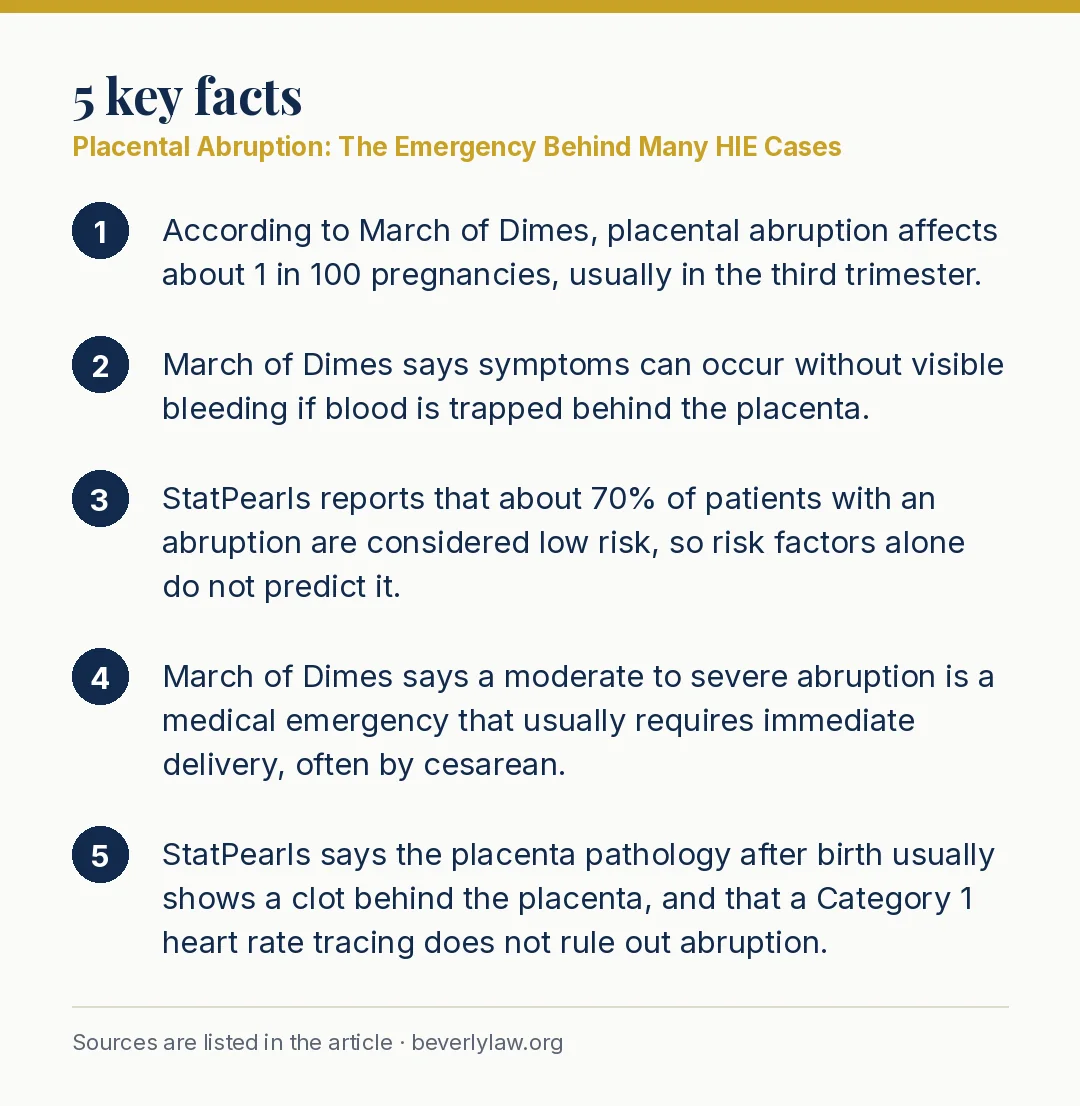
- According to March of Dimes, placental abruption affects about 1 in 100 pregnancies, usually in the third trimester.
- March of Dimes says symptoms can occur without visible bleeding if blood is trapped behind the placenta.
- StatPearls reports that about 70% of patients with an abruption are considered low risk, so risk factors alone do not predict it.
- March of Dimes says a moderate to severe abruption is a medical emergency that usually requires immediate delivery, often by cesarean.
- StatPearls says the placenta pathology after birth usually shows a clot behind the placenta, and that a Category 1 heart rate tracing does not rule out abruption.
Free birth-injury case review
We review the delivery records with medical experts and tell you honestly whether there is a case. You pay nothing unless we win.
Questions parents ask
Can a placental abruption happen without bleeding?
Yes. March of Dimes notes that symptoms can occur without bleeding if blood is trapped behind the placenta, and StatPearls says that no bleeding does not rule out an abruption. Sudden belly or back pain, a hard belly or changes in the baby’s movement are reasons to call your provider or go to the hospital.
Can an abruption be prevented?
Not always. The cause is largely unknown, according to March of Dimes. Steps that may lower risk include not smoking, avoiding cocaine and other drugs, and getting high blood pressure treated; StatPearls notes that treating chronic hypertension in pregnancy reduces abruption. Talk with your provider about your own situation.
What records should I ask for if my baby had HIE after an abruption?
You may ask for the full labor and delivery chart, including the fetal monitoring strip, nursing notes, the operative note if you had a cesarean, the placenta pathology report, cord blood gas results and the newborn record. Records can be requested in writing from the hospital’s medical records department.
Sources
March of Dimes
StatPearls (National Library of Medicine, NCBI Bookshelf)
MedlinePlus (National Library of Medicine)
Placental abruption is uncommon, but it can become an emergency within minutes, and it can happen even to patients with no known risk factors. Knowing the warning signs, and knowing that the fetal strip, nursing notes, operative note and placenta report together show what happened and when, can help you ask better questions. If your baby was diagnosed with HIE after an abruption and you have questions about what happened, Beverly Law invites you to request a free case review.
Ask a question
Not ready to call? Write your question and a member of our team answers you — no cost, no commitment.
Placental Abruption: The Emergency Behind Many HIE Cases — Beverly Law
Free case review for families in California, Texas and Washington. We obtain the delivery records, have them reviewed by medical experts and deal with the hospital and its insurer — you focus on your child. You pay nothing unless we win.
Related pages
Cerebral Palsy · Erb’s Palsy / Brachial Plexus Injury · HIE / Oxygen Deprivation at Birth · Statute of Limitations · All birth-injury guides · Birth injury news
Important: This page is general information about birth injuries and California law, not legal advice, and reading it does not create an attorney-client relationship with Beverly Law. Every case is different — talk to a lawyer about your own situation. Attorney advertising. Prior results do not guarantee a similar outcome. No fee unless we win. Last reviewed: 2026-09-18.