

By Michael Shemtoub, Esq., Managing Attorney, Beverly Law
Dealing with an insurance adjuster?
Leave your name and phone. We call back today, in English or Spanish. The consultation is free and confidential.
Free consultation · English y Español · No fees or costs unless we win
Your rights before you sign anything
You can take the release home. You can ask the adjuster for a Spanish translation, or ask for time to have someone you trust translate it. You can ask questions in writing and keep the answers. Nothing requires you to sign on the spot, in a parking lot or on a video call while someone reads it to you.
Write down anything the adjuster tells you about what the form means. If what you were told differs from what the form says, that can matter later. Our page signed a release, can I still sue explains why.
A real release form
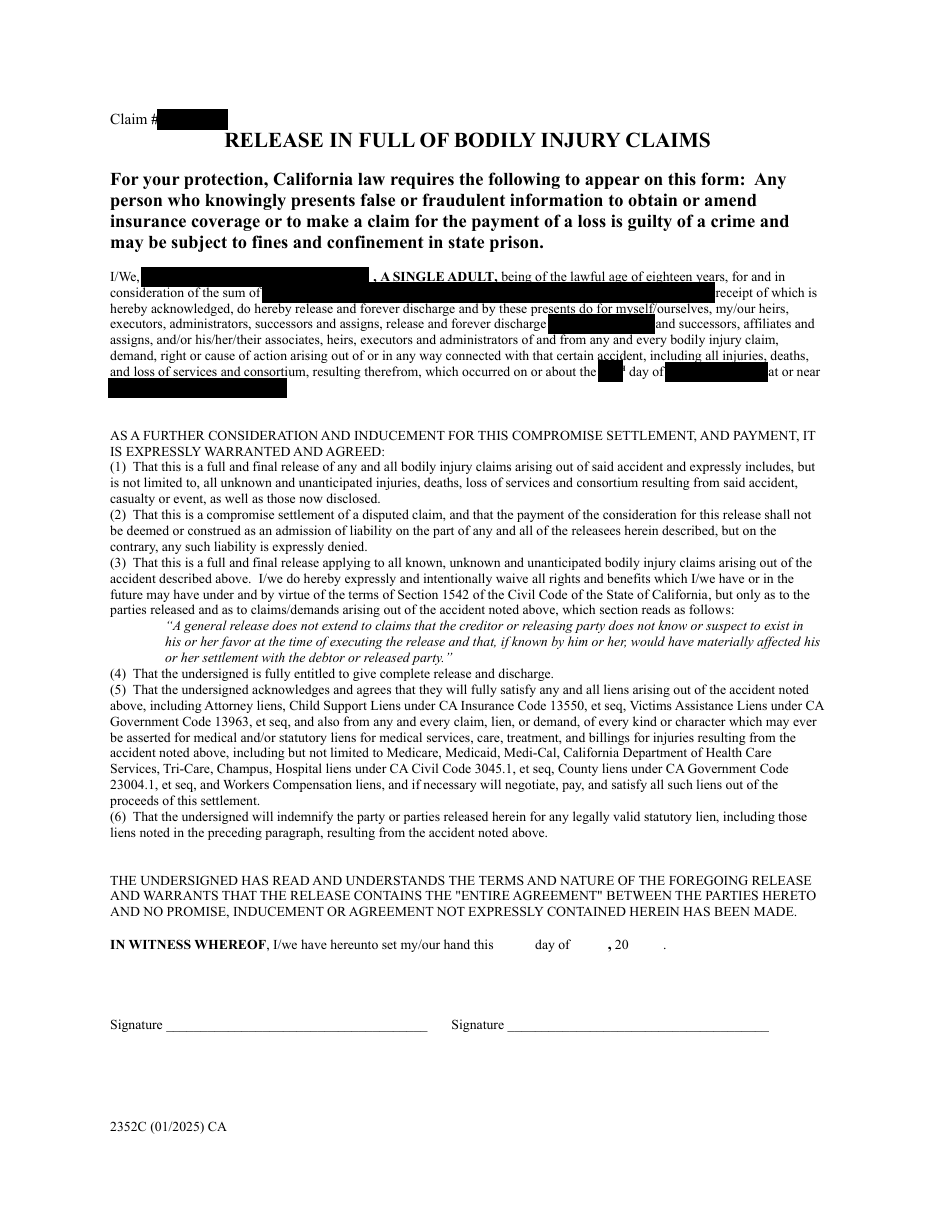
This release came to our office from one insurer in 2025, written only in English. The personal details are blacked out. It is a typical example of what people are asked to sign: it releases the at-fault driver from every injury claim from the crash, including injuries not yet known, it waives a California statute, Civil Code section 1542, for this crash, and it puts the repayment of liens on the person signing. A longer clause-by-clause review is on what is in an insurance release.
The clauses, in plain English and Spanish
Releasor (la persona que libera). That is you, the injured person. Sometimes a spouse is added.
Releasees (las personas liberadas). The people and companies you are letting go: often the driver, the car’s owner, the insurer, and sometimes “all other persons, firms and corporations” (todas las demás personas y compañías). Read this list slowly. A broad list can end claims against people other than the driver.
Any and all claims (todos y cualesquiera reclamos). Every kind of claim from the crash, not only the medical bills.
Known and unknown (conocidos y desconocidos). Injuries you have now and injuries that may show up later. Once signed, a future surgery is not paid by this insurer.
Bodily injury (lesiones corporales). Your physical injuries. If the release is for your car only, this phrase should not be there. See property damage release form.
Loss of consortium (pérdida de compañía). A spouse’s claim for the loss of companionship and help at home. If this is in the form, your spouse’s claim may be released too.
No admission of liability (no se admite culpa). The driver does not admit fault by paying. This is standard.
Liens (gravámenes). Debts that attach to the settlement, such as amounts owed to a hospital, a health plan or Medicare. If Medicare paid your bills, its recovery rules say those payments must be repaid from a settlement.
Hold harmless and indemnify (mantener indemne e indemnizar). You promise to protect the driver if someone else, such as a lienholder, later demands payment. In practice, any unpaid lien becomes your problem.
Entire agreement (acuerdo completo). Only what is written counts. Spoken promises do not.
Confidentiality (confidencialidad). You agree not to share the amount or terms.
Free case review
Tell us what happened. We will tell you plainly whether there is a case and what to do next. You owe no fees or costs unless we win.
What signing means
A signed release usually ends the claim for good. Courts treat a settlement as final; Louisiana’s code, for example, says a compromise precludes a later action on what was settled. Reading the form in a second language does not change that, so get it translated first.
If the injured person is a child, the rules are different and a court may have to approve. See settling a child’s injury claim.
What to do next
- Ask the adjuster in writing for a Spanish translation or for time to get one.
- Use our English-Spanish insurance claim glossary for other terms in the letter.
- Mark every clause above that appears in your form, and write down your questions.
- Find out the lien amounts before you sign.
- If a check came with the release, read cashed the insurance check, can I still sue before depositing it.
- Read should I sign a release of all claims for the checklist before signing.
More answers are on our insurance adjuster questions page.
Common questions
Does the insurance company have to give me the release in Spanish?
Many insurers send English only. You can ask for a translation, and you can take the time to have it translated before signing.
If I sign a release in English I could not read, is it still valid?
In most places, yes, on its own. What you were told about the document can matter if you were misled. Talk to a lawyer soon if that happened.
What does "release of all claims" mean in Spanish?
“Liberación de todos los reclamos.” It means you give up every claim from the crash against the people named, in exchange for the payment.
What does "hold harmless" mean?
That you will protect the released people from later claims, such as an unpaid lien. If someone asks them for money tied to your injury, you may have to pay it.
Can a family member sign for me?
Generally only the injured adult signs, unless someone has legal authority, such as a power of attorney or a court appointment. For a child, a parent signs, and a court may need to approve. Texas cases are handled by the firm’s Texas-licensed attorneys, Joyce Ondich and John Efstathiou. You owe no fees or costs unless we win. Call toll-free 1-877-427-2752 (1-877-4-ASAP-LAW), 24/7, from anywhere in the country.
Ask a question
Not ready to call? Write your question and someone on our team will answer. No cost, no commitment.
Injury lawyer — Beverly Law
Hurt because of someone else in California, Texas and Washington? Talk to an injury attorney. Free, confidential, English or Spanish. You owe no fees or costs unless we win.
Related pages
Insurance adjuster questions · Injury law FAQs
Sources
Important: This page is general information, not legal or medical advice, and reading it does not create an attorney-client relationship. Every case is different; talk to a lawyer about yours. Texas cases are handled by the firm’s Texas-licensed attorneys, Joyce Ondich and John Efstathiou. Last reviewed: November 23, 2026.