

By Michael Shemtoub, trial attorney, Beverly Law. Updated November 2026.
Hurt on someone else’s property?
Leave your name and phone. We call back today, in English or Spanish. The consultation is free and confidential.
Free consultation · English y Español · No fees or costs unless we win
Defects that turn a stair fall into a claim
These are the conditions that come up again and again in stairway cases at stores, restaurants, gyms, offices and parking structures:
- A missing handrail, a loose one, or one that stops before the last step
- Steps of different heights or depths, especially one odd step in an otherwise even run
- Worn, rounded, cracked or slick step edges
- Loose carpet, torn treads, or mats that slide on the landing
- Burned-out or missing lights in the stairwell
- Spills, ice, trash or merchandise left on the steps
- A single step or short drop with no paint, sign or contrast, where nobody expects a change in level
Some of these are built into the structure and have been there for months or years. Others, like a spilled drink, come and go. That difference changes what you have to prove, as the state table below shows.
Immediate steps after the fall
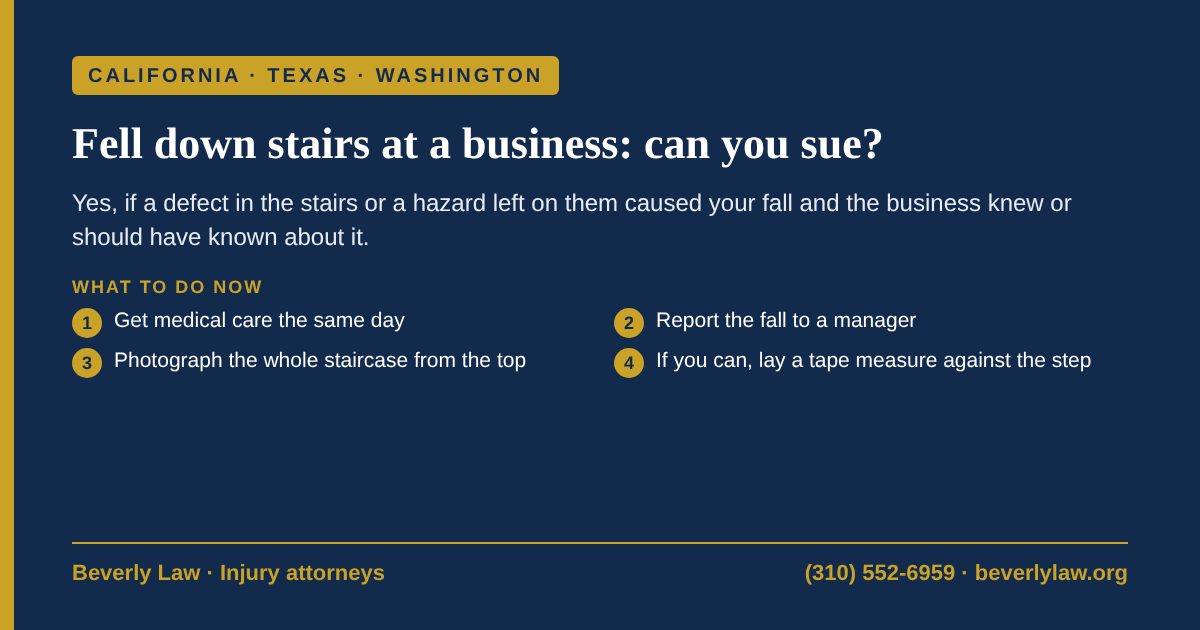
- Get medical care the same day. If you hit your head, read the head injury danger signs and go to the emergency room if any apply.
- Report the fall to a manager and get the incident report number.
- Photograph the whole staircase from the top and the bottom, then the exact step where you fell, the handrail and the lighting.
- If you can, lay a tape measure against the step you fell on and the steps next to it, and photograph each one.
- Keep the shoes you wore. Do not clean them. Put them in a bag.
- Get the names and phone numbers of witnesses, then send the business a written request to keep its video.
- Do not give a recorded statement to the business’s insurance company before you get advice.
Why measurements matter
Building codes set limits on how tall and how deep steps can be, how much they can vary from one step to the next, and where handrails are required. We do not quote those numbers here, because the rule that applies depends on the code edition in force for that building, and the comparison is usually done by a construction or code consultant. Your tape-measure photos give that person something to work with even after the business repairs the stairs.
Measurements also answer the notice question. A riser that is taller than its neighbors did not appear the morning you fell. It was part of the building, and staff walked past it every day.
Free case review
Tell us what happened. We will tell you plainly whether there is a case and what to do next. You owe no fees or costs unless we win.
What you must prove in California, Texas and Washington
| State | What the business must have known | Deadline to sue | If you were partly at fault |
|---|---|---|---|
| California | An owner is charged with notice of a condition its employees created. For other hazards, failing to inspect within a reasonable time lets a jury infer the owner should have found it (Ortega v. Kmart; CACI 1011) | 2 years (CCP 335.1) | Recovery is reduced by your share (Li v. Yellow Cab) |
| Texas | The owner knew or reasonably should have known. Proof that employees created the hazard supports that inference but does not establish it automatically (Keetch v. Kroger). For a spill, you generally need some proof of how long it was there (Wal-Mart v. Reece) | 2 years (CPRC 16.003) | No recovery if you are more than 50% at fault (CPRC 33.001) |
| Washington | No separate proof of notice is needed when the business or its employees caused the unsafe condition (Pimentel v. Roundup Co., discussed in Johnson v. Liquor & Cannabis Board) | 3 years (RCW 4.16.080) | Recovery is reduced by your share (RCW 4.22.005) |
In Texas the knowledge element is where most stair cases are fought, so maintenance records, repair requests, prior complaints and earlier falls on the same stairs carry a lot of weight. Those records exist in all three states, and a written preservation request should name them along with the video.
Stairs in a government building
If you fell at a city hall, library, courthouse, public school or transit station, a government agency owns the stairs and different rules apply.
- California: a written claim generally has to be filed within six months (Gov. Code 911.2). The agency is liable for a dangerous condition of its property only if an employee created the condition or the agency had notice in time to fix it (Gov. Code 835). For City of Los Angeles property, see our page on a claim against the City of Los Angeles.
- Texas: written notice is generally due within six months (CPRC 101.101). For a premises defect, the agency owes only the duty owed to a licensee unless you paid to use the premises (CPRC 101.022).
- Washington: a claim goes to the local government’s designated agent, and you must wait 60 days before suing (RCW 4.96.020).
What the business will argue
Expect to hear that you were not holding the rail, were looking at your phone, were carrying too much, or wore the wrong shoes. Video is often the fastest answer, which is why the preservation letter matters. Your own shoes, kept uncleaned, can also rebut a claim that worn soles caused the slip. Any share of fault a jury assigns to you is handled differently in each state, as the table shows.
If you fell on the stairs where you live, the landlord rules are different. See fell on apartment stairs: can you sue the landlord.
Falling on stairs at work
A fall on stairs at your own job is generally a workers’ compensation claim against your employer. A separate injury claim against someone other than your employer, such as the building owner or a company hired to maintain the stairs, stays open in California (Labor Code 3852), Texas (Labor Code 417.001) and Washington (RCW 51.24.030). In Texas, workers’ comp is the exclusive remedy against an employer that carries it (Labor Code 408.001), but an employer without coverage can be sued for negligence (Labor Code 406.033). Our page on workers’ comp versus a personal injury claim explains how the two fit together.
What this means for your case
The strongest stair cases start with photos and measurements taken before the repair crew arrives. Get the incident number, keep your shoes, and send the preservation request within days. Then find out who owns and maintains the stairs, because a property owner, a tenant business and a maintenance contractor can each be responsible.
Common questions
Is falling down the stairs considered an accident?
In everyday terms, yes. For a claim, the question is whether a defect or hazard the business should have dealt with caused the fall.
How hard is it to win a stair fall case?
It depends on proof of the defect and of notice. A measured, photographed defect with records of earlier complaints is a very different case from a fall with no visible cause. See is it worth suing for a slip and fall.
What if nobody saw me fall?
You can still bring a claim. Photos, video and your medical records fill the gap. See slip and fall with no witnesses.
Do I need a building code inspection?
Not right away. Your photos with a tape measure preserve the evidence. A consultant can compare them with the applicable code later.
Can I sue if the business fixed the stairs after my fall?
Yes. A repair does not erase the claim, but it does erase the evidence, which is why photos taken the same day matter so much. Texas cases are handled by the firm’s Texas-licensed attorneys, Joyce Ondich and John Efstathiou. More answers are on our FAQ page. Beverly Law offers a free case review in English or Spanish at (310) 552-6959. You owe no fees or costs unless we win.
Ask a question
Not ready to call? Write your question and someone on our team will answer. No cost, no commitment.
Injury lawyer — Beverly Law
Hurt because of someone else in California, Texas and Washington? Talk to an injury attorney. Free, confidential, English or Spanish. You owe no fees or costs unless we win.
Related pages
Sources
- Ortega v. Kmart Corp. (2001) 26 Cal.4th 1200 (scocal.stanford.edu)
- Judicial Council of California Civil Jury Instructions (CACI) 2026, No. 1011 and Sources and Authority (Getchell v. Roge (courts.ca.gov)
- Keetch v. Kroger Co., 845 S.W.2d 262 (Tex. 1992) (courtlistener.com)
- Wal-Mart Stores, Inc. v. Reece, 81 S.W.3d 812 (Tex. 2002) (courtlistener.com)
- Johnson v. Liquor & Cannabis Board, 197 Wn.2d 605 (2021) (discussing Pimentel v. Roundup Co.) (courts.wa.gov)
- Li v. Yellow Cab Co. (1975) 13 Cal.3d 804 (scocal.stanford.edu)
- Cal. Code of Civil Procedure 335.1 (leginfo.legislature.ca.gov)
- Tex. Civ. Prac. & Rem. Code 16.003 (statutes.capitol.texas.gov)
- Tex. Civ. Prac. & Rem. Code 33.001 (statutes.capitol.texas.gov)
- RCW 4.16.080 (app.leg.wa.gov)
- RCW 4.22.005 (app.leg.wa.gov)
- Cal. Gov. Code 911.2 (leginfo.legislature.ca.gov)
- Cal. Gov. Code 835 (leginfo.legislature.ca.gov)
- Tex. Civ. Prac. & Rem. Code 101.101 (statutes.capitol.texas.gov)
- Tex. Civ. Prac. & Rem. Code 101.022 (statutes.capitol.texas.gov)
- RCW 4.96.020 (app.leg.wa.gov)
- Cal. Labor Code 3852 (leginfo.legislature.ca.gov)
- Tex. Labor Code 408.001 (statutes.capitol.texas.gov)
- Tex. Labor Code 406.033 (statutes.capitol.texas.gov)
- Tex. Labor Code 417.001 (statutes.capitol.texas.gov)
- RCW 51.24.030 (app.leg.wa.gov)
Important: This page is general information, not legal or medical advice, and reading it does not create an attorney-client relationship. Every case is different; talk to a lawyer about yours. Texas cases are handled by the firm’s Texas-licensed attorneys, Joyce Ondich and John Efstathiou. Last reviewed: November 7, 2026.