

By Michael Shemtoub, trial attorney, Beverly Law. Updated November 2026.
Hurt on someone else’s property?
Leave your name and phone. We call back today, in English or Spanish. The consultation is free and confidential.
Free consultation · English y Español · No fees or costs unless we win
Beverly Law is not affiliated with Airbnb.
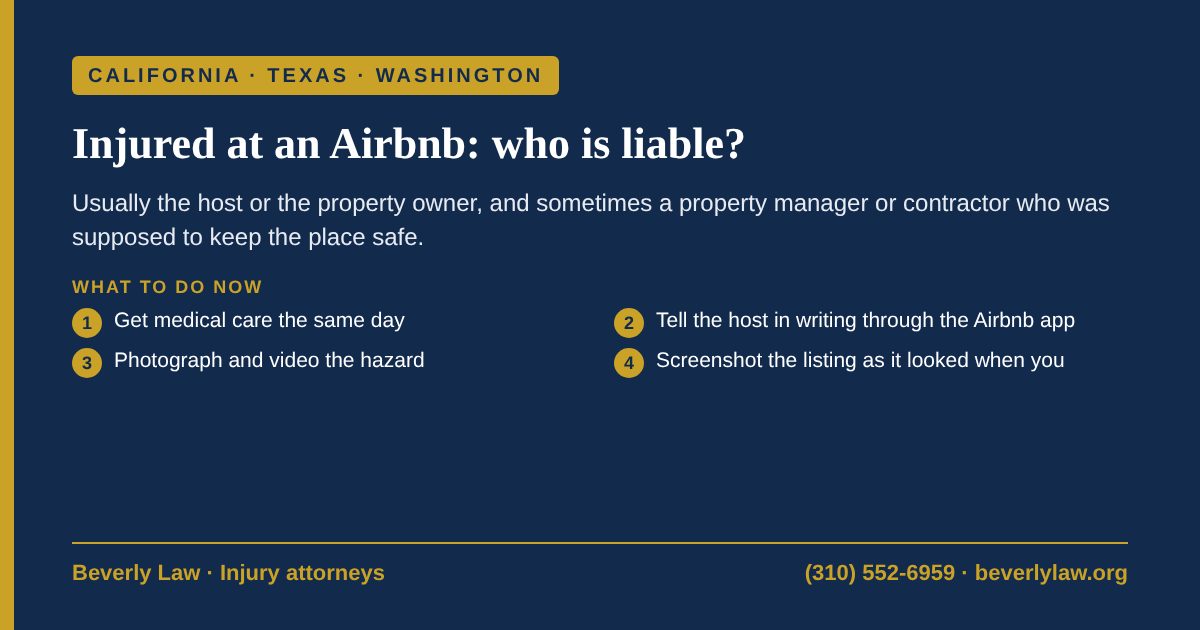
Who can be responsible
- The host, for hazards the host knew about or should have found: a broken stair or railing, a loose rug on a hard floor, a rotted deck board, a hot tub with no cover or barrier, faulty wiring.
- The property owner, when the host is a tenant who sublets or a manager who runs the listing for someone else.
- A management, cleaning or repair company that was hired to inspect or fix the problem.
- A manufacturer, if a product in the home failed, such as a bunk bed, a heater or a pool drain.
Deck and balcony failures have their own page: deck or balcony collapse. For pool and hot tub injuries, see swimming pool injuries.
What you have to show
The basic rule is the same as any injury on someone else’s property. The owner or host had to use reasonable care, and you have to connect a hazard they knew about, or should have found, to your injury.
In California, Civil Code 1714 makes everyone responsible for injuries caused by a lack of ordinary care in managing their property. In Texas, premises cases such as Wal-Mart Stores v. Reece turn on whether the owner actually knew of the hazard or it existed long enough that the owner should have discovered it. In Washington, Johnson v. Liquor & Cannabis Board (2021) lets a business be held responsible when the way it operates made a hazard reasonably foreseeable, even without proof it knew of the specific danger; whether a particular host’s rental counts as that kind of operation is a question for your lawyer.
Texas cases are handled by the firm’s Texas-licensed attorneys, Joyce Ondich and John Efstathiou.
| State | Deadline to sue | If you were partly at fault |
|---|---|---|
| California | 2 years (CCP 335.1) | Award reduced by your share (Li v. Yellow Cab) |
| Texas | 2 years (CPRC 16.003) | Nothing if over 50% (CPRC 33.001) |
| Washington | 3 years (RCW 4.16.080) | Award reduced by your share (RCW 4.22.005) |
Free case review
Tell us what happened. We will tell you plainly whether there is a case and what to do next. You owe no fees or costs unless we win.
Where the money comes from
Airbnb’s own host liability insurance page says the coverage is part of AirCover for Hosts and lists $1 million in coverage for situations where a host is found legally responsible for a guest getting hurt. The page says people who help the host, such as co-hosts and cleaners, are also included. It also says the insurance does not cover injury from something done intentionally, that other exclusions apply, and that some hosts are left out, including hosts of stays in Japan. Read the current page, because Airbnb can change the terms.
The host may also have a homeowner’s, landlord or commercial policy. Whether that policy covers a paid short-term rental depends on its wording, so your lawyer will ask for all of the host’s policies.
Steps to take right away
- Get medical care the same day. If you hit your head, the CDC lists danger signs such as a worsening headache, repeated vomiting or confusion that need emergency care.
- Tell the host in writing through the Airbnb app so there is a dated record, and report the injury to Airbnb.
- Photograph and video the hazard before the host repairs it, with something in the frame for scale.
- Screenshot the listing as it looked when you booked, including photos, the description and house rules. Listings can be edited later.
- Save your booking confirmation, receipts and every message with the host.
- Get names and phone numbers of everyone staying with you who saw it.
Our page on slip and fall evidence covers how to preserve photos and records.
What the host or insurer will argue
Expect to hear that the danger was obvious, that you were using the space in a way the house rules did not allow, or that the hazard appeared during your stay and the host had no chance to fix it. Your own share of fault matters; our comparative fault guide explains how each state counts it.
What to avoid
Do not accept a refund, discount or travel credit in exchange for signing a release before you know how badly you are hurt. Do not give a recorded statement to an insurer until you have advice. A partial refund for a ruined stay can be fine. Read anything you are asked to sign, and look for language giving up injury claims.
What this means for your case
Your evidence lives on your phone and in the app. Save it before the listing, the messages or the hazard change. Then a lawyer can sort out who owned the property, who managed it and which insurance applies. More answers are on our injury law FAQs page.
Injured at an Airbnb: is Airbnb itself liable, and does its arbitration clause stop a claim?
Most injury claims from a rental stay are against the host or the property owner, as explained above. Guests often ask whether they can bring Airbnb into it, and whether the terms they accepted when they booked take away their day in court.
Airbnb’s Terms of Service for people who live in the United States include a “United States Dispute Resolution and Arbitration Agreement” in Section 23 (Airbnb Terms of Service). It is written as an agreement between you and Airbnb: disputes between you and Airbnb generally go to individual arbitration, with an option for small claims court and some listed exceptions. The text does not say that it covers a claim by a guest against a host, and Airbnb’s Terms also say Airbnb is not a party to the contracts between hosts and guests.
What that means in practice:
- A claim against the host or owner for a broken stair, a rotted deck board or another hazard is usually handled like any other injury claim on someone else’s property.
- A claim against Airbnb itself is a separate question, and the arbitration agreement may decide where it is heard.
- The host liability insurance described above is a source of payment for a host who is found responsible. It does not make Airbnb the defendant.
Keep a copy of the terms as they read when you booked, along with your confirmation, so your lawyer can see which version applied.
Common questions
Can I sue Airbnb directly?
Most claims are brought against the host or owner, since they control the property. Airbnb’s host liability insurance may respond if the host is found legally responsible.
Does Airbnb's insurance cover guests who get hurt?
Airbnb’s page describes coverage for hosts who are found legally responsible for a guest’s injury, with exclusions. It protects the host, and a claim still has to show the host was at fault.
What if the host says the hazard was in the house rules?
A rule like “do not use the balcony” may be argued as your fault. It does not by itself settle whether the host acted reasonably about a danger the host knew about.
What if a child in my group was hurt?
Get the child checked right away and save the same evidence. A parent or guardian can speak with a lawyer about the child’s claim.
Is it the same for VRBO or other rental sites?
The premises rules are the same. The insurance terms differ, so read that platform’s own policy pages. Beverly Law offers a free case review in English or Spanish at (310) 552-6959. You owe no fees or costs unless we win.
Can I sue Airbnb if I got hurt at a rental?
For people who live in the United States, Airbnb’s Terms of Service send most disputes between you and Airbnb to individual arbitration, with a small claims court option and listed exceptions, including individual claims of sexual assault or sexual harassment. Claims against the host or owner who controlled the hazard are a separate matter.
Does Airbnb’s arbitration clause cover my claim against the host?
The agreement is written between you and Airbnb, and its text does not say it covers guest claims against hosts. A lawyer should read the version you accepted.
Ask a question
Not ready to call? Write your question and someone on our team will answer. No cost, no commitment.
Injury lawyer — Beverly Law
Hurt because of someone else in California, Texas and Washington? Talk to an injury attorney. Free, confidential, English or Spanish. You owe no fees or costs unless we win.
Related pages
Sources
- Airbnb Help Center, Host liability insurance (airbnb.com)
- Cal. Civil Code 1714 (leginfo.legislature.ca.gov)
- Wal-Mart Stores, Inc. v. Reece, 81 S.W.3d 812 (Tex. 2002) (courtlistener.com)
- Johnson v. Liquor & Cannabis Board, 197 Wn.2d 605 (2021) (courts.wa.gov)
- Cal. Code of Civil Procedure 335.1 (leginfo.legislature.ca.gov)
- Li v. Yellow Cab Co. (1975) 13 Cal.3d 804 (scocal.stanford.edu)
- Tex. Civ. Prac. & Rem. Code 16.003 (statutes.capitol.texas.gov)
- Tex. Civ. Prac. & Rem. Code 33.001 (statutes.capitol.texas.gov)
- RCW 4.16.080 (app.leg.wa.gov)
- RCW 4.22.005 (app.leg.wa.gov)
- CDC, Symptoms of Mild TBI and Concussion (cdc.gov)
Important: This page is general information, not legal or medical advice, and reading it does not create an attorney-client relationship. Every case is different; talk to a lawyer about yours. Texas cases are handled by the firm’s Texas-licensed attorneys, Joyce Ondich and John Efstathiou. Last reviewed: November 7, 2026.