

By Michael Shemtoub, Esq., Managing Attorney, Beverly Law
Dealing with an insurance adjuster?
Leave your name and phone. We call back today, in English or Spanish. The consultation is free and confidential.
Free consultation · English y Español · No fees or costs unless we win
The form on this page
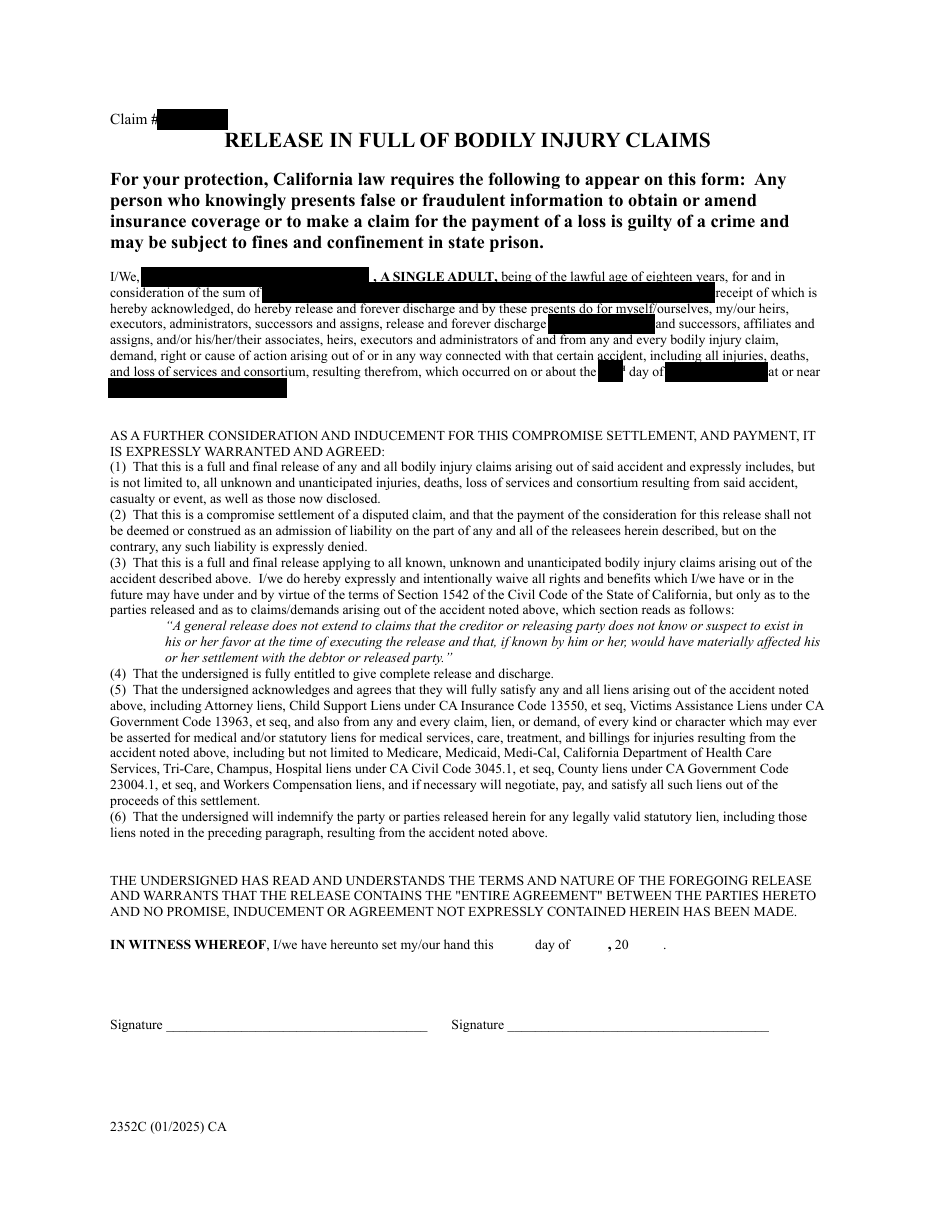
This is a Progressive release titled Release in Full of Bodily Injury Claims, form 2352C (01/2025) CA. Progressive sent it to our office in 2025. We blacked out the claim number, the injured person’s name, the settlement amount, the insured driver’s name, and the date and city of the crash. Releases from other insurers use different words and some go further, so treat this as one example and read the actual document you get.
The clauses that matter, by number
- Who you are letting go. The opening paragraph releases the at-fault driver and a long list of people connected to that driver: successors, affiliates, assigns, associates, heirs, executors and administrators. It covers every bodily injury claim from the crash, including deaths and loss of services and consortium. Loss of consortium is usually a spouse’s claim for what the injury took from the marriage, so a spouse who signs gives that up too.
- Injuries you have not found yet. Paragraphs 1 and 3 say the release covers “known, unknown and unanticipated” injuries. A disc problem that shows up on an MRI six months later is still released.
- The California code waiver. Paragraph 3 prints a California statute, Civil Code section 1542, in italics and then waives it, but only as to the released parties and claims from this crash. As the form prints it, that section says a general release does not reach claims the person did not know or suspect existed when signing, if knowing about them would have materially affected the settlement. By waiving it, you agree the release reaches them anyway. We could not open the official code text for this page, so we report only what the form itself says.
- No admission. Paragraph 2 calls the payment a compromise of a disputed claim and says the driver denies liability. Paying you is not an admission of fault.
- You promise you can sign. Paragraph 4 says you are fully entitled to give the release. If someone else holds part of your claim, such as a lienholder or a spouse, this promise matters.
- Every lien becomes your job. Paragraph 5 has you agree to satisfy every lien from the accident out of the settlement. It names attorney liens, child support liens, victim assistance liens, Medicare, Medicaid, Medi-Cal, the California Department of Health Care Services, Tricare, Champus, hospital liens, county liens and workers’ compensation liens, and cites several California code sections for them. It adds that you will negotiate and pay them if necessary.
- Indemnity. Paragraph 6 goes one step further. If a valid statutory lien goes unpaid and the lienholder comes after the driver, you agree to cover the driver. That is a promise that can cost money after the check has been spent.
- The entire agreement clause. Just above the signature, you state that the release is the whole deal and that no promise outside it was made. If the adjuster told you on the phone that a later surgery would still be paid, that promise is gone unless it is written into the release.
There is also a fraud warning in bold at the top, which the form says California law requires, and two signature lines for a married couple or two people signing together.
Why the lien language deserves attention
Health insurers, government programs and hospitals that paid for crash treatment often have a right to be repaid from the settlement. The release puts that burden on you by contract. Federal law also requires liability insurers to report settlements with Medicare beneficiaries to CMS under Section 111 of the Medicare, Medicaid, and SCHIP Extension Act, as CMS explains. That is one reason Medicare appears in the lien list.
Example only: a person settles for an amount that looks fair, then learns a health plan paid several thousand dollars for the ER visit and expects repayment. Under paragraph 5 that repayment comes out of the settlement. The facts of each case decide what any lien is actually worth and whether it can be reduced.
Free case review
Tell us what happened. We will tell you plainly whether there is a case and what to do next. You owe no fees or costs unless we win.
Before you sign, check these
- Is there more coverage? Ask whether the at-fault driver has other policies, and whether your own policy has underinsured motorist coverage. See will the adjuster tell me the policy limits.
- Are all the bills in? If treatment is ongoing, the release still ends the claim for future care.
- Are the liens known? Get a written final amount from every lienholder before the release is signed, or at least know who they are.
- Who exactly is released? Read the names. A release that reaches past the at-fault driver to other parties, or to your own insurer, may cost you an uninsured motorist claim.
- Is every promise written down? Because of the entire agreement clause, anything the adjuster said that you are relying on has to be in the document.
What to do next
Ask for the release in advance and read it slowly. Have changes made in writing before you sign, never after. If the adjuster is pressing for a fast signature, read why an adjuster wants to settle quickly first. Our page on whether to sign a release of all claims goes through the decision itself. Property damage often has its own separate property damage release. Browse the full insurance adjuster questions guide for related topics.
Common questions
Can I change the wording of a release?
You can ask. Insurers often agree to fix names, remove parties who are not involved, or add a written promise. Get the corrected version before you sign.
I signed a release. Can I still sue?
It is hard to undo a signed release, and the answer turns on the facts and your state. See signed a release, can I still sue and cashed the insurance check, can I still sue.
Does a release cover injuries I find out about later?
This one does. Paragraphs 1 and 3 say so in plain terms, and the waiver in paragraph 3 removes the code section the form describes as protecting unknown claims.
What if the release is in English and I read Spanish?
Ask for a translation before you sign. Our page on the release of all claims in Spanish explains the key terms.
How long after I sign do I get paid?
That depends on the insurer and the state. See how long to pay after a settlement. Texas cases are handled by the firm’s Texas-licensed attorneys, Joyce Ondich and John Efstathiou. You owe no fees or costs unless we win. Call toll-free 1-877-427-2752 (1-877-4-ASAP-LAW), 24/7, from anywhere in the country.
Ask a question
Not ready to call? Write your question and someone on our team will answer. No cost, no commitment.
Injury lawyer — Beverly Law
Hurt because of someone else in California, Texas and Washington? Talk to an injury attorney. Free, confidential, English or Spanish. You owe no fees or costs unless we win.
Related pages
Insurance adjuster questions · Injury law FAQs
Sources
Important: This page is general information, not legal or medical advice, and reading it does not create an attorney-client relationship. Every case is different; talk to a lawyer about yours. Texas cases are handled by the firm’s Texas-licensed attorneys, Joyce Ondich and John Efstathiou. Last reviewed: November 23, 2026.