

By Michael Shemtoub, Esq., Managing Attorney, Beverly Law
Dealing with an insurance adjuster?
Leave your name and phone. We call back today, in English or Spanish. The consultation is free and confidential.
Free consultation · English y Español · No fees or costs unless we win
The federal rule behind the question
Section 111 of the Medicare, Medicaid, and SCHIP Extension Act of 2007 is codified at 42 U.S.C. 1395y(b)(8). It applies to liability insurers (including self-insured companies), no-fault insurers and workers’ compensation plans. CMS calls them Responsible Reporting Entities. They report claims where the injured person is a Medicare beneficiary, and CMS uses those reports to tell when other coverage should pay before Medicare (CMS, Mandatory Insurer Reporting).
The point is repayment. When another payer may be responsible for crash care, Medicare can pay first on a conditional basis, and that money must be repaid when the beneficiary receives a settlement, judgment or award (CMS, Non-Group Health Plan Recovery). Insurers ask everyone because they cannot tell who is on Medicare by looking at a file.
What the insurer actually has to send CMS
According to the CMS user guide, a query record must contain the injured person’s Social Security number or Medicare ID, along with name, date of birth and gender. The guide also allows a partial number: the last five digits of the SSN (CMS NGHP User Guide, Chapter I). So when an adjuster says they need your full number, it is fair to ask whether the last five digits will do.
What the forms look like
GEICO posts a Medicare consent form on its claims website. It asks Medicare beneficiaries for their Medicare number, date of birth, sex and Social Security number or its last five digits, says the information is for federal Section 111 reporting, and has a section for someone who refuses to provide it. GEICO’s standard medical authorization also has a line for your Social Security number. See the GEICO medical authorization form.
Infinity, a Kemper company, sent our office a packet in 2026 with an acknowledgment letter. It included a driver statement that asks for a Social Security number, Medicare status and Medicare claim number (HICN) on the same page as questions about the trip, the weather and the crash scene.
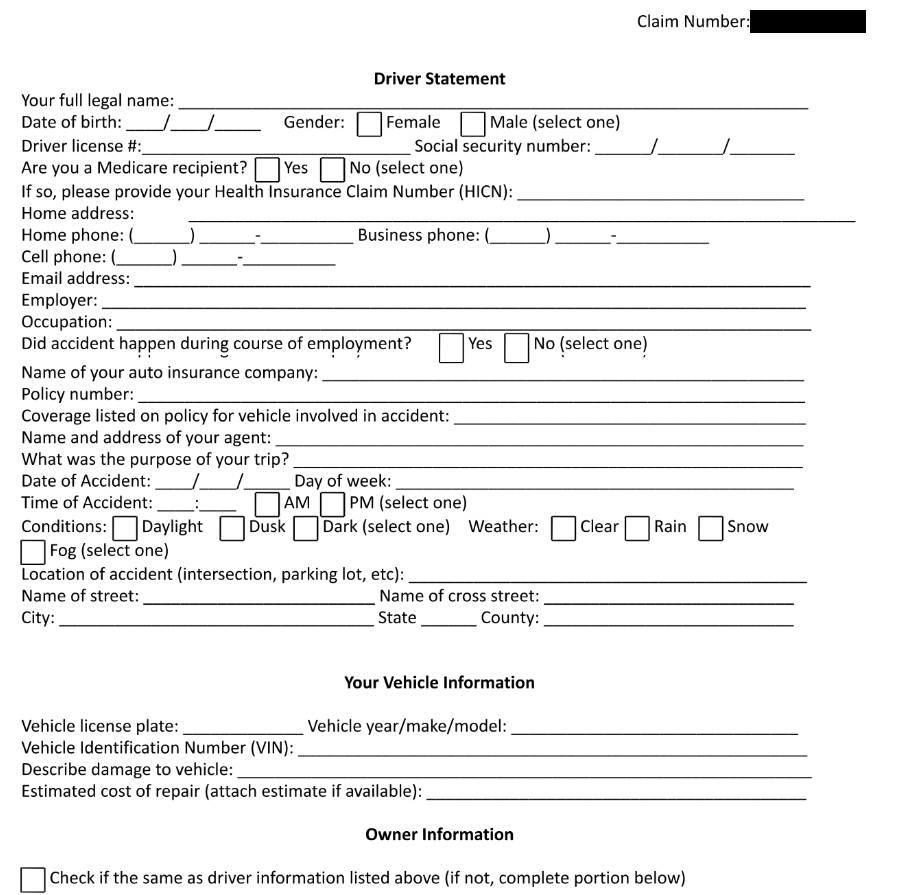
The Medicare questions are a real federal reporting need. The rest of that driver statement is a written statement about the crash, and it deserves the same care as a recorded one. See the driver statement questionnaire.
Free case review
Tell us what happened. We will tell you plainly whether there is a case and what to do next. You owe no fees or costs unless we win.
Do I have to give it?
To the other driver’s insurer, there is no law that forces you to answer on the first call. In practice, insurers will want the Medicare check done before they pay an injury settlement, because CMS can seek repayment of conditional payments from insurers as well as from beneficiaries. A sensible middle path:
- Answer the Medicare question itself. “I am not on Medicare” or “I am on Medicare” is a complete answer early on.
- Hold the number until the claim is close to settling, or until you have confirmed who is asking.
- Offer the last five digits if the insurer’s form allows it.
- If you are on Medicare, expect the settlement to account for Medicare’s conditional payments. See why adjusters ask about other insurance.
If you do not have a Social Security number, say so in writing and ask what the insurer needs instead. Do not make up a number or use someone else’s.
How to give it safely
Call the insurer back at the number on its official website, using the claim number, before you share anything. Put the number on the insurer’s own form, sent through its claim portal or by mail, rather than in a text message. Never give it to someone who calls you first and asks for it right away. Keep a copy of what you sent and the date. Our sample letters include a short cover note for this.
The insurance adjuster questions hub lists related pages, including questions adjusters ask.
Common questions
Why does the claim adjuster keep asking for my Social Security number?
Usually because the Medicare check is not done and the file cannot close without it. Ask the adjuster to say in writing why they need it and whether the last five digits are enough.
Is it normal for insurance to ask for an SSN?
Yes, on injury claims, mostly near settlement. It is less normal on the first call, before anyone has talked about your injuries.
I am not on Medicare. Why do they still ask?
The insurer cannot know that without checking. The CMS query is how they confirm it.
Will my settlement be delayed if I refuse?
It can be. Insurers commonly hold injury payments until the Medicare question is answered. Answering it, with or without the full number, usually removes the obstacle.
Does the release mention Medicare?
Many do. Read that part before you sign. See what is in an insurance release. Texas cases are handled by the firm’s Texas-licensed attorneys, Joyce Ondich and John Efstathiou. You owe no fees or costs unless we win. Call toll-free 1-877-427-2752 (1-877-4-ASAP-LAW), 24/7, from anywhere in the country.
Ask a question
Not ready to call? Write your question and someone on our team will answer. No cost, no commitment.
Injury lawyer — Beverly Law
Hurt because of someone else in California, Texas and Washington? Talk to an injury attorney. Free, confidential, English or Spanish. You owe no fees or costs unless we win.
Related pages
Insurance adjuster questions · Injury law FAQs
Sources
Important: This page is general information, not legal or medical advice, and reading it does not create an attorney-client relationship. Every case is different; talk to a lawyer about yours. Texas cases are handled by the firm’s Texas-licensed attorneys, Joyce Ondich and John Efstathiou. Last reviewed: November 23, 2026.