

By Michael Shemtoub, trial attorney, Beverly Law. Updated November 2026.
Hurt on someone else’s property?
Leave your name and phone. We call back today, in English or Spanish. The consultation is free and confidential.
Free consultation · English y Español · No fees or costs unless we win
What makes the case
The question in almost every apartment stair case is notice. A landlord who never had a chance to learn about a defect is in a different position from one who ignored texts about a loose step for two months.
Good notice evidence includes:
- Your own repair requests by text, email or tenant portal, with dates.
- Neighbors’ complaints about the same stairs.
- Photos showing the defect has been there a long time, such as rust, rot, or a crack with dirt in it.
- A work order that was opened and never closed.
- Prior falls on the same stairs.
Common defects
Loose, cracked or rotted treads are the classic case. Handrails that are missing, wobbly or end before the last step cause many falls. Steps of uneven height trip people who expect a regular rhythm. Worn carpet, torn nosing and missing non-slip strips make indoor stairs slick. Burned-out bulbs leave stairwells dark at night. Outdoor stairs collect water, leaves and algae.
If you fell on stairs at a store, restaurant or office instead, see our page on falls on stairs at a business.
What the law says about stairs and repairs
California’s general negligence rule is Civil Code 1714, which makes everyone responsible for injuries caused by a lack of ordinary care in managing their property. The habitability statute, Civil Code 1941.1, lists “floors, stairways, and railings maintained in good repair” among the standards a rental must meet, and also covers electrical lighting and wiring, and keeping areas under the landlord’s control clean and free of debris.
Washington’s RCW 59.18.060 requires landlords to keep structural components, including floors, in reasonably good repair, and to keep shared or common areas reasonably safe from defects that increase the hazard of accident.
Texas works through notice. Under Property Code 92.052, a landlord must make a diligent effort to repair a condition that materially affects the physical health or safety of an ordinary tenant once the tenant gives notice and is not behind on rent. The notice has to be in writing only if a written lease requires it. Texas premises cases such as Wal-Mart Stores v. Reece also turn on whether the owner knew of the hazard or it existed long enough that the owner should have found it. Texas cases are handled by the firm’s Texas-licensed attorneys, Joyce Ondich and John Efstathiou.
Free case review
Tell us what happened. We will tell you plainly whether there is a case and what to do next. You owe no fees or costs unless we win.
If you are worried about retaliation
Some tenants hold back because they fear eviction. All three states have anti-retaliation statutes, though each protects specific acts.
| State | What the statute protects | Time window |
|---|---|---|
| California | Repair complaints to the landlord or a government agency; also lawful exercise of rights under the law (Civ. Code 1942.5) | Landlord may not evict, raise rent or cut services within 180 days of a repair complaint, if you are not in default on rent |
| Texas | Notice to repair, good-faith exercise of a legal right or remedy, code complaints (Prop. Code 92.331) | 6 months, with exceptions such as unpaid rent (Prop. Code 92.332) |
| Washington | Code complaints to a government agency and asserting rights under the landlord-tenant act (RCW 59.18.240) | Action within 90 days is presumed retaliatory, subject to rebuttal (RCW 59.18.250) |
Notice what the three have in common. California’s 180-day protection applies to a tenant not in default on rent, the Texas repair duty applies when the tenant is current, and Washington’s protection applies to a tenant in compliance with the act. Keep paying rent and do not withhold it over the injury without legal advice.
Steps to take after the fall
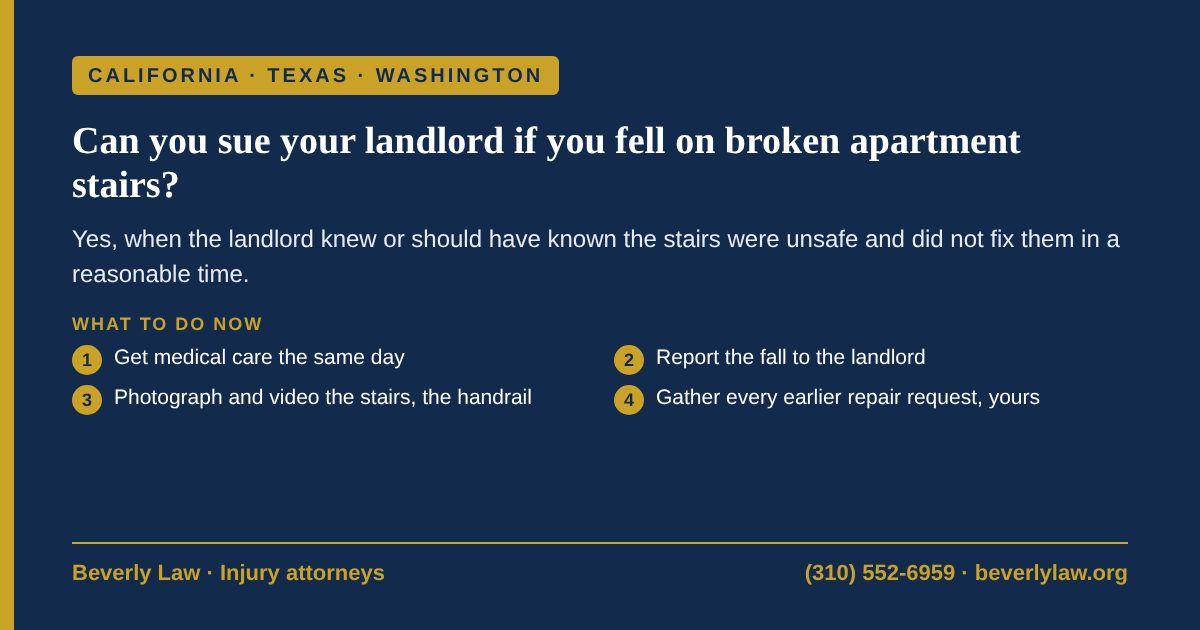
- Get medical care the same day.
- Report the fall to the landlord or manager in writing and keep a copy.
- Photograph and video the stairs, the handrail and the lighting before anything is repaired. Measure the defect if you can, with a ruler or tape in the photo.
- Gather every earlier repair request, yours and your neighbors’.
- Get the names of neighbors who complained before or saw the fall.
- Keep your lease and rent receipts.
Our page on slip and fall evidence explains how to keep photos and messages usable.
What the landlord will argue
The landlord will say nobody reported the problem, that you were rushing or carrying too much, or that the defect was small. Some landlords also argue the tenant was responsible for that area under the lease. The repair requests and the photos answer most of this.
Who pays
Often the landlord’s liability insurance, not the landlord personally. Ask for the owner’s legal name; the management company on your rent checks may be a different business from the owner.
Deadlines
| State | Private landlord | Public agency owner |
|---|---|---|
| California | 2 years (CCP 335.1) | Claim generally within 6 months (Gov. Code 911.2) |
| Texas | 2 years (CPRC 16.003) | Notice generally within 6 months (CPRC 101.101) |
| Washington | 3 years (RCW 4.16.080) | Claim first, then a 60-day wait (RCW 4.96.020) |
What this means for your case
Collect the repair history before you do anything else. A dated text about a loose step, sent weeks before the fall, often matters more than any other single piece of evidence. Keep your tenancy in good standing while the claim goes forward.
Fell on apartment stairs: can I sue the landlord if I was partly at fault?
Landlords and their insurers almost always say the tenant was careless: not holding the handrail, carrying laundry or groceries, wearing slippers, looking at a phone, or using the stairs in the dark. Even when some of that is true, a broken step or a loose rail can still make the landlord responsible for part of the harm. How much your own share counts depends on the state.
- California: your damages are reduced by your percentage of fault, but your share does not bar the claim (Li v. Yellow Cab Co.).
- Texas: if you are found more than 50 percent responsible, you recover nothing; at 50 percent or less, your damages are reduced by your percentage (CPRC 33.001 and 33.012).
- Washington: your share of fault reduces your damages without barring them (RCW 4.22.005).
The evidence that shifts those percentages is usually physical. Photograph the handrail and whether it was loose, missing or too short to reach the step where you fell, the lighting and whether the bulb was out, and the step edge. If you were carrying something, say so plainly; it is ordinary on apartment stairs, and the question is whether the stairs were safe for ordinary use.
Common questions
Can I sue my apartment complex if I fell down the stairs?
Yes, if the complex knew or should have known about a defect and did not fix it. A fall with no defect, such as a simple misstep, is much harder.
How hard is it to win a stair fall case against a landlord?
It depends on notice. With written repair requests it is much easier. Our page on how long a slip and fall case takes covers the timeline.
What kind of lawyer do I need?
A personal injury lawyer who handles premises cases. A landlord-tenant lawyer handles evictions and rent disputes, which is a different matter.
Can my landlord evict me for filing a claim?
The statutes above limit retaliation, with conditions. Talk to a lawyer before responding to any notice.
What if I was attacked in the stairwell instead of falling?
That is a negligent security question. See assaulted at an apartment complex. More answers are on our injury law FAQs page. Beverly Law offers a free case review in English or Spanish at (310) 552-6959. You owe no fees or costs unless we win.
I wasn’t holding the handrail when I fell. Can I still sue my landlord?
Often, yes. Not holding the rail can lower what you recover in California and Washington, and in Texas it bars recovery only if you are found more than 50 percent at fault. A loose or missing rail cuts the other way.
The landlord says I fell because I was carrying laundry. Does that end my claim?
No, not by itself. Tenants carry things on stairs every day. The question is whether a defect, such as a broken step or bad lighting, helped cause the fall, and how fault is shared.
Ask a question
Not ready to call? Write your question and someone on our team will answer. No cost, no commitment.
Injury lawyer — Beverly Law
Hurt because of someone else in California, Texas and Washington? Talk to an injury attorney. Free, confidential, English or Spanish. You owe no fees or costs unless we win.
Related pages
Sources
- Cal. Civil Code 1714 (leginfo.legislature.ca.gov)
- Cal. Civil Code 1941.1 (leginfo.legislature.ca.gov)
- Cal. Civil Code 1942.5 (leginfo.legislature.ca.gov)
- Tex. Property Code 92.052 (statutes.capitol.texas.gov)
- Tex. Property Code 92.331 (statutes.capitol.texas.gov)
- Tex. Property Code 92.332 (statutes.capitol.texas.gov)
- Wal-Mart Stores, Inc. v. Reece, 81 S.W.3d 812 (Tex. 2002) (courtlistener.com)
- RCW 59.18.060 (app.leg.wa.gov)
- RCW 59.18.240 (app.leg.wa.gov)
- RCW 59.18.250 (app.leg.wa.gov)
- Cal. Code of Civil Procedure 335.1 (leginfo.legislature.ca.gov)
- Tex. Civ. Prac. & Rem. Code 16.003 (statutes.capitol.texas.gov)
- RCW 4.16.080 (app.leg.wa.gov)
- Cal. Government Code 911.2 (leginfo.legislature.ca.gov)
- Tex. Civ. Prac. & Rem. Code 101.101 (statutes.capitol.texas.gov)
- RCW 4.96.020 (app.leg.wa.gov)
Important: This page is general information, not legal or medical advice, and reading it does not create an attorney-client relationship. Every case is different; talk to a lawyer about yours. Texas cases are handled by the firm’s Texas-licensed attorneys, Joyce Ondich and John Efstathiou. Last reviewed: November 7, 2026.