

By Michael Shemtoub, trial attorney, Beverly Law. Updated November 2026.
Hurt on someone else’s property?
Leave your name and phone. We call back today, in English or Spanish. The consultation is free and confidential.
Free consultation · English y Español · No fees or costs unless we win
Who can be responsible
- Apartment owner or landlord: for failing to inspect and repair a balcony, deck or exterior stairway that tenants use. Our page on falls on apartment stairs covers the landlord’s side in more detail.
- Condo or homeowners association: when the balcony is a common area or part of the building’s structure the association must maintain.
- Homeowner: when a guest is hurt on a deck the owner knew, or should have known, was in bad shape.
- Builder, framer or repair contractor: for building it wrong, using the wrong fasteners, skipping flashing or waterproofing, or covering up rot during a repair.
- Vacation rental host or hotel: for renting out a unit with an unsafe deck. See our Airbnb injury page.
- Property manager: when it received repair requests and did nothing.
Several of these can share fault in the same case. The owner and the builder often blame each other, which is one reason to keep the physical evidence.
Was your building inspected? (California)
California has two balcony inspection laws, and either one can become key evidence.
Apartment buildings. Health and Safety Code 17973 covers buildings with three or more multifamily units. Balconies, decks and stairways more than 6 feet above the ground that rely on wood or wood-based supports had to be inspected by January 1, 2026, and every 6 years after that. The deadline used to be January 1, 2025; AB 2579 pushed it back a year in 2024. A building whose permit application was filed on or after January 1, 2019 has 6 years from its certificate of occupancy instead.
Condominiums. Condo and other common interest developments are not covered by 17973. They follow Civil Code 5551, which required the association to finish its first inspection of wood-supported elevated elements by January 1, 2025 and repeat it every 9 years. That deadline was not extended. In 2025, SB 410 made these reports association records and added them to resale disclosures.
What to do with this:
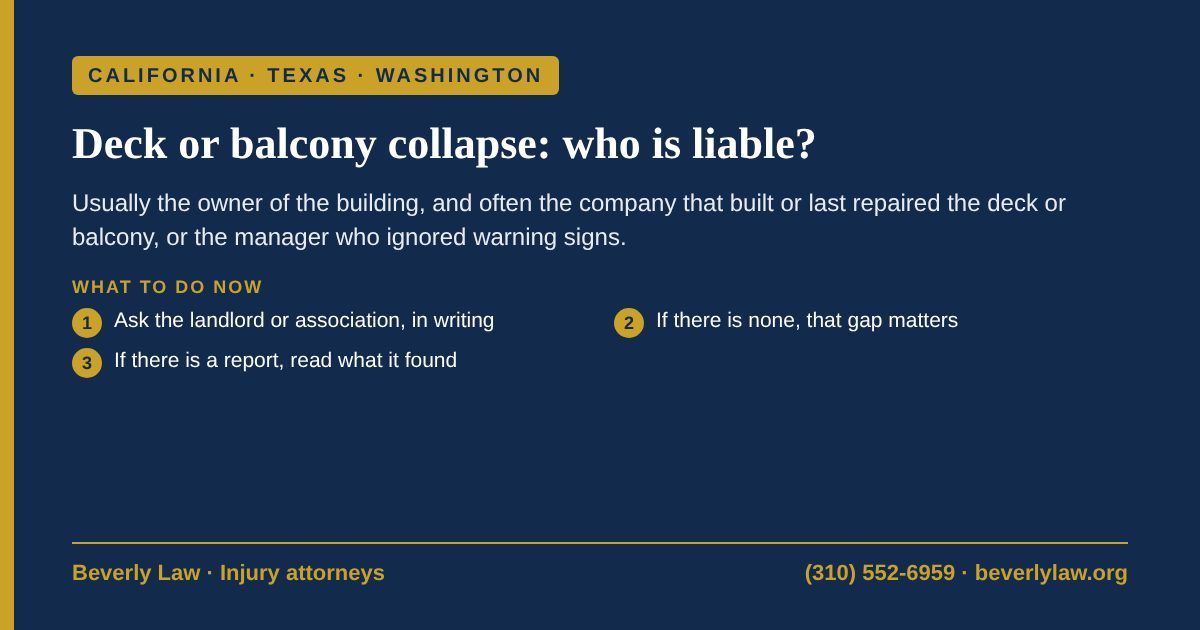
- Ask the landlord or association, in writing, for the most recent balcony inspection report.
- If there is none, that gap matters. An owner who skipped a required inspection will have a hard time saying it had no reason to look.
- If there is a report, read what it found and whether the repairs it called for were made before the collapse.
Some cities run their own enforcement programs on top of the state law, so ask the city’s building department for permits and notices on the address too.
Immediate steps
- Get medical care. Falls from height can hurt the spine, pelvis and head. The CDC lists danger signs after a head injury that call for the emergency room right away, including a headache that keeps getting worse, repeated vomiting and slurred speech. Our head injury danger signs page goes through them.
- Call 911 if anyone is trapped. The fire department and police reports become evidence.
- Photograph the wreckage up close before anyone clears it: where the ledger pulled away from the building, the rot, the rusted or missing connectors.
- Send a written request asking the owner and manager to keep the debris and not throw it out.
- Write down how many people were on the deck and who they were.
- Save earlier complaints, texts to the manager, repair requests and inspection notices.
Free case review
Tell us what happened. We will tell you plainly whether there is a case and what to do next. You owe no fees or costs unless we win.
What they will argue
The usual defense is that too many people were on it. A deck built and kept up to code is supposed to hold a normal gathering, and the broken connections usually show whether it was. They may also argue you were partly at fault. In California your award is reduced by your share of fault (Li v. Yellow Cab). In Texas you recover nothing if you are more than 50% at fault (CPRC 33.001). In Washington your share reduces the award without barring it (RCW 4.22.005). Our comparative fault page explains how that math works.
Deadlines, including builder time limits
The regular deadline to sue for an injury is 2 years in California (CCP 335.1), 2 years in Texas (CPRC 16.003) and 3 years in Washington (RCW 4.16.080).
Claims against the builder have an outer limit too. In Texas, a personal injury suit against a person who built or repaired an improvement generally must be filed within 10 years of substantial completion, or 6 years for some homes covered by a qualifying written warranty, and if the injury happens in the last year of that period, you get 2 years from the injury (CPRC 16.009). In Washington, the claim must arise within 6 years after substantial completion or the end of the builder’s services, whichever is later (RCW 4.16.310). Neither limit protects the owner or other person in control of the property when the injury happens, so an old deck does not let a landlord off the hook. In California, ask a lawyer how the builder rules apply to your facts.
What this means for your case
Start by finding out who owned the building, who managed it, and who built or last worked on the deck. In California, the inspection report or its absence is often the most useful document in the file. Serious falls can lead to spinal injuries with lifelong costs; our page on what drives the value of a spinal cord injury case explains those factors. Texas cases are handled by the firm’s Texas-licensed attorneys, Joyce Ondich and John Efstathiou.
Common questions
Will insurance cover a collapsed deck?
Injury claims usually go to the owner’s liability insurance: a landlord’s commercial policy, an association’s master policy or a homeowner’s policy. The builder may have its own policy. Coverage depends on each policy’s terms.
Can the owner repair the deck right away?
The owner may start repairs or haul the debris off quickly. That is why the photos and the written request to keep the broken pieces should happen in the first days.
What happens if you fall from a balcony?
Get emergency care first. Then preserve the evidence and find out who owned and maintained the balcony, since that decides who pays.
Can a tenant sue if the balcony was in their own unit?
Yes, if the landlord was responsible for the structure. The balcony’s support system is usually the owner’s job, not the tenant’s.
Does California's inspection law apply to single-family homes?
No. Section 17973 applies to buildings with three or more multifamily units, and Section 5551 applies to condo associations. You can find more answers about injuries on our FAQ hub. Beverly Law offers a free case review in English or Spanish at (310) 552-6959. You owe no fees or costs unless we win.
Ask a question
Not ready to call? Write your question and someone on our team will answer. No cost, no commitment.
Injury lawyer — Beverly Law
Hurt because of someone else in California, Texas and Washington? Talk to an injury attorney. Free, confidential, English or Spanish. You owe no fees or costs unless we win.
Related pages
Sources
- Cal. Health & Safety Code 17973 (leginfo.legislature.ca.gov)
- AB 2579 (Stats. 2024, ch. 835) (leginfo.legislature.ca.gov)
- Cal. Civ. Code 5551 (leginfo.legislature.ca.gov)
- SB 410 (Stats. 2025, ch. 516) (leginfo.legislature.ca.gov)
- Cal. Code Civ. Proc. 335.1 (leginfo.legislature.ca.gov)
- Li v. Yellow Cab Co. (1975) 13 Cal.3d 804 (scocal.stanford.edu)
- Tex. Civ. Prac. & Rem. Code 16.003 (statutes.capitol.texas.gov)
- Tex. Civ. Prac. & Rem. Code 16.009 (statutes.capitol.texas.gov)
- Tex. Civ. Prac. & Rem. Code 33.001 (statutes.capitol.texas.gov)
- RCW 4.16.080 (app.leg.wa.gov)
- RCW 4.16.310 (app.leg.wa.gov)
- RCW 4.22.005 (app.leg.wa.gov)
- CDC, Symptoms of Mild TBI and Concussion (cdc.gov)
Important: This page is general information, not legal or medical advice, and reading it does not create an attorney-client relationship. Every case is different; talk to a lawyer about yours. Texas cases are handled by the firm’s Texas-licensed attorneys, Joyce Ondich and John Efstathiou. Last reviewed: November 7, 2026.