

By Michael Shemtoub, Esq., Managing Attorney, Beverly Law
Dealing with an insurance adjuster?
Leave your name and phone. We call back today, in English or Spanish. The consultation is free and confidential.
Free consultation · English y Español · No fees or costs unless we win
This page is part of our guide to insurance adjuster questions. It covers the plain written account, the diagram, and the fill-in forms some insurers mail out.
Why a written statement is often the safer choice
On a recorded call, you answer on the spot, and the adjuster picks the questions and the order. On paper, you have time to check your photos and the crash report, and you can reread before you send. Nothing is said in passing that you would phrase differently with a minute to think.
Writing is not risk-free. Whatever you send becomes part of the file. Keep it short and stick to what you know firsthand. If you have already been asked for a recorded statement, our page on a recorded statement to the other insurance company covers that choice, and what to say in a recorded statement covers the call itself.
What to include
A useful statement can fit on one page.
- Date, time and the exact place, with street names or the parking lot
- Your direction of travel and lane
- The traffic signal or sign that applied to you, and its state if you saw it
- What the other vehicle did, in one or two sentences
- Where the cars came to rest
- The police or crash report number
- Names and contact details of witnesses
- Weather and light, if you remember them
Write in the first person and in the past tense. “I was driving north on Main Street in the left lane. The light was green for me. A white pickup turned left in front of me from the southbound lane.” Short sentences like those are hard to misread.
Free case review
Tell us what happened. We will tell you plainly whether there is a case and what to do next. You owe no fees or costs unless we win.
What to leave out
Guesses about speed and distance. If you must mention speed, say it was your estimate.
Opinions about fault beyond the facts. “He ran the red light” is a fact if you saw it. “He’s a reckless driver” is an opinion.
A description of injuries before a doctor has seen you. Write “I am being evaluated by a doctor” instead. If you already told someone you were fine, read told the adjuster I was fine.
Apologies. “I’m sorry” said out of politeness can be read as an admission.
Your medical history, finances and anything nobody asked for.
The diagram
Many insurers ask for a sketch. Keep it simple: street names, lane lines, an arrow for each vehicle’s direction, labels for “my car” and “other car,” and an X where they hit. Add the traffic light or stop sign if there was one. Do not add measurements you did not take. If you are not sure of a detail, leave it off and say so in the text.
Take a photo of your diagram before you send it, so you have a copy.
When the insurer sends a form instead
Some insurers send a fill-in “driver statement” with their first letter. The one below is a form one insurer sent to our office in 2026, with the claim number blacked out.
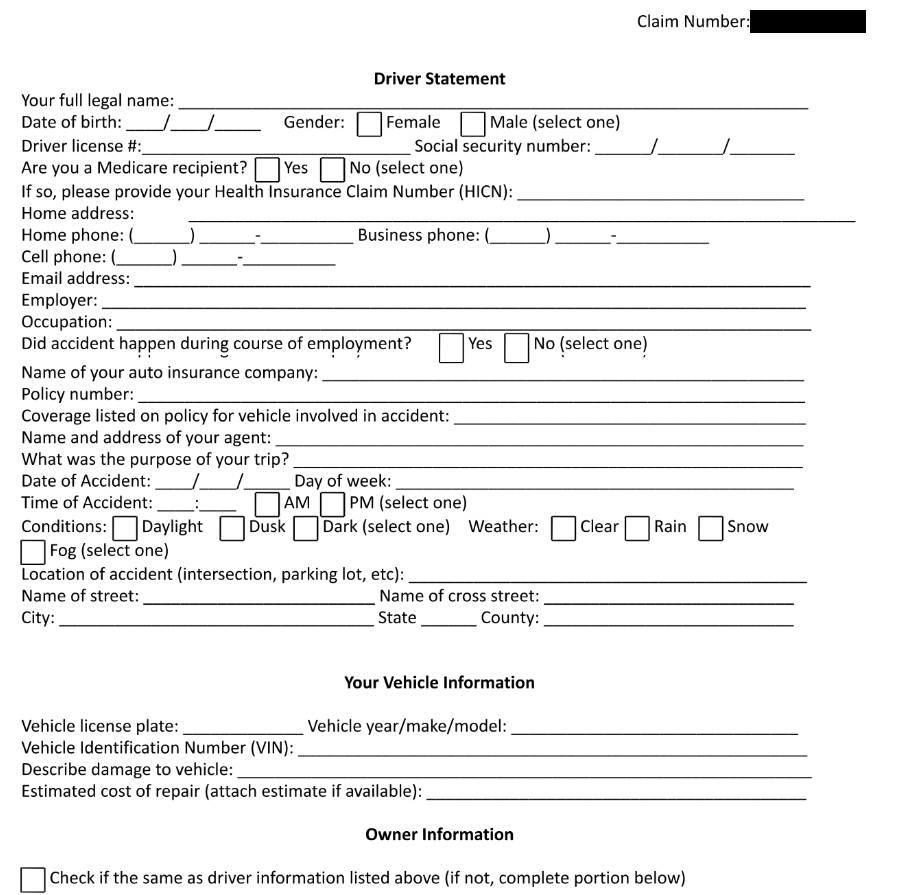
The first page asks for far more than how the crash happened. It wants your Social Security number, your Medicare status and claim number, your employer and occupation, your own policy and coverages, and even “What was the purpose of your trip?” It also asks about light and weather and the exact location. Further down, the same page asks about your vehicle, its damage, the repair estimate and who owns it.
Treat a form like this as a written statement with blanks. Every answer can be used when the insurer weighs fault and value. You can fill in the crash facts you know and leave sensitive lines for a separate, written exchange. Our page on the driver statement questionnaire goes through the form line by line, and the Social Security number page covers that request.
The Medicare question has a real basis. Federal law requires liability insurers to report claims involving Medicare beneficiaries, as the CMS mandatory insurer reporting page explains. That does not require you to answer it on a fault questionnaire. See why adjusters ask about other insurance.
What to do next
Draft the statement, wait a day and reread it. Check it against your photos and the crash report. Send it by email or mail and keep a copy with the date. If the adjuster follows up with more questions, ask for those in writing too. For the questions you can expect, see questions insurance adjusters ask.
If the request comes from your own insurer, check your policy’s cooperation terms before you decline any part of it.
Common questions
Do I have to give the other driver's insurance a written statement?
You have no policy with them, so it is a request. A short written account can help the claim move. You can decide what to include.
Should I sign the written statement?
Sign your own letter if you like. Do not sign a statement that an adjuster wrote for you without reading every line and fixing anything wrong.
Can I write my statement in Spanish?
Yes. You can write in the language you know and ask the insurer to translate it. Keep a copy of what you sent.
How long should a written statement be?
Usually a page or less. Longer statements give more room for small mistakes.
Can I change my written statement later?
You can send a correction. Do it in writing, as soon as you notice the error, and keep a copy. Texas cases are handled by the firm’s Texas-licensed attorneys, Joyce Ondich and John Efstathiou. You owe no fees or costs unless we win. Call toll-free 1-877-427-2752 (1-877-4-ASAP-LAW), 24/7, from anywhere in the country.
Ask a question
Not ready to call? Write your question and someone on our team will answer. No cost, no commitment.
Injury lawyer — Beverly Law
Hurt because of someone else in California, Texas and Washington? Talk to an injury attorney. Free, confidential, English or Spanish. You owe no fees or costs unless we win.
Related pages
Insurance adjuster questions · Injury law FAQs
Sources
Important: This page is general information, not legal or medical advice, and reading it does not create an attorney-client relationship. Every case is different; talk to a lawyer about yours. Texas cases are handled by the firm’s Texas-licensed attorneys, Joyce Ondich and John Efstathiou. Last reviewed: November 23, 2026.