

By Michael Shemtoub, Esq., Managing Attorney, Beverly Law
Dealing with an insurance adjuster?
Leave your name and phone. We call back today, in English or Spanish. The consultation is free and confidential.
Free consultation · English y Español · No fees or costs unless we win
The first visit sets the story
The earliest records after the crash carry the most weight. Adjusters check how soon you were seen, what you told the ambulance crew or the ER, and which body parts were listed. A neck complaint that first appears three weeks later invites an argument that something else caused it.
They also read the history line, the short paragraph where a nurse or doctor writes what you said happened. “Patient was rear-ended at a stop light” helps. “Patient unsure how injury occurred” does not. Small words get quoted back later. If you told the adjuster on the phone that you were fine, see I told the adjuster I was fine.
Gaps, missed visits and stopping early
Insurers treat time without care as a sign you healed. A gap of several weeks between visits, a string of missed physical therapy sessions, or stopping treatment while the chart still shows pain will be flagged. The real reason matters: no ride, no childcare, a job that would not give time off, an insurance denial, a doctor who told you to rest. If the reason is not in the chart, the adjuster will supply its own. The page the adjuster says there was a gap in my treatment shows how to answer it.
Pain scores and “doing well”
Many charts include a pain score from 0 to 10 at each visit, plus quick phrases like “improving,” “doing well” or “no acute distress.” Adjusters pull these into a summary to argue the injury was minor. A doctor’s “doing well” often means doing well compared with last visit, which is different from being back to normal. Your own words during visits matter. Describe what you cannot do, such as lifting a child, sleeping through the night or sitting through a work shift, so it ends up in the notes. Adjusters also lean on how a crash looked; see the adjuster says it was a low-impact crash.
Free case review
Tell us what happened. We will tell you plainly whether there is a case and what to do next. You owe no fees or costs unless we win.
Prior complaints and activities
Any earlier visit for the same body part gets attention, along with imaging terms like “degenerative.” That does not end a claim; the page the adjuster says my injury was pre-existing explains aggravation. Adjusters also scan for activities written into the chart after the crash: a note that you went to the gym, moved apartments or went on a trip. Some insurers assign a nurse to review or follow the file, as covered on the insurance nurse case manager.
The last thing many adjusters look for is a link. Does any doctor connect the injury to the crash in writing? A clear note on causation and on future care needs carries real weight when the claim is valued, as explained on how adjusters calculate pain and suffering.
Where your records can travel
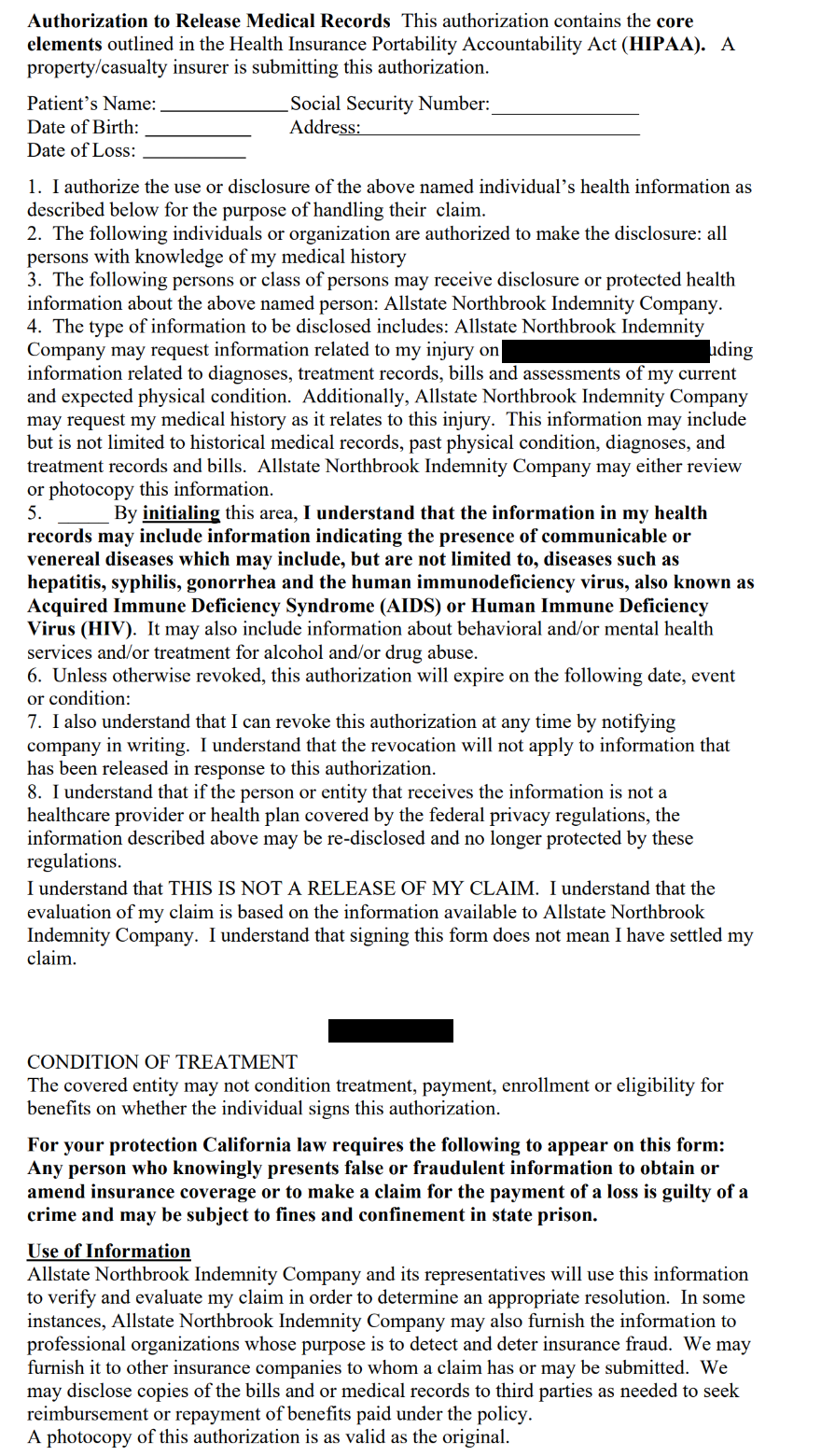
Records you release do not always stay with one adjuster. An Allstate authorization sent to our office in late 2025 included a section letting the company give the information to fraud-detection organizations and to other insurance companies to which a claim “has or may be submitted.” That is one more reason to read the chart before it leaves and to limit what goes out. The Allstate form page covers the rest of that form.
How to fix real errors
HIPAA gives you a right to ask a provider to amend your records. Under 45 CFR 164.526, the provider must act on the request within 60 days, with one extension of up to 30 more days if it tells you in writing why and when it will finish. It may require the request in writing with a reason. It can deny the request if the record is accurate and complete. If it denies, it must say why in writing, and you have the right to file a written statement of disagreement that can travel with future disclosures of that record.
Use this for real mistakes: the wrong side of the body, a wrong date, a crash description that is simply wrong, a medication you never took. Do not ask a provider to remove true history. That tends to backfire.
Example only: a chart says “left knee” when the ER treated the right knee. The patient writes to the records office, points to the imaging report that shows the right knee, and asks for an amendment. The facts of each case decide whether a provider agrees.
What to do next
Get your records under the right of access in 45 CFR 164.524 and read them in date order with a highlighter. Mark the first complaint for each body part, every gap, every “doing well,” every earlier visit for the same area and every doctor’s note on cause. Request amendments for real errors. Then send the package yourself, following how to send medical records to the adjuster yourself. The full series is on our insurance adjuster questions page.
Common questions
Do adjusters read every page?
On a larger claim, someone usually does, sometimes a nurse reviewer or a records summary service. Assume every note will be seen.
Can I ask my doctor to add something to my chart?
You can tell your doctor at your next visit about symptoms and limits you have not mentioned. The amendment process is for correcting records, and the provider decides whether to accept.
Will missed appointments hurt my claim?
They can. Call to reschedule and make sure the reason is noted.
What about records from before the crash?
See can the insurance company ask for my medical records for how far back requests usually reach. Texas cases are handled by the firm’s Texas-licensed attorneys, Joyce Ondich and John Efstathiou. You owe no fees or costs unless we win. Call toll-free 1-877-427-2752 (1-877-4-ASAP-LAW), 24/7, from anywhere in the country.
Ask a question
Not ready to call? Write your question and someone on our team will answer. No cost, no commitment.
Injury lawyer — Beverly Law
Hurt because of someone else in California, Texas and Washington? Talk to an injury attorney. Free, confidential, English or Spanish. You owe no fees or costs unless we win.
Related pages
Insurance adjuster questions · Injury law FAQs
Sources
Important: This page is general information, not legal or medical advice, and reading it does not create an attorney-client relationship. Every case is different; talk to a lawyer about yours. Texas cases are handled by the firm’s Texas-licensed attorneys, Joyce Ondich and John Efstathiou. Last reviewed: November 23, 2026.