

By Michael Shemtoub, Esq., Managing Attorney, Beverly Law
Dealing with an insurance adjuster?
Leave your name and phone. We call back today, in English or Spanish. The consultation is free and confidential.
Free consultation · English y Español · No fees or costs unless we win
The form on this page
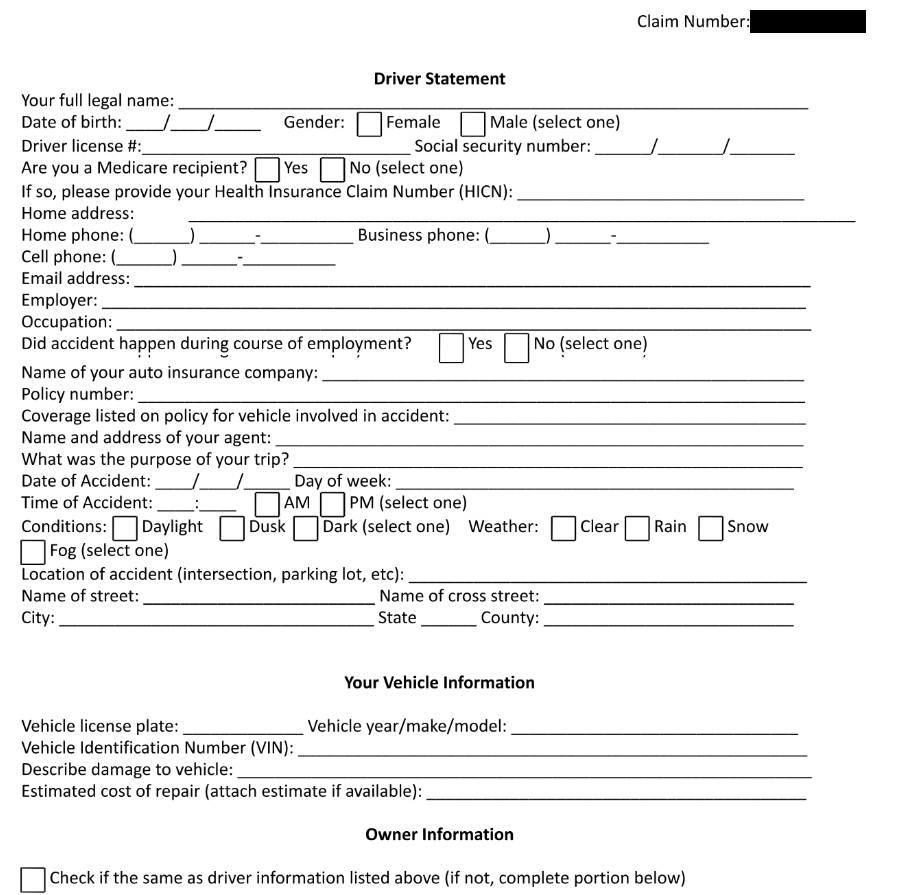
This Driver Statement came to our office in 2026 from Infinity, a Kemper company, enclosed with the insurer’s acknowledgment letter. We blacked out the claim number. The image shows the first page through the start of the owner section, and we describe only that part. Other insurers send similar questionnaires under names like accident report, claimant statement or loss questionnaire.
The questions, by number
- Identity. Full legal name, date of birth, gender, driver’s license number and Social Security number, home address, home, business and cell phones, and email. Your name, address and a contact number are reasonable. The license and Social Security numbers deserve a reason first; see why the insurer wants your Social Security number.
- Medicare. A yes or no on whether you receive Medicare, and if so, your Medicare claim number. This question has a real basis. Federal law requires liability insurers to report claims by Medicare beneficiaries to CMS under Section 111, as CMS explains. That reporting duty sits apart from the rest of the questionnaire and can be handled on its own.
- Work. Employer, occupation, and whether the accident happened during the course of employment. The last answer can bring in workers’ compensation and an employer’s insurer, and it affects who pays whom.
- Your own insurance. Your insurer, policy number, the coverages on the car, and your agent’s name and address. Why an at-fault driver’s insurer asks this is covered in why adjusters ask about other insurance.
- Purpose of the trip. The form asks, “What was the purpose of your trip?” The answer can suggest you were rushing, working or distracted. A one-word answer here can become a whole theory about your driving.
- Date, time and conditions. Date, day of week, time with AM or PM, daylight, dusk or dark, and clear, rain, snow or fog. These are checkboxes. A wrong box, ticked from memory months later, can be compared against the police report and weather data and used to question everything else you wrote.
- Location. Type of place (intersection, parking lot), street, cross street, city, state and county.
- Your vehicle. Plate, year, make and model, VIN, a description of the damage and an estimated repair cost, with the estimate attached if you have one.
- Owner. A checkbox if the owner is the same as the driver, and if not, the owner’s details.
Why this is a statement in all but name
Adjusters use what you say to decide fault and value, and a written form is still something you said. Unlike a phone call, it carries your handwriting and you cannot correct a slip in the next sentence. Our page on how adjusters determine fault shows how details like time, light and direction get used. The same caution applies here as to a recorded statement to the other insurance company.
Example only: someone checks Dusk because it felt dim, but the police report lists Daylight. The adjuster then argues the person’s memory of the light, and of who had the signal, is unreliable. The facts of each case decide whether a mismatch like that matters.
Free case review
Tell us what happened. We will tell you plainly whether there is a case and what to do next. You owe no fees or costs unless we win.
How to respond instead
You do not have to treat a blank questionnaire as a test you must pass. Options that usually work better:
- If you have a lawyer, send the form to the lawyer and let the insurer know through a letter of representation. The lawyer decides what to answer.
- Give the basic facts the insurer needs to open the claim: your name, a contact address, the date and place of the crash, and your vehicle.
- Answer the Medicare question separately, since it is tied to federal reporting.
- Leave out your Social Security number, driver’s license number and trip purpose until there is a clear reason to give them.
- Do not guess at conditions. Write that you will rely on the police report, or leave those fields for later.
- Keep a copy of anything you send.
For more on putting things in writing, see written statements for insurance, and for the spoken version, the questions insurance adjusters ask.
What to do next
Set the form aside the day it arrives. Gather the police report, photos and your repair estimate so that anything you eventually provide matches documents. If the adjuster calls to follow up, read what to do when the other driver’s insurance calls. Later in the claim you may also see a settlement release; our page on what is in an insurance release walks through one. Our insurance adjuster questions guide covers the rest.
Common questions
Do I have to fill out the other driver's insurance questionnaire?
You have no policy with that insurer. The practical question is what it needs to evaluate your claim, and that can usually be supplied in a shorter, more careful way, often through a lawyer.
Why does the form ask if I have Medicare?
Liability insurers must report claims involving Medicare beneficiaries to CMS under Section 111. That is a real federal requirement.
Why do they want to know the purpose of my trip?
It can show whether you were working, which may bring in other insurance, and it can be used to suggest you were in a hurry or distracted.
What if I already sent it back?
Get a copy of what you sent. If something was wrong, a lawyer can correct it in writing before it hardens into the insurer’s version of events.
Is this the same as a recorded statement?
It covers much of the same ground. The difference is that it is in your own handwriting. Texas cases are handled by the firm’s Texas-licensed attorneys, Joyce Ondich and John Efstathiou. You owe no fees or costs unless we win. Call toll-free 1-877-427-2752 (1-877-4-ASAP-LAW), 24/7, from anywhere in the country.
Ask a question
Not ready to call? Write your question and someone on our team will answer. No cost, no commitment.
Injury lawyer — Beverly Law
Hurt because of someone else in California, Texas and Washington? Talk to an injury attorney. Free, confidential, English or Spanish. You owe no fees or costs unless we win.
Related pages
Insurance adjuster questions · Injury law FAQs
Sources
Important: This page is general information, not legal or medical advice, and reading it does not create an attorney-client relationship. Every case is different; talk to a lawyer about yours. Texas cases are handled by the firm’s Texas-licensed attorneys, Joyce Ondich and John Efstathiou. Last reviewed: November 23, 2026.