

By Michael Shemtoub, trial attorney, Beverly Law. Updated November 2026.
Hurt on someone else’s property?
Leave your name and phone. We call back today, in English or Spanish. The consultation is free and confidential.
Free consultation · English y Español · No fees or costs unless we win
What counts as a security failure
These are the problems that show up most in apartment, hotel, bar, parking garage and shopping center cases:
- Broken gates, entry doors or unit locks that were reported and not fixed
- Burned-out lights in parking areas, stairwells, hallways and laundry rooms
- Cameras that do not record, or that point at nothing useful
- No response after earlier break-ins, robberies or assaults on the property
- Gate codes and keys handed out carelessly, or never changed after a former tenant left
- Security guards or patrols that were promised in the lease or advertising and never provided
- Staff who saw a threat building and did nothing
Immediate steps
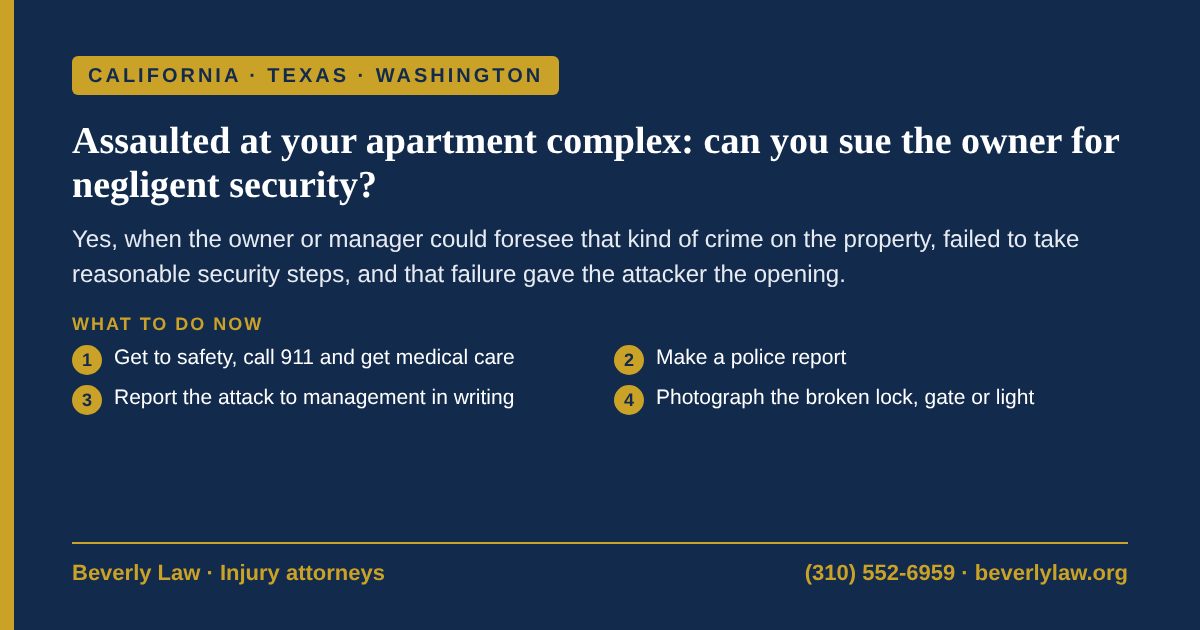
- Get to safety, call 911 and get medical care.
- Make a police report and write down the report number and the officer’s name.
- Report the attack to management in writing, by email or through the tenant portal, so there is a dated record.
- Photograph the broken lock, gate or light and the exact spot where it happened.
- Save every earlier complaint you made: texts, emails, maintenance requests and portal tickets.
- Ask neighbors about earlier crimes at the property and write down what they tell you.
- Send a written request asking the owner to keep video, gate and key-fob logs, maintenance records and security contracts.
How each state decides whether the crime was foreseeable
Foreseeability is the heart of every negligent security case, and the three states test it differently.
- Texas looks at earlier crimes on or near the property and asks how close, how recent, how frequent, how similar and how well known they were (Timberwalk Apartments v. Cain). Owners are charged with crimes they actually knew of or that were publicized; crime that was never reported does not count as evidence.
- California generally requires notice of prior similar crimes before an owner can be required to take costly measures like hiring guards (Ann M. v. Pacific Plaza). Simpler, low-cost steps can be required on a lesser showing, prior incidents do not have to be identical, and a business must take reasonable steps when it sees danger unfolding in front of it (Delgado v. Trax Bar & Grill).
- Washington usually requires either knowledge of an imminent threat or a history of prior similar incidents on the premises. Those earlier incidents must be similar in nature and location, close in time and numerous enough to make the crime likely, and the court rejected a looser “totality of the circumstances” test (McKown v. Simon Property Group).
California’s sliding scale matters in practice. Fixing a broken gate or replacing a light costs little, so the proof needed to require it is lower than the proof needed to require a full-time guard.
Free case review
Tell us what happened. We will tell you plainly whether there is a case and what to do next. You owe no fees or costs unless we win.
Where the proof comes from
Earlier crimes are proved with records, not memories. The usual sources are police calls for service and crime reports for the property’s address and the blocks around it, earlier tenant complaints, the owner’s own incident logs, emails between the manager and the owner about security, contracts with security companies and the dates they ended, and maintenance tickets for lights, locks and gates. News reports matter in Texas because publicity is one of the Timberwalk factors.
Your own complaints are often the most powerful evidence. A dated email saying the gate has been broken for three weeks answers the question of whether the owner knew.
Apartments, hotels, bars and parking lots
The same rules reach beyond apartments. Hotels, bars, nightclubs, parking garages, stores and shopping centers all owe their guests reasonable security once crime is foreseeable. Delgado itself involved a bar, and McKown involved a shopping mall. For apartment conditions that are not about crime, such as broken stairs, see fell on apartment stairs: can you sue the landlord.
If the property is public housing or other government property, a government claim comes first: generally six months in California (Gov. Code 911.2) and Texas (CPRC 101.101), and a claim plus a 60-day wait in Washington (RCW 4.96.020).
What the owner will argue
That nobody could have predicted a criminal’s act, and that the owner is not an insurer of tenant safety. Records of similar earlier crimes at the same address answer the first point. The second is true as far as it goes, which is why the case focuses on specific, reasonable steps the owner skipped. Expect questions about your own conduct too; how fault is shared depends on the state.
Deadlines and fault
| State | Standard deadline | Your share of fault |
|---|---|---|
| California | 2 years (CCP 335.1) | Reduces recovery (Li v. Yellow Cab) |
| Texas | 2 years (CPRC 16.003) | No recovery above 50% (CPRC 33.001) |
| Washington | 3 years (RCW 4.16.080) | Reduces recovery (RCW 4.22.005) |
Claims that arise from a sexual assault can have different deadlines than the standard injury deadline; Texas, for example, makes its two-year rule subject to longer periods for certain sexual-offense claims. Read sexual abuse statute of limitations and get advice before assuming any deadline has passed. More on shared fault is in our comparative fault guide.
What this means for your case
The case is built on what the owner knew before the attack. Save your complaints, write down what neighbors tell you, and get the preservation letter out quickly, because many camera systems record over themselves. In California, our negligent security lawyer page explains how we pursue these claims.
What an apartment complex negligent security lawyer looks at first: gates, locks and keys
Before anyone argues about earlier crimes, an apartment complex negligent security lawyer checks the basic lock and key duties that state law puts on every landlord. They do not decide the case on their own, but a lock the law required and the owner left broken can be strong evidence that the owner knew about the danger and did not act.
- California. Landlords must install and maintain dead bolts on the main entry door of each unit, working locks on windows that open, and locks that meet code on exterior doors leading into common areas of a multifamily building (Civil Code 1941.3). Under this section, the landlord is liable for a broken lock only if it does not fix it within a reasonable time after it knows of the problem or receives notice of it, which is why your written repair requests matter so much.
- Texas. Every unit must have a keyed dead bolt or doorknob lock, a keyless bolting device and a door viewer on each exterior door, window latches and sliding-door locks, and the locks must be rekeyed within seven days after each tenant moves out (Property Code 92.153 and 92.156). Repairs are presumed due within seven days after the landlord receives the request, or within 72 hours if, when asking, the tenant reports an unauthorized entry or attempted entry at the unit, or, in the previous two months, one at another unit or a crime of personal violence at the complex (Property Code 92.161).
- Washington. Landlords must provide reasonably adequate locks and keys, safeguard master and duplicate keys with reasonable care, and keep shared areas safe from defects that increase the hazard of fire or accident (RCW 59.18.060).
A broken gate or entry door at a building where shootings, robberies or break-ins had already happened is the kind of fact that ties these duties to the foreseeability rules above. Bring photos of the lock or gate, the dates you reported it, and anything showing who still had keys or gate codes.
Common questions
Can I sue my landlord if I was robbed or attacked in the parking lot?
Yes, if earlier crimes made it foreseeable and the landlord skipped reasonable steps, such as fixing lights or the gate.
Does the attacker have to be caught or convicted?
No. The claim against the owner is about the security failure, and it stands on its own.
Do the earlier crimes have to be exactly the same?
No, but they have to be similar enough. California does not require identical incidents, while Washington looks for incidents similar in nature and location.
I never complained before. Do I still have a case?
Possibly. Other tenants’ complaints, police records and the owner’s own logs can show what the owner knew.
Do the same rules apply to hotels and bars?
Yes. The foreseeability tests on this page come from cases about apartments, a shopping center, a bar and a mall. Texas cases are handled by the firm’s Texas-licensed attorneys, Joyce Ondich and John Efstathiou. You can find related answers on our frequently asked questions page. Beverly Law offers a free case review in English or Spanish at (310) 552-6959. You owe no fees or costs unless we win.
Is my landlord liable for a crime if the gate or lock was broken?
It can be, if the owner knew or should have known about the broken lock or gate, did not fix it within a reasonable time, and the crime was foreseeable under your state’s rules. In California, a landlord is liable under Civil Code 1941.3 for a broken lock only if it does not fix it within a reasonable time after it knows of the problem or receives notice of it, so a dated repair request is key evidence.
How fast must a Texas landlord fix a broken lock after a crime at the complex?
A reasonable time is presumed to be no later than 72 hours after the request if, when making the request, the tenant reports an unauthorized entry or attempted entry at the unit, one at another unit in the complex in the previous two months, or a crime of personal violence at the complex in the previous two months. Otherwise it is presumed to be seven days (Property Code 92.161).
What if a former tenant or worker still had a key to my apartment?
Texas requires locks operated by a key, card or combination to be rekeyed within seven days after each tenant turnover (Property Code 92.156), and Washington requires landlords to safeguard master and duplicate keys with reasonable care (RCW 59.18.060). In California the question is whether the owner used reasonable care. Write down who had keys or gate codes and when the locks were last changed.
Ask a question
Not ready to call? Write your question and someone on our team will answer. No cost, no commitment.
Injury lawyer — Beverly Law
Hurt because of someone else in California, Texas and Washington? Talk to an injury attorney. Free, confidential, English or Spanish. You owe no fees or costs unless we win.
Related pages
Sources
- Timberwalk Apartments, Partners, Inc. v. Cain, 972 S.W.2d 749 (Tex. 1998) (hallapproved.com)
- Ann M. v. Pacific Plaza Shopping Center (1993) 6 Cal.4th 666 (scocal.stanford.edu)
- Delgado v. Trax Bar & Grill (2005) 36 Cal.4th 224 (scocal.stanford.edu)
- McKown v. Simon Property Group, Inc., 182 Wn.2d 752 (2015) (hallapproved.com)
- Cal. Code of Civil Procedure 335.1 (leginfo.legislature.ca.gov)
- Li v. Yellow Cab Co. (1975) 13 Cal.3d 804 (scocal.stanford.edu)
- Tex. Civ. Prac. & Rem. Code 16.003 (statutes.capitol.texas.gov)
- Tex. Civ. Prac. & Rem. Code 33.001 (statutes.capitol.texas.gov)
- RCW 4.16.080 (app.leg.wa.gov)
- RCW 4.22.005 (app.leg.wa.gov)
- Cal. Gov. Code 911.2 (leginfo.legislature.ca.gov)
- Tex. Civ. Prac. & Rem. Code 101.101 (statutes.capitol.texas.gov)
- RCW 4.96.020 (app.leg.wa.gov)
Important: This page is general information, not legal or medical advice, and reading it does not create an attorney-client relationship. Every case is different; talk to a lawyer about yours. Texas cases are handled by the firm’s Texas-licensed attorneys, Joyce Ondich and John Efstathiou. Last reviewed: November 7, 2026.