

By Michael Shemtoub, trial attorney, Beverly Law. Updated November 2026.
Hurt on someone else’s property?
Leave your name and phone. We call back today, in English or Spanish. The consultation is free and confidential.
Free consultation · English y Español · No fees or costs unless we win
Private campgrounds and RV parks
When you pay for a campsite, the owner generally cannot hide behind the recreational use laws that protect landowners who let the public on for free. California’s Civil Code 846 protects private owners only when entry is free, and it keeps liability for willful or malicious failure to guard or warn and for people the owner expressly invited. Washington’s RCW 4.24.210 also drops its protection when the owner charges a fee.
Texas is different. Camping is listed as “recreation” in section 75.001, and under section 75.003(c) a private owner who charges for entry can still be covered if its total recreation charges for the prior calendar year were no more than 20 times the property taxes on the premises, or if it carries liability insurance in the amounts set by section 75.004. So a paid Texas campground may argue it owes campers only the duty owed a trespasser. Whether it qualifies is a factual question worth checking early.
Campground claims are ordinary premises cases outdoors: a wet bathhouse floor, rotted dock boards, a dead limb the owner was told about, a faulty electrical hookup, or a camp vehicle speeding through the sites.
State, county and city parks
Government parks come with three separate hurdles.
Immunity for natural conditions and trails. California’s Government Code 831.2 says a public entity is not liable for injuries caused by a natural condition of unimproved public property, such as a lake, river or beach. Section 831.4 adds immunity for unpaved access roads and recreational trails. Courts read “trail” broadly: in Lee v. Department of Parks & Recreation (2019), a stairway that was part of a trail was covered. California’s Section 846 does not protect public entities at all (Delta Farms Reclamation Dist. v. Superior Court); these Government Code sections do that job instead.
Recreational use laws that cover government land. In Texas, a person who enters government land for recreation is owed no more care than a trespasser (75.002(f)), fee or no fee, and Chapter 75 controls over the Tort Claims Act where the two conflict (75.003(g)). The claim then generally needs proof of gross negligence, malicious intent or bad faith (75.002(d)). Washington’s RCW 4.24.210 covers “public or private landowners” who open land without a fee, with an exception for a known, dangerous, man-made hidden condition that has no conspicuous warning sign. The statute says some charges, such as a state recreation pass like the Discover Pass, do not count as a fee.
A short claim deadline. You must file a written claim before you can sue. California: generally 6 months, with a late-claim application allowed only within one year. Texas: notice within 6 months of the incident (CPRC 101.101), and a city charter can require it sooner. Washington: a claim with the right office and a 60-day wait before suing (RCW 4.96.020 for local governments, RCW 4.92.110 for the State). Our page on claims against a city or county walks through the California form.
Cases against a park that get past these hurdles usually involve something people built or keep up, outside the immunities: a railing that gave way, a collapsed footbridge or deck, a park vehicle, or a known man-made hazard with no warning.
National parks and national forests
Injuries caused by federal employees go through the Federal Tort Claims Act. You must present a written claim stating a specific dollar amount to the agency, such as the National Park Service or the Forest Service, within 2 years. A standard form is not required; any written notice with a “sum certain” works (28 C.F.R. 14.2). If the agency mails a denial, you have 6 months to sue in federal court. If it does not decide within 6 months, you may treat the claim as denied (28 U.S.C. 2675). The United States is liable only as a private person would be under the law of the state where you were hurt (2674), so the state recreational use statutes can limit these claims too. A child’s age does not extend the federal deadline. Our federal claim rules page covers the same process for postal trucks.
Free case review
Tell us what happened. We will tell you plainly whether there is a case and what to do next. You owe no fees or costs unless we win.
Immediate steps
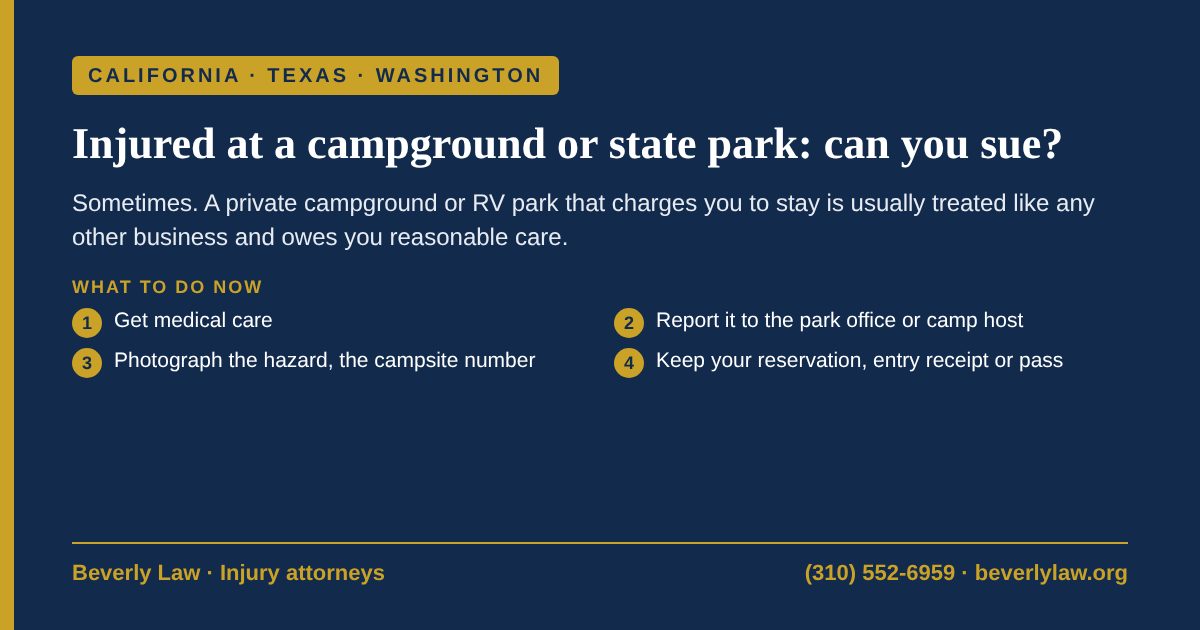
- Get medical care. Call 911 or flag down a ranger or camp host. After a fall or a blow to the head, the CDC lists danger signs that need the emergency room right away; see our head injury danger signs page.
- Report it to the park office or camp host and ask for the report number.
- Photograph the hazard, the campsite number or trail marker, and save the GPS location on your phone.
- Keep your reservation, entry receipt or pass. Whether you paid, and what you paid for, can decide which law applies.
- Get the names and phone numbers of witnesses and other campers.
- Do not give a recorded statement to the owner’s insurer or a government risk office before talking to a lawyer.
What they will argue
A private campground will say the hazard was open and obvious, or in Texas that Chapter 75 applies. A government park will say it was a natural condition, that you were on a trail, or that your claim was late. The answers are in the facts: what was man-made, who maintained it, and the dates on your claim.
What this means for your case
The first question is who owns the land, because a private owner, a city, a state agency and the federal government each follow a different set of rules. The second is the calendar: a 6-month government claim deadline can pass long before the regular deadline to sue, which is 2 years in California (CCP 335.1), 2 years in Texas (CPRC 16.003) and 3 years in Washington (RCW 4.16.080). Our slip and fall deadline page explains how those regular deadlines work. Texas cases are handled by the firm’s Texas-licensed attorneys, Joyce Ondich and John Efstathiou.
Common questions
Can you sue a public park for an injury?
Yes in some cases, mostly over man-made hazards the park built or maintained, and only if the written government claim is filed on time.
Does paying an entry or campsite fee matter?
Often. In California and Washington a fee usually takes a private owner outside the recreational use law. In Texas a paid private campground can still be covered in some cases, and a government park is covered whether or not you paid.
What if my child was hurt at a park pool or lake?
The same deadlines apply, and being a minor does not pause California’s 6-month claim clock or the federal 2-year clock. In California, a late-claim application for a child who was a minor for the whole 6 months must be granted, but it still has to be filed within one year of the injury (Gov. Code 911.6). Our swimming pool injury page covers pool cases.
Who do I file the claim with?
The agency that runs the park: a city or county, a state parks department, or a federal agency. Confirm the right office in writing. If you were hurt outdoors and have other questions, our injury FAQs may help. Beverly Law offers a free case review in English or Spanish at (310) 552-6959. You owe no fees or costs unless we win.
Ask a question
Not ready to call? Write your question and someone on our team will answer. No cost, no commitment.
Injury lawyer — Beverly Law
Hurt because of someone else in California, Texas and Washington? Talk to an injury attorney. Free, confidential, English or Spanish. You owe no fees or costs unless we win.
Related pages
Sources
- Cal. Civ. Code 846 (leginfo.legislature.ca.gov)
- Delta Farms Reclamation Dist. v. Superior Court (1983) 33 Cal.3d 699 (law.justia.com)
- Cal. Gov. Code 831.2 (leginfo.legislature.ca.gov)
- Cal. Gov. Code 831.4 (leginfo.legislature.ca.gov)
- Lee v. Department of Parks & Recreation (2019), No. A154021 (law.justia.com)
- Cal. Gov. Code 911.2 (leginfo.legislature.ca.gov)
- Cal. Gov. Code 911.4 (leginfo.legislature.ca.gov)
- Cal. Gov. Code 911.6 (leginfo.legislature.ca.gov)
- Cal. Code Civ. Proc. 335.1 (leginfo.legislature.ca.gov)
- Tex. Civ. Prac. & Rem. Code 75.001 (statutes.capitol.texas.gov)
- Tex. Civ. Prac. & Rem. Code 75.002 (statutes.capitol.texas.gov)
- Tex. Civ. Prac. & Rem. Code 75.003 (statutes.capitol.texas.gov)
- Tex. Civ. Prac. & Rem. Code 101.101 (statutes.capitol.texas.gov)
- Tex. Civ. Prac. & Rem. Code 16.003 (statutes.capitol.texas.gov)
- RCW 4.24.210 (app.leg.wa.gov)
- RCW 4.96.020 (app.leg.wa.gov)
- RCW 4.92.110 (app.leg.wa.gov)
- RCW 4.16.080 (app.leg.wa.gov)
- 28 U.S.C. 2401 (Cornell LII) (law.cornell.edu)
- 28 U.S.C. 2674 (Cornell LII) (law.cornell.edu)
- 28 U.S.C. 2675 (Cornell LII) (law.cornell.edu)
- 28 C.F.R. 14.2 (eCFR) (ecfr.gov)
- CDC, Symptoms of Mild TBI and Concussion (cdc.gov)
Important: This page is general information, not legal or medical advice, and reading it does not create an attorney-client relationship. Every case is different; talk to a lawyer about yours. Texas cases are handled by the firm’s Texas-licensed attorneys, Joyce Ondich and John Efstathiou. Last reviewed: November 7, 2026.